Europe’s Opportunity to Counter Russian Influence in the Sahel
As Russia repositions itself on the world stage and the Ukraine War continues, Moscow has found key allies in the new military governments of the Sahel states of Mali, Niger, and Burkina Faso. Moscow’s private military companies (PMCs), first the Wagner Group and now its state-owned successor, Africa Corps, provide security to these regimes and guarantees against terrorist threats in return for financial compensation and access to raw materials.
The Russian security model is failing in Mali, where rebels now hold much of Eastern Mali despite government attacks and besiege the capital Bamako. Russia’s failures and the Sahelian states’ security crisis present Europe with a unique opportunity to counter Russian influence in the region and take on the terrorist threat. That effort’s success requires European states to offer non-interventionist security cooperation to Sahelian states.
France’s Eviction from the Sahel
Europe has long retained interests in the Sahel, particularly through France. After formal European colonialism ended, France maintained a privileged economic and political relationship with the Sahel states and led European engagement with the region. In response to a separatist and jihadist threat in Mali, France deployed its military to Mali in 2013, known as Operation Serval. The initial military operation, popular among Sahelian publics, succeeded in pushing back the insurgent groups.
The subsequent French campaign, Operation Barkhane, adopted a broader counterterrorism objective against jihadists dispersed across population centers in the Sahel. Without a clear military strategy or exit plan, the continued military presence fed post-colonial skepticism of French intentions, aggravated by the violence of the Malian army and France’s own airstrikes.
Most importantly, Operation Barkhane failed to improve Malian security. Throughout the operation, jihadist territorial control over central Mali grew despite French counterterrorism efforts. By 2022, 96% of Malians held a negative view of the French presence. After Malian military coups in 2020 and 2021, the junta expelled the French ambassador in 2022, and France withdrew its troops the same year. Similar patterns of terrorist revival occurred in Burkina Faso and Niger, where new military leaders ended French influence over the region by the end of 2023.
Coming to power in the wake of French military failures, the Sahelian military governments built their legitimacy on the promise of combating terrorism. Most notably, al-Qaeda affiliate Jama’at Nusrat al-Islam wal-Muslimin (JNIM) and Islamic State in Sahel Province (IS-SP) established the Sahel as the global epicenter of terrorism, with 51% of all terror-related deaths in 2024 taking place in the Sahel. The new governments are closely aligned, having formed the Alliance of Sahel States (AES), itself intended to unify into a unified federal state. The AES has sought Russian help in its fight against the jihadist threat.
Russia in the Sahel
Africa Corps is a state-employed private grouping of mercenaries representing Russian interests in Africa. It promised African governments security in return for closer economic relations with Moscow. The image of Africa Corps as counterinsurgency specialists aligns with the priorities of the juntas. Mali invited the Wagner Group for counterterrorism support in 2021, and Burkina Faso and Niger welcomed troops from the newly-formed Africa Corps in 2024.
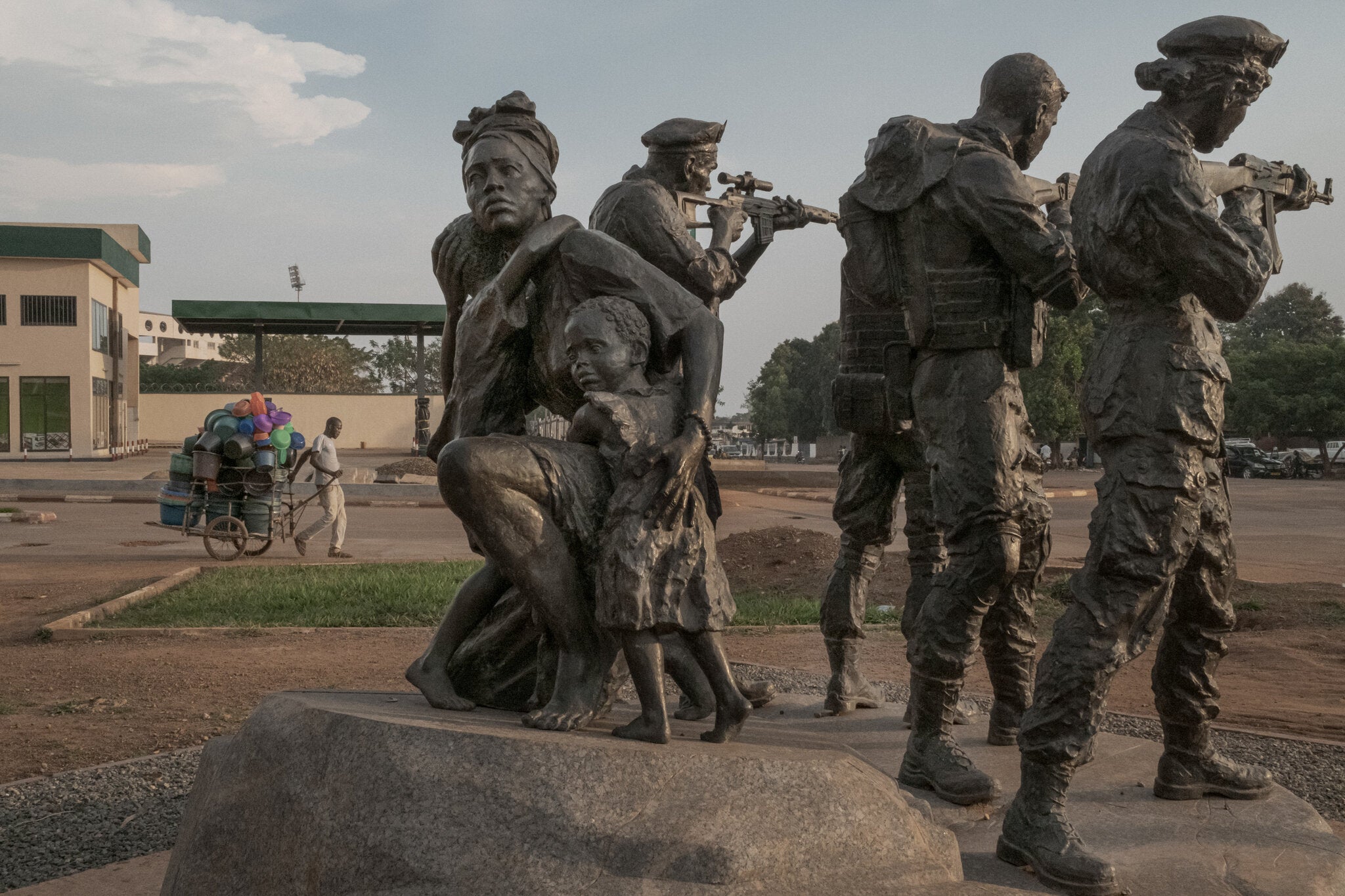
Africa Corps provides protection guarantees to Sahelian regimes. In contrast with Western governments that set governance conditions, Sahelian governments view Africa Corps as a reliable group to support counterterrorist operations without threatening the regime. Africa Corps (then Wagner) proved its willingness to provide no-strings-attached military support through its significant deployment in defense of the authoritarian Touadéra regime in the Central African Republic in 2020. The Africa Corps’ regime support is clearest in Burkina Faso, where it describes its own mission as the protection of President Traoré.
Russia’s historic self-portrayal as an anti-imperialist supporter or pan-Africanism capitalizes upon the anti-French sentiment underlying the legitimacy of the juntas. Africa Corps propaganda plays upon historic Soviet Union promotion of anti-colonial Pan-Africanism, producing promotional material in front of a mural of Thomas Sankara, Burkina Faso’s anti-imperialist 20th-century leader. Sahelian leaders channel anti-colonial sentiment by collaborating with a state threatening France.
Russian Security Failures
Russian PMCs failed to curb the jihadist threat to Sahelian states. Jihadist groups’ improved strength has translated into territorial gains, with IS-SP doubling its territorial control in central Mali between 2022 and 2023. Russian paramilitaries often avoided engaging JNIM fighters, and ceded control of Kidal in northern Mali to a renewed coalition of JNIM and Tuareg separatists in April 2026.
Africa Corps’ counterterrorism tactics carry an elevated civilian casualty toll and have led to prominent human rights violations, which are a “deliberate part” of the Africa Corps’ strategy in Mali. Seventy-one percent of political violence conducted by Africa Corps (then Wagner) in 2022 targeted civilians. Civilians fear Africa Corps and their government more than the insurgents, driving vulnerable populations towards jihadist groups.
For Russia, instability is good for business. The longer the security challenge lasts, and the further it spreads, the more states will partner with counterterrorist mercenaries. Russia knows that authoritarians will sustain strong demand for Africa Corps services because the Corps protects regime stability regardless of civilian cost. The 2,500-person Africa Corps presence, considerably smaller than the already overstretched Operation Barkhane forces, is not equipped to eliminate the jihadist threat.
The Sahel in Russia’s War Machine
Russian operations in the Sahel breed terrorism, fund the war in Ukraine, and entrench European dependence on Russian uranium. Africa Corps receives direct compensation for its protective services from Sahelian clients. The Malian government, for instance, pays Russian groups $10 million per month for their presence in the state.
The AES states granted the Africa Corps mining rights to gold and other natural resources, a key asset given Mali’s prominence as the fourth-largest gold producer in Africa. Burkina Faso granted Nordgold, a key Russian mining company, a license to operate a new gold mine in 2022. Russia purchased Iranian Shahed drones with gold, suggesting Sahelian resources directly fund Russia’s war effort. The Blood Gold Report estimates that paramilitary trade of African gold injected $114 million per month into the Russian war effort in 2023.
The Sahel area is rich in uranium, particularly Niger. Niger invited Russian state-owned nuclear exporter Rosatom to support mining in uranium mines previously operated by French state-owned Orano. One thousand tons of missing Nigerien uranium from old Orano mines have likely already entered Russian control.
Russian control over Sahelian uranium entrenches a deep European dependency on Russian nuclear energy. Niger supplies about 25% of all European uranium, making it the second largest source of uranium for the continent. Rosatom already controls 46% of global uranium enrichment facilities. Control over the enrichment industry and Nigerien uranium extraction grants Rosatom significant power over the global nuclear energy market.
Rosatom nuclear influence creates a conflict between European investment into nuclear energy and disentanglement from Russian energy. Rosatom already contributes significantly to the Russian economy, reporting $139 billion worth of orders from foreign states over a 10-year period. Rosatom control over nuclear plants in Europe (most notably Hungary and Türkiye) and European nuclear fuel imports grant Rosatom influence over European decision-makers and have helped it evade sanctions.
Russia’s ability to raise European energy costs or cut off European nuclear supply increases the costs of supporting Ukraine. As such, Russia retains a significant leverage over Europe’s goals to increase its nuclear energy supply with the European Commission calling for €241 billion of investment into nuclear energy by 2050.
What Should Europe Do?
Europe’s best chance of resisting Russian influence in the region lies in providing a preferable security apparatus without perceived colonial intervention. Sahelian publics oppose Russian presence and human rights violations, and domestic militaries experience “friction” working alongside Russian paramilitaries. The French experience proves that security failures precipitate regime change. Africa Corps’ failures in combating terrorism expose the new regimes to that risk and leave room for a European alternative preferable to AES leaders.
European states should propose a mutually beneficial “security cooperation package” to meet these objectives. Europe should offer intelligence-sharing agreements with AES governments concerning JNIM and IS-SP activities. The Nigerien junta canceled intelligence-sharing agreements with Ankara and Moscow due to low-quality information, a gap which established European intelligence networks (such as the Netherlands) could fill. Europe could extend additional capabilities which do not require European boots on the ground, such as communications systems, to Sahelian forces in operations against militants.
On a case-by-case basis, European states should offer support to Sahelian militaries through unmanned force, such as unmanned aerial vehicles (UAVs), anti-drone technology in partnership with Ukrainian experts, or airstrikes from bases in neighboring countries. Europe should establish a specific set of permissible uses of its systems. The conditions would prevent the use of European information in conjunction with Africa Corps or Russia-affiliated mercenaries.
This security package would augment Sahelian security without feeding anti-colonial opposition or committing a European presence to the Sahel. For the Sahel, European capabilities, most notably concerning intelligence, could provide a critical advantage for operations against militant groups. Whilst not as visible as Russian troops on the ground, European capabilities would strengthen the domestic military position and reduce civilian casualties, and by extension undermine JNIM recruitment. Unlike Africa Corps, European providers would have no incentive to sustain the jihadist threat. By acting on European intelligence, rather than outsourcing to France or Russia, the domestic militaries appear stronger against jihadist groups.
Europe can only rebuild relations with the juntas and counter Russian interests if France distances itself from the package. The junta governments built their legitimacy on opposing French imperialism, staging mass graves intended to implicate the French military in war crimes and accusing France of supplying ammunition and weaponry to the jihadi groups. France must therefore sideline its long-standing sense of “responsibility” towards its former Sahelian colonies. Germany, the United Kingdom, and other European states who retain interests and military presence in the Sahel and West Africa, must lead cooperation efforts with the AES.
Why this Strategy?
Alternative proposals for Western engagement in the Sahel encourage a conventional Western “whole-of-government approach.” In this view, combining security initiatives with aid and investment ensures sustainable development necessary for long-term stability. This model, which brought success in Sierra Leone, encourages decisive military intervention to protect democracy followed by foreign direct investment and democratic institution-building to improve living standards.
This view underestimates the importance of security to the legitimacy of junta governments and Europe’s role in the underdevelopment of the region. The survival of a military government in the “coup belt” depends upon the satisfaction of the army above the progress of the populace. That satisfaction requires effective repression of the jihadist threat. Human rights violations against the Fulani group, which the juntas view as jihadist collaborators, demonstrate that Sahelian governments prioritize counterterrorism over human security objectives.
Second, the juntas view Western “development” initiatives as exploitative colonial structures which justify the extraction of Sahelian natural resources. They point to forcible debt collection for French colonial infrastructure and Orano’s uranium monopoly as evidence that Western development projects are purely self-interested and under-develop the Sahel. The prospect of development-based intervention, no matter its form, harms any prospect of cooperation with the AES states.
Capabilities-sharing sidesteps those suspicions. Limited military collaboration would strengthen counterterrorism efforts and combat Russian power in the region at low cost. Europe should promote the offer as a deliberately non-interventionist package to assuage Sahelian skepticism. The free security offer, devoid of penalties or sanctions if refused, would demonstrate this new tone to Afro-European relations. European narrative change would permit the Sahelian states to accept the more effective security package whilst claiming victory for their anti-colonial mandate.
For Russia, whose regional credibility wanes as the resurgent Tuareg-JNIM coalition advances, the European proposal forces an unenviable choice. Should Sahelian governments accept the European proposal, Russian presence becomes a liability to AES states, and Russia risks losing its economic and material revenue from the Sahel altogether. To compete with Europe’s offer, Russia would have to move resources from the Ukrainian front to the fight against JNIM.
Russian intervention and terrorism represent the two greatest security challenges Europe faces. The AES governments sit at the crossroads of the two: they combat terrorism and fund Russia’s military operations in Ukraine. But Russia’s security offer is failing, and Europe can counter Russian influence. To erode Russian economic benefits and uranium extraction from the Sahel, Europe must offer a more effective, low-presence counterterrorism package that breaks from colonial patterns.
Views expressed are the author’s own and do not represent the views of GSSR, Georgetown University, or any other entity. Image Credit: New York Times