Courting Kabul: How India’s Growing Relationship with the Taliban Threatens Regional Counterterrorism
When the United States withdrew its troops from Afghanistan in August 2021, in accordance with the 2020 Doha Agreement, the Western-backed Afghan government quickly collapsed, paving the way for the Taliban to resume control over the country. Since then, the Taliban has sought to make inroads with governments around the world, exemplified by participation in Beijing’s Belt and Road Initiative and strategizing with Moscow on using Afghanistan as a transit hub for Russian oil and natural gas.
India, a nation that has assisted Afghanistan for decades, is the latest country to openly seek a collaborative relationship with the Taliban-led Afghan government. Since 2001, India has provided over $3 billion for infrastructure projects, humanitarian assistance, and security support to Afghanistan, primarily to bolster Afghanistan as a counterweight to Pakistan. After the U.S. withdrawal and the Taliban’s subsequent resumption of power, India quickly ceased its operations and evacuated state officials and citizens. Although India rationalizes its closer Taliban partnership with security, economic, and humanitarian reasons, it inadvertently continues facilitating Afghanistan as a hub for terrorist activity.
An India-Taliban Rapprochement
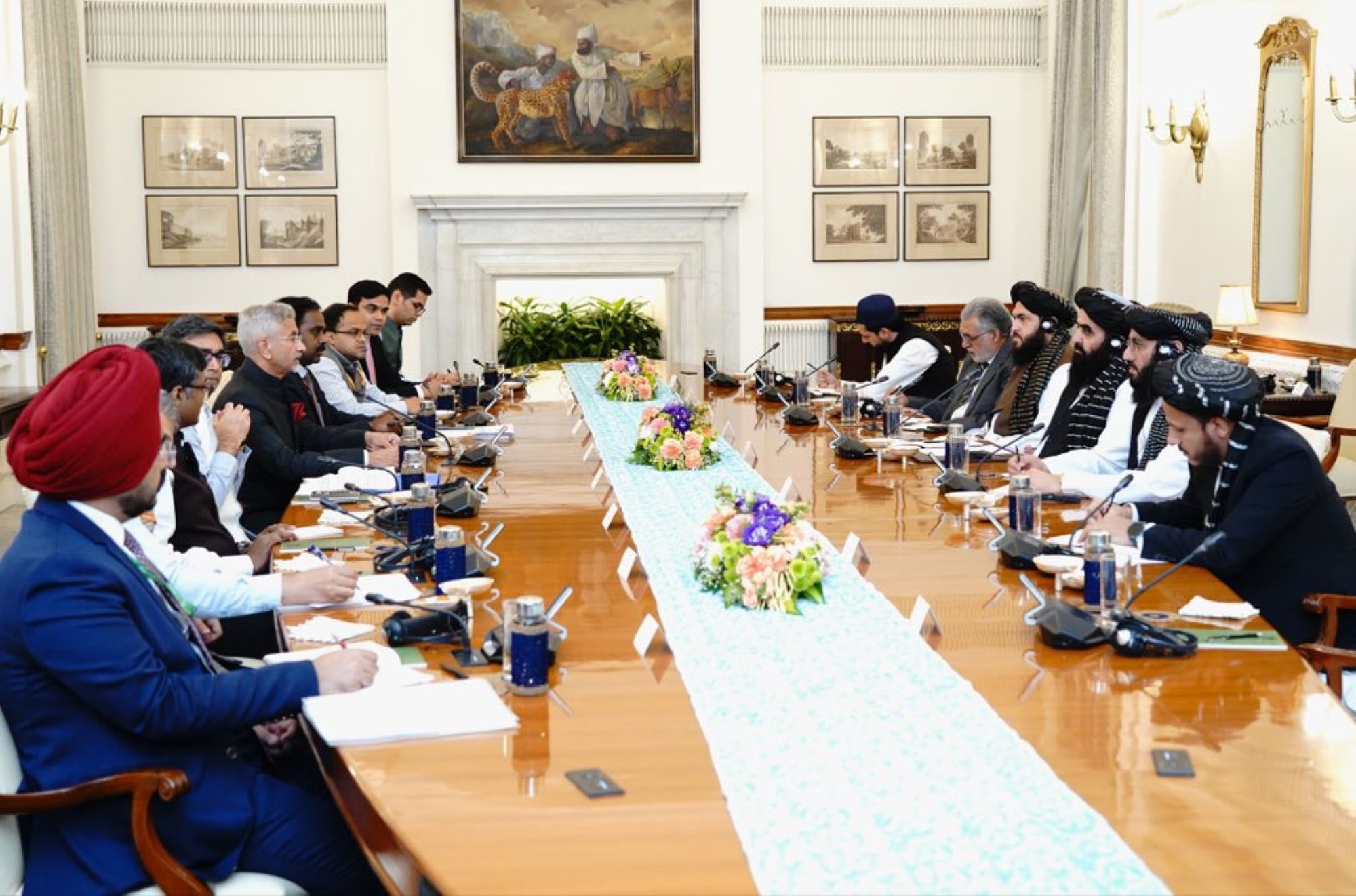
On October 10, Afghan Taliban Foreign Minister Amir Khan Muttaqi met with Indian Foreign Minister Dr. Subrahmanyam Jaishankar in New Delhi, signifying a closer relationship between India and the Taliban-led Afghan government. The week-long, high-level discussions centered on increasing economic, diplomatic, and political ties between the two nations. After the conference, the Indian government made the surprising decision to reopen its embassy in Kabul, a reversal from its evacuation and closure after the United States’ withdrawal and Taliban takeover.
The conference comes at a time when both countries see Pakistan as a common enemy. The longstanding Taliban-Pakistan relationship is recently strained, emblematic in the October border clashes between the two countries during the diplomatic visit to India. India also blamed Pakistan for the terrorist attack that occurred in Pahalgam on April 22 this year, threatening a fatal escalation between two nuclear-armed states. The Taliban-led Afghan government supported India during the conflict and publicly condemned Pakistan and the terrorist attacks, suggesting an alignment between the two governments.
What is the Goal?
By establishing warmer, direct relations with India, the Taliban’s main goals are to cement its legitimacy as a capable government on the international stage and to improve the nation’s economy. In the years since their takeover, the Taliban has successfully revived the Turkmenistan-Afghanistan-Pakistan-India Gas Pipeline (TAPI) project and the Central Asia-South Asia Electricity Transmission and Trade Project (CASA-1000). These major, multinational infrastructure projects demonstrate a trust in the new government, potentially boosting Afghanistan’s long-term economic strength. Although the Indian government has not recognized the Taliban as the official government of Afghanistan thus far (Russia is the only country to do so), increasing diplomatic discussions and meetings cede the insurgency-turned-government de facto legitimacy.
A myriad of reasons drive India’s goals in closer political relations with Afghanistan. When it comes to security, India hopes to both counter Pakistan and continue combating the effects of terrorism domestically. Economically, it wants to increase their trade routes to Iran and Central Asia, circumventing Pakistan. India also seeks to continue providing humanitarian assistance to the Afghan people, showing continuity in their mission even after the Taliban’s renewed control.
Afghanistan’s Terrorist Safe Haven
At the recent conference, in an effort to quell India’s security fears, Foreign Minister Muttaqi reiterated that Afghanistan will continue counterterrorism efforts and that it will not allow terrorist organizations to establish safe havens in the country. Many analysts are skeptical of this commitment, pointing to the Taliban’s harboring of Ayman al-Zawahiri, one of the masterminds of 9/11 and the successor to al-Qaeda’s Osama bin Laden. U.S. Intelligence successfully killed al-Zawahiri in a drone strike in 2022, solidifying that Afghanistan can and will protect, or at the very least tolerate, members of terrorist organizations that are beneficial to their regime. Furthermore, reports from the United Nations Security Council highlight that al-Qaeda and the Tehrik-e-Taliban (TTP) operate training camps and safe houses in Afghanistan. The TTP is responsible for the increase in violence on Afghanistan’s border with Pakistan, leading the Pakistani government to accuse the Taliban of providing shelter to the TTP.
Reality does not match the Taliban-led Afghan government’s public-facing statements claiming that they do not support terrorist activity. Al-Qaeda militarily supported the Taliban during its post-2001insurgency and maintains deep ideological and cultural ties with the Taliban. The two organizations are dependent on each other, making it incredibly unlikely that the Taliban would relinquish their support of the terrorist group. Regardless, countries selfishly continue to partner with Afghanistan while knowing that terrorist activity continues freely within its borders, eliminating credibility for accountability measures. Instead of collectively countering terrorism, countries, like India, seek guarantees for a decrease in terrorist activity perpetrated against their citizens. Essentially, India is turning a blind eye to their responsibility in the growth of terrorist activity by accepting Afghanistan’s unreliable claims to curb terrorism and allowing their assertion into geopolitical affairs.
The Economic Factor
Since the Taliban resumed control in 2021, Afghanistan has faced a humanitarian crisis with profound poverty and food insecurity. International sanctions and the withdrawal of aid and assistance, brought on by the Taliban’s draconian policies, sharply contracted the economy. Since 2022, Afghanistan’s fragile economy has remained weak, but largely stabilized. One of the Taliban’s goals in partnering more closely with India is to begin reintegrating Afghanistan’s economy into the global market, highlighting the Taliban’s economically driven foreign policy.
For instance, as part of the renewed partnership, Indian businesses are invited to invest in Afghanistan’s mining industry, bringing foreign capital into the country. On one hand, strengthened economic cooperation in multiple sectors could assist in lifting the nation out of poverty and bring better living conditions to the Afghan people. This would be a direct result of the Taliban-led government’s leaders’ strategic capitalizing on India’s competition for critical minerals with China. On the other hand, a flourishing Taliban-led economy could lead to more covert financing for established and new terrorist organizations in Afghanistan. As a result, India’s economic relationship may inadvertently strengthen terrorist groups that continue to exist in the region.
Exploiting Humanitarian Aid
India’s talks with Afghanistan were also driven by continuing the commitment of humanitarian aid to Afghan citizens. When the Taliban resumed control of Afghanistan in 2021, India established a technical mission to continue aid delivery to the country. Between 2022 and 2025, the Indian government has supplied wheat, earthquake relief equipment, medicine, and vaccines. More recently, India intentionally assumed the “first responder” role for Afghanistan, sending aid after the November 3, 6.3 magnitude earthquake that impacted the northern part of the country. India is employing its soft power to show its goodwill to Afghanistan over China, their primary competitor for similar efforts.
Providing humanitarian aid helps shift the Afghan people’s perception of India. Ultimately, it assists in maintaining stability in Afghanistan, which provides India with strategic security in the region and a counterbalance against Pakistan. However, if Afghanistan progressively becomes a hotbed for terrorism, the increase in humanitarian aid stands to support terrorist activity if mismanaged. As Jessica Trisko Darden warns, terrorist organizations can unintentionally become aid recipients due to inadequate government oversight, capture aid for their own future financial gain, or even control the distribution of assistance. The eagerness of foreign countries, like India, to provide humanitarian aid further bolsters terrorist groups’ strength in the country, especially when coupled with the ongoing safe harboring of terrorists and the influx of new capital from trade. In fact, a recent report from the Special Inspector General for Afghanistan Reconstruction (SIGAR) illuminates the Taliban’s redirection of humanitarian aid and assistance to its own military training camps and religious schools, which reportedly have trained al-Qaeda members. This fuels terrorist organizations’ growth instead of lifting the broader public during a crisis.
A Possibility of Trust?
There is the chance that a growth in international partners forces the Taliban-led Afghan government to crack down on terrorist groups operating within its borders, effectively honoring its commitment to counterterrorism. As more countries in the region seek economic and security partnerships with Afghanistan, the government needs to maintain positive public perceptions and continue the reversal of international isolation. Ideally, India could trust that the Taliban will actively adhere to their promises to contain terrorist activity. However, this notion is flawed.
First, it seems that India’s latest friendly discourse with Afghanistan is driven by fear and anger—fear of China’s rise and anger towards Pakistan—rather than the pragmatism needed to later develop trust with the Taliban. The Taliban can continue to benefit from India-China-Pakistan dynamics without sacrificing their alliances with terrorist organizations. Secondly, the Taliban is concerned with maintaining control of the government and its regime. The Taliban’s relationships with terrorist organizations are symbiotic in nature, gaining revenue from illicit activity and assisting in the creation of a climate of chaos and fear. This further removes the incentive for domestic reform and a crackdown on terrorist activities.
A Loss for Counterterrorism Efforts
The jury is out on whether Taliban-led Afghanistan will be a trustworthy government, although the signs seem to be negative. In any event, the Taliban is proving to be savvy in how it cements its role in regional issues and geopolitical systems without sacrificing its strategic relations with terrorist organizations. The Taliban’s endeavor to alter global perceptions is going to be a long, arduous process; yet, warming relations with more powerful nations, like India, is a win for the group and a loss for counterterrorism efforts.
Views expressed are the author’s own and do not represent the views of GSSR, Georgetown University, or any other entity. Image Credit: Dr. S. Jaishankar on X