The Fujian-class Aircraft Carrier: The PRC’s Challenge to the Indo-Pacific Order
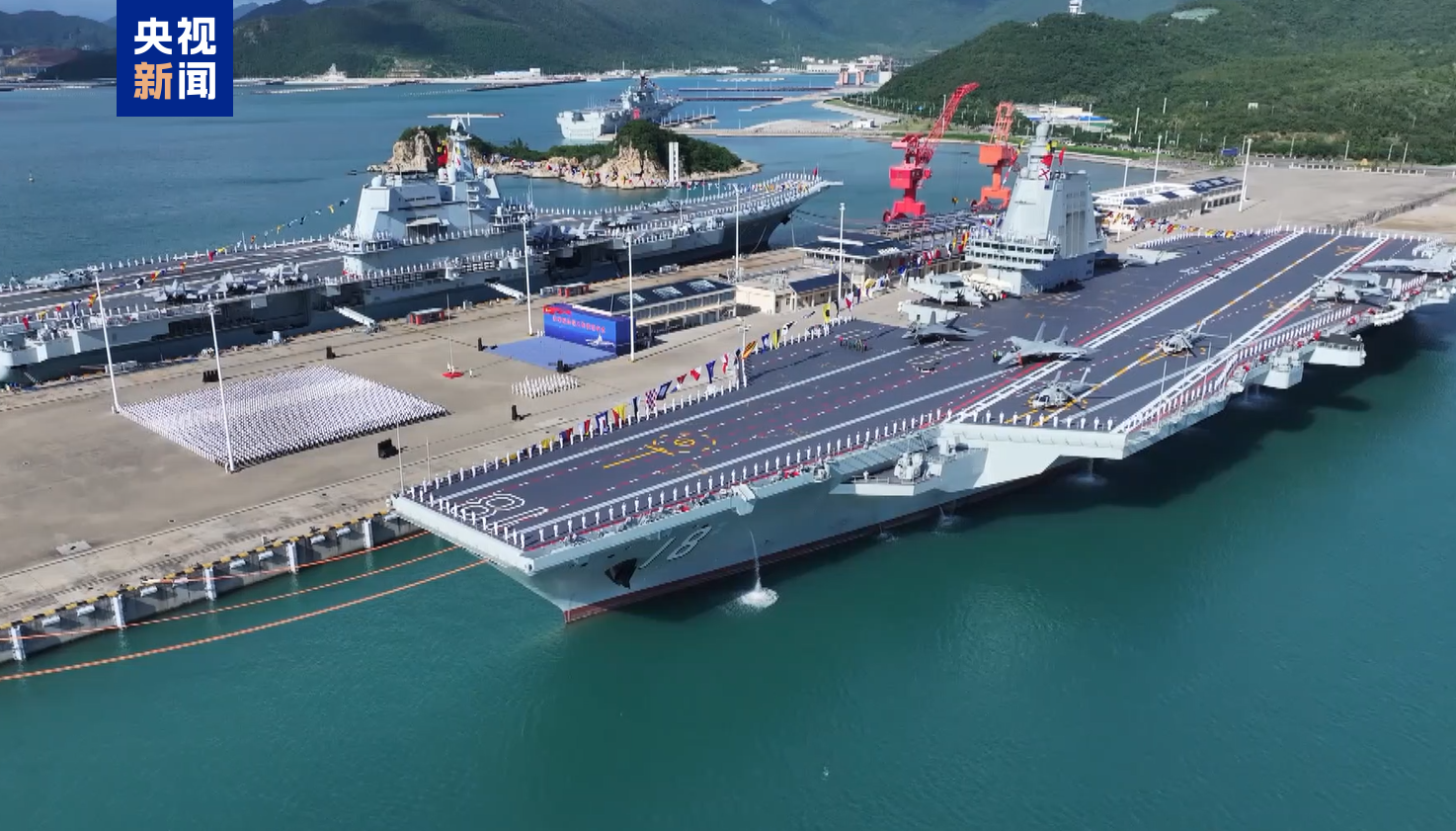
On November 5, 2025, the People’s Liberation Army Navy (PLAN) commissioned its most advanced aircraft carrier to date: the Type 003 Fujian. The ceremony was presided over by President Xi Jinping, who also personally tested the platform’s new Electromagnetic Aircraft Launch System (EMALS). This milestone represents a significant step in the PLAN’s efforts to modernize its naval fleet, marking the culmination of the carrier’s construction, which began in Shanghai in early 2018.
With the Fujian entering service, the People’s Republic of China (PRC) has formally entered a three-carrier era, joining the Liaoning and Shandong in an expanding carrier fleet. The leap represented by the Fujian over the PRC’s first two carriers has sparked debate about Beijing’s long-term ambitions for its carrier program and, more importantly, how the Fujian might enhance the PRC’s ability to pursue its strategic objectives in the Indo-Pacific.
The Strategic Value of Aircraft Carriers
Modern aircraft carriers typically serve as the core of carrier strike groups, which include escort ships and a range of aircraft from F/A-18 fighter jets to E-2C surveillance planes, providing air and missile cover for the carrier. The U.S., for example, operates 11 nuclear-powered carriers that provide sea control and global power projection, including through the Seventh Fleet based in Yokosuka, Japan, which supports U.S. presence and security cooperation with its allies in the Indo-Pacific.
Aircraft carriers remain critical operational platforms in modern warfare. They serve as sovereign and mobile airbases; they deploy fixed-wing aircraft, surveillance platforms, and logistics without host-nation support, which provides credible and flexible power projection. In complex 21st-century environments with A2/AD zones and contested littoral waters, among others, the ability to project multi-domain power from the sea gives carriers a high level of operational versatility and responsiveness. Other platforms, like submarines or cruisers, lack such capacity to deploy and sustain full air wings for sustained strike, surveillance, and joint support operations.
Aircraft carriers also provide immense and massed long-range fires, serving as a crucial force multiplier for combat operations. For instance, modern U.S. carriers like the Ford and Nimitz-class can generate up to 125 strike sorties per day at surge rates and engage up to six precision aimpoints per sortie. This output is possible because carriers possess high magazine weapons capacity and can be efficiently resupplied at sea by the combat logistics force. Such a capability enables them to sustain strike missions and maintain battlespace dominance for extended periods. This high volume of sorties is crucial in contemporary warfare, where air superiority and the ability to strike deep against an enemy’s key bases can decisively influence the outcome of a conflict.
Finally, carriers are unique symbols of a nation’s power and commitment to its regional partners and allies. A carrier strike group (CSG)’s presence in a region demonstrates a nation’s military capabilities and provides a firm deterrence to potential adversaries. For example, U.S. Freedom of Navigation Operations in the South China Sea (SCS) visibly challenge Chinese territorial claims while reinforcing U.S. presence in the Indo-Pacific. Furthermore, carriers have significant diplomatic value. A port visit by a single CSG brings thousands of sailors and Marines who act as informal ambassadors, helping to build goodwill and strengthen personal and cultural ties with host nations. Such visits signal direct U.S. support for the security of allies and partners, demonstrating a willingness to invest visible military presence in their defense. They also create practical opportunities for joint naval exercises that strengthen interoperability within the U.S. alliance network.
The Fujian’s Technological Innovations and Operational Capabilities
The Fujian is the PRC’s first supercarrier, possessing a displacement exceeding 80,000 tons. It is also the PRC’s first carrier equipped with an Electromagnetic Aircraft Launch System (EMALS), making it the second carrier class in the world after the Ford to adopt this technology.
EMALS uses electromagnetic force rather than steam pressure to propel the launch shuttle along the catapult track. This allows for smoother and more uniform acceleration, reducing the sharp jolt experienced during conventional catapult launches. In theory, this system offers numerous advantages over traditional steam-based catapults. First, the aircraft’s smoother acceleration limits the initial stresses put on its airframe and the carrier’s flight deck, increasing service life. Second, launch cycles are faster, with each launch taking about three seconds and a potential turnaround rate of one launch every 45 seconds. Third, EMALS can more precisely calibrate launch power, enabling it to handle a wide range of aircraft, from advanced fifth-generation fighters to lightweight drones. This also facilitates the Fujian’s ability to participate in future carrier-based drone operations. Fourth, the system occupies roughly half the internal volume required by steam catapults, improving spatial efficiency below deck. Finally, EMALS demands less energy and maintenance—it eliminates the need for hydraulic or pneumatic power. It also requires minimal lubrication, and its self-diagnostic features also reduce manpower needs for inspection and troubleshooting.
The Fujian also supports a larger, more advanced airwing of around 50-60 fixed-wing aircraft, compared to its predecessors. This includes the J-15T multirole fighter, the J-15DT electronic warfare variant, the J-35 fifth-generation stealth fighter, and the KJ-600 airborne early warning aircraft. The J-35 marks the PRC as only the second nation after the United States, to develop a stealth carrier-based fighter. At the same time, the KJ-600 is the PRC’s first indigenous fixed-wing carrier early-warning platform, significantly enhancing the carrier’s ability to detect enemy targets beyond the horizon. Collectively, these systems reflect a navy steadily expanding its blue-water surveillance, strike, and overall combat capabilities.
Comparisons with U.S Carrier Capabilities
While both the Fujian and the Ford use EMALS technology, some assessments suggest that the Chinese carrier may outperform its U.S. counterpart in certain technical areas. For example, senior Chinese military analyst Wang Qiang claims that Fujian’s Medium-Voltage Direct Current (MVDC) integrated power system achieves a failure rate of less than 0.2%— just one-eighteenth that of the US Ford-class system. He also highlights two notable Chinese innovations. First, the Fujian uses supercapacitors for energy storage, enabling full-system electrification. Second, it adopts dedicated power supply and storage modules for each catapult track, allowing individual failures to be isolated without disrupting the operation of the remaining catapults.
Despite this, the Fujian still lags behind U.S. carriers in several critical respects. It remains conventionally powered with an estimated range of around 10,000 nautical miles. In contrast, all U.S. carriers are nuclear-powered and enjoy effectively unlimited endurance, giving the U.S. a far greater ability to project power globally. The Ford class is also physically larger, allowing it to accommodate more aircraft. Moreover, the Fujian’s flight deck configuration limits the pace at which aircraft can be launched and recovered. Due to its longer landing area and narrower deck angle, U.S. reports suggest that the Fujian’s operational capability would only be around 60% that of the Nimitz-class.
The PLAN’s Human Capital and Training Challenges
The PLAN also faces important limitations in operational experience and personnel development. Although the PRC has gained valuable experience with its first two carriers, the Fujian represents a major technological leap from the older Kuznetsov-derived STOBAR designs. It demands the mastery of complex launch and recovery procedures, intensive deck-management disciplines, and a high-tempo sortie generation that can function together as a coordinated system. Therefore, the Fujian will likely require years of trials before reaching full operational capability.
At the same time, the PLAN must also continue expanding and training its cadre of carrier-based pilots. While training pipelines began to accelerate in 2020, operating a carrier with such an advanced airwing requires a new generation of carrier-qualified aviators who can execute both day and night missions, as well as engineering teams and deck crews capable of managing the more intricate choreography of aircraft movement, maintenance, and real-time strike planning. Meeting these requirements depends on sustained investments in doctrine and experience, which the PRC cannot achieve through platform acquisition alone.
The Fujian’s Role in Regional Deterrence
The Fujian’s entry into service means the PLAN has finally entered the “three-carrier era”. This means one carrier can undertake carrier presence operations at all times, while another undergoes maintenance and the third maintains training readiness. These upgrades will increase the PRC’s leverage over key contested territories in the South and East China Sea, particularly on Taiwan. The symbolic naming of the Fujian—after the mainland province closest to Taiwan—underscores this.
While any Chinese invasion against Taiwan is unlikely to be led by carrier strike groups, they would play an important supporting role by improving the PLAN’s anti-access/area-denial (A2/AD) capability in surrounding waters. Their primary value would lie in the deeper reaches of the Pacific, beyond the first island chain, where they could impede U.S. and allied forces attempting to assist Taiwan. As retired U.S. Navy intelligence officer J. Michael Dahm notes, the PRC would deploy its carrier strike groups past the first island chain to “delay, disrupt, and degrade U.S. capabilities,” shaping the battlespace in Beijing’s favor.
The PRC’s Blue Water Navy Ambitions
Chinese ambitions extend beyond defending its immediate coastline and regional waters. Since its resurgence as a great power in the 21st century, the PRC has sought to expand its naval power and presence throughout the Indo-Pacific. This trend accelerated as the PRC increasingly engaged in sea-borne trade and increased foreign direct investment, including in unstable regions, prompting Beijing to take steps to protect its overseas interests. Under Hu Jintao, the Central Military Commission had announced two “New Historic Missions” for the PRC—protecting “national interests” and safeguarding “world peace.” Central to this shift was Hu’s endorsement of “far seas operations” (yuanhai zuozhan), a concept that has since become embedded in the PRC’s naval modernization strategy. These ambitions have only intensified under Xi Jinping, who has tied the goal of becoming a maritime great power to his broader vision of the “great rejuvenation of the Chinese nation.” Considering the PRC’s vast coastline of over 9,000 miles, being a maritime superpower appears to be an indispensable part of the PRC’s rejuvenation narrative.
Thus, the Fujian is a sign of the PRC’s ambition to field a true blue-water navy capable of protecting its sea lines of communication (SLOCs) and engaging in military diplomacy in distant seas. These capabilities are increasingly important for the PRC to preserve its expanding economic interests. In 2020, an estimated value of US$3.37 trillion in trade passed through the SCS alone, including Chinese imports of up to 1.16 million barrels of crude oil and 131 trillion cubic meters of natural gas. Under Xi, the PRC’s trade routes and energy lanes have extended further into the Indian Ocean via chokepoints such as the Malacca and Sunda straits, drawing Chinese economic interests deeper into South Asia. Moreover, Beijing’s development of military facilities and port infrastructure across the region supports the notion of a growing, PRC-led economic and security network. This heavy reliance on maritime trade and energy flows, combined with the PRC’s aspirations for regional economic primacy, underscores the need for a modern navy capable of securing its SLOCs across the Indo-Pacific. Indeed, the PRC’s 2019 Defence White Paper noted that the Liaoning had already operated in the “far seas” of the Western Pacific, signalling the PLAN’s growing confidence and its deliberate shift toward a blue-water posture.
Therefore, the PRC must contest and diminish the sea control of the U.S. and its allies in the region, which remains Beijing’s primary obstacle to achieving its economic and territorial ambitions. Sea control encompasses superiority across multiple domains at sea, including anti-surface, undersea, anti-air, anti-missile, mine warfare, and the electromagnetic spectrum. In several of these areas, the PLAN has already built a formidable force: its fleet now surpasses the U.S. Navy in sheer numbers and includes a wide array of modern corvettes, frigates, attack submarines, and ballistic and guided-missile submarines. However, one key domain where the PRC still lags is carrier power, both in terms of size and technological capability. Analyst Liu Zhen notes that for the PRC to successfully contest the U.S., it would require at least seven aircraft carriers—two each for its three fleets in the North, East, and South, and at least one for undertaking further operations in the Indian Ocean Region. The Fujian represents a key step towards that end.
The Future of the Indo-Pacific
Recent images of the Dalian shipyard in Liaoning province suggest that the PRC is already developing its fourth aircraft carrier—and potentially its first nuclear-powered supercarrier. If confirmed, the PRC will take another giant leap towards closing the carrier gap with the U.S. Navy.
The momentum of the PRC’s naval modernization, combined with uncertainty about the future reliability of the U.S. security guarantee, is likely to drive regional states to accelerate their own force modernization and defense spending. Japan and other regional actors have already signaled heightened vigilance in response to the PRC’s military expansion. Chief Cabinet Secretary Minoru Kihara, under Prime Minister Sanae Takaichi’s government, has emphasized that Japan will “calmly but decisively respond” to Chinese military activity if necessary.
For the U.S. and its allies, the PRC’s accelerating naval buildup serves as a clear warning. To preserve a free and open Indo-Pacific and counterbalance the expansion of Chinese maritime power, Washington must continue investing in its own naval capabilities, deepen interoperability with regional partners, and reaffirm longstanding security commitments. Sustained coordination and credible forward presence will be essential in maintaining stability and deterring coercion in the region.
Views expressed are the author’s own and do not represent the views of GSSR, Georgetown University, or any other entity. Image Credit: BGR