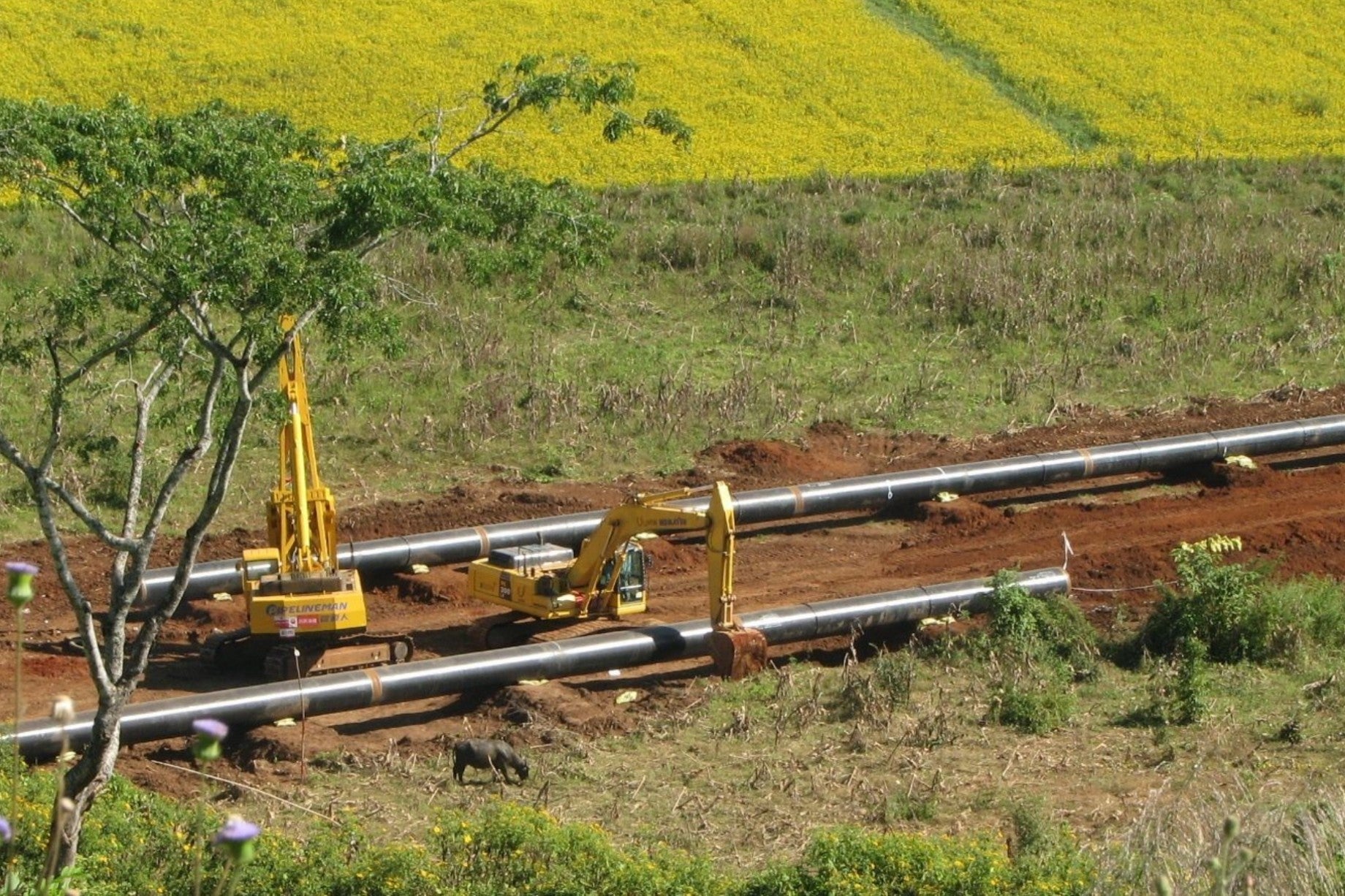
The Pipeline That Fuels Myanmar’s War
An oil and gas pipeline owned by the People’s Republic of China (PRC) is a strategic focal point in Myanmar’s ongoing civil war. The PRC built a natural gas pipeline from the Myanmar port city of Kyaukphyu to the PRC border in 2013 and followed it up with a sister oil pipeline in 2017. The $1.5 billion project ensured PRC’s access to Myanmar’s large Shwe gas field, provided a shortcut for Middle Eastern oil, and helped fund the then-democratic government under Aung San Suu Kyi. Today, Myanmar is suffering the consequences. That 1,500-mile pipeline is a powerful form of leverage for Beijing, which has calculated that a frozen conflict between the junta and resistance groups serves its interests as it continues to fill its strategic oil reserve. This article explains how that calculus works and recommends ways Washington can counter it.
Strategic Significance
The pipeline supports the PRC’s security interests by diversifying its energy sources and transit routes. Transiting oil across Myanmar eliminates roughly half, or 2,000 miles, from the traditional route through the Malacca Strait. Beijing is currently building a deepwater port in Kyaukpyu at the pipeline’s western terminus. Once completed, this project is expected to reduce the PRC’s reliance on the Malacca Strait by a further 14%. In addition to cutting transit costs, the pipeline shortcuts a chokepoint that would be easily patrolled by U.S. vessels in a future conflict.
The pipeline also connects the PRC with a vital source of natural gas. Myanmar’s Shwe gas field in the Bay of Bengal can supply up to 10% of the PRC’s annual gas imports with the pipeline running at full capacity. The U.S. and Israeli war against Iran — and the resulting disruption to Strait of Hormuz transit that sent global energy prices surging — vindicated Beijing’s long-standing goal of reducing its dependence on vulnerable maritime shipping routes. Even as the June U.S.-Iran framework agreement has partially stabilized prices, the episode demonstrated the kind of supply shock the Myanmar pipeline was designed to hedge against.
Fuel to the Fire
The pipeline adds fuel to the fire in Myanmar in several ways. It is first and foremost a survival mechanism for the junta. The regime is financially motivated to use its own forces to protect the pipeline and secure the territory it traverses in order to secure PRC payments. The regime controls roughly 35% of the country’s territory, while National Unity Government (NUG)-aligned resistance groups control 40%, making the pipeline’s districts disproportionately strategic. Rebel groups have more frequently conducted operations near the pipeline in attempts to destabilize the regime as the war has progressed. This has led the PRC to support the junta with increasing levels of money and materiel.
On the other hand, the PRC has a strategic interest in keeping the regime weak. A strong, unified Myanmar could challenge its regional economic ambitions by demanding more favorable concessions. This explains why PRC financial and military support continues to flow toward some resistance groups even as it bankrolls the regime. The result is that no side has been able to gain a definitive advantage across the country.
An official PRC armed presence further contributes to the overall instability and complicates an opaque security environment on the ground. Distrustful of the junta’s ability to fully protect its infrastructure, Beijing ordered the formation of joint security firms led by PRC security companies. These are positioned at the Kyaukphyu terminal and along the Chinese border. In serving as an additional hedge against rebel sabotage on the one hand and possible regime collapse on the other, these forces reflect the careful but destructive insecurity balance that the PRC has crafted around its critical pipeline.
Despite PRC investment in the protection of its infrastructure, at the time of writing, the Arakan Army has effectively established control in Rakhine State along the country’s western coast. The NUG-associated group has surrounded the Kyaukphyu port and special economic zone at the western terminus of the pipeline. This development shows how the PRC’s support of the junta has limits, even in the territory of one of its most valuable economic assets.
What To Do
Recent developments present an opportunity for policymakers in Washington and partner capitals to disrupt the PRC’s influence and alleviate Myanmar’s suffering. The formal March 30th founding of the Steering Council for the Emergence of a Federal Democratic Union (SCEF), comprised of democratic resistance groups including the Kachin Independence Organization (KIO), Karen National Union (KNU), Chin National Front (CNF), Karenni National Progressive Party (KNPP), and the NUG, presents the most unified resistance since the war began. At the same time, the junta faces headwinds as it takes heat for a crashing economy and weakening support from Iran and Russia. Four recommendations follow.
First, Washington and Western allies should recognize and establish ties with the SCEF. Western foreign policy toward Myanmar has long been transactional and fragmented, a reflection of the fragmentation of the resistance movement. The SCEF presents a single, diplomatic position and is already publicly preparing to engage with the EU, Canada, and India.
One way to engage is through humanitarian aid, of which the country is in dire need. In 2024, the UN requested $1 billion for Myanmar, of which only $390 million was ultimately granted. By comparison, Ukraine received $2.5 billion in humanitarian aid and an additional $7.9 billion in economic support through the 2024 Ukraine Aid Package for a country with 20 million fewer people. The Trump administration’s 2025 USAID cuts compounded this need gap. According to the UN’s latest estimates, 6.3 million Burmese are in urgent need of humanitarian aid and social protection.
Second, Washington and allies should use this new diplomatic channel to counter Chinese election influence. A PRC funding package enabled a 2025 census and a sham January 2026 vote which reaffirmed Gen. Min Aung Hlaing’s grip on power and formalized the establishment of a “civilian” government. Restoring support for democracy through the SCEF would help fill the soft power vacuum left by USAID and provide a counterweight to the legitimacy of the junta.
Third, the Trump Administration should use the Arakan Army’s momentum against the military at Kyaukphyu to extract concessions from Beijing when Presidents Xi and Trump meet at their fall summit. The siege of the port and its pipeline is a consequence of Beijing’s support for the junta, and damage to Chinese infrastructure is something Xi will want to avoid. A binding Chinese commitment to halt military aid to Naypyitaw could be tied to a regional ceasefire, giving Trump a tangible deliverable on Myanmar without requiring direct U.S. involvement on the ground.
Conclusion
The bottom line is that the PRC’s energy security interests are hurting Myanmar, and Western leaders should step in. Supportive of a pliant regime but unable to swallow the strategic risk of a victorious junta, the PRC chooses to selectively support resistance groups and deploy its own armed personnel as insurance. The outcome is the result of contemporary PRC foreign policy that prioritizes energy hegemony over peaceful stability or legitimate government, democratic or otherwise.
A pipeline built by an outsider is a powerful form of leverage in times of peace and an agent of instability in the event of war. Through recognition of and engagement with SCEF, democratic and humanitarian aid, and using the Kyaukphyu siege as a diplomatic chip, Washington and its partners can weaken this leverage and alleviate Myanmar’s suffering.
Views expressed are the author’s own and do not represent the views of GSSR, Georgetown University, or any other entity. Image Credit: Myanmar Now