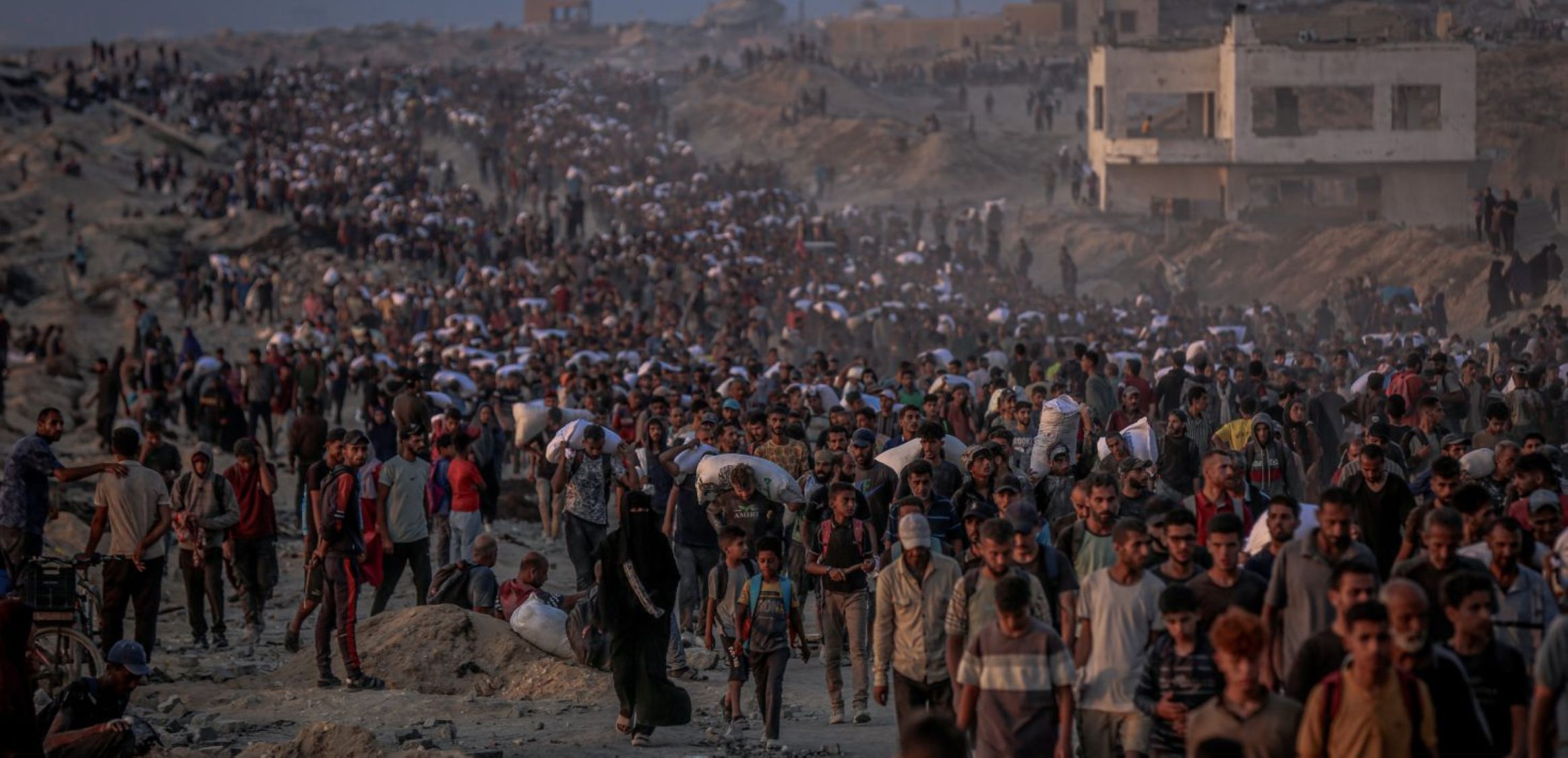
Report: At Georgetown, B’Tselem Outlines Evidence of Genocide in Gaza
Israeli human rights group argues that the October 7 Hamas attacks triggered a shift in state policy from repression to “destruction and annihilation,” calling the present moment “the most dangerous yet.”
Last week, Georgetown University’s Center for Contemporary Arab Studies hosted an event with the Israeli human rights organization, B’Tselem.
The event, entitled Accountability in the Gaza Genocide, featured B’Tselem’s Executive Director, Yuli Novak, and Field Research Director, Kareem Jubran. Georgetown was the first stop in B’Tselem’s U.S. tour discussing its Our Genocide report released this past July.
According to B’Tselem’s Spokesperson, Yair Dvir, the title’s use of “our” reflects the fact that B’Tselem’s staff includes both Palestinians and Israelis, “who belong both to the group that is the victim of the genocide and to the collective carrying it out.” He continued that the word “our” also expresses their “understanding of a shared struggle against Israeli apartheid and the genocide perpetrated by this regime.” Working across the fractures of Israeli society, Novak and Jubran estimated that B’Tselem is among the relatively small minority of Israelis and Palestinians who meaningfully interact across the social and physical borders imposed by the Israeli state.
The report asserts that since October 7, 2023 Israel has been committing genocide against the Palestinian population of Gaza. It details the ideology, previous conditions, and machinery of violence that have characterized the Israel-Palestine conflict and its intensification since October 7. According to Novak, one must “understand” a system to “struggle against” it. Consequently, Novak and Jubran identified five fundamental elements of the genocide:
- Mass killing and physical harm;
- Mass destruction of physical infrastructure;
- Forced removal and dislocation of the Gazan population;
- Total destruction of society economically, socially, politically, and physically;
- An umbrella of constant de-humanization.
Novak emphasized that genocide is not an event, but a process. It is usually the culmination of years of preparatory groundwork laid by politicians and radical civil society groups which shift the overton window and allow a “repressive and discriminatory regime to turn genocidal.” While many Israelis perceived the October 7 Hamas attack as “an event devoid of context or background,” B’Tselem argues that the attack was the catalyst which shifted Israeli policy from “repression and control to destruction and annihilation.” They assert that decades of apartheid, demographic engineering, systemic violence, and institutionalized mechanisms of dehumanization laid the groundwork for genocide to unfold in the wake of October 7.
Asked about Zionism, Novak spoke about its role as a guiding ideology in Israeli politics. She commented that for Israelis, Zionism is a “zero-sum game,” the primary goal of which is “preserving Jewish supremacy over the land.” This assertion reminds of early Zionist ideas. In 1923, Ze’ev Jabotinsky wrote that Zionist colonization was incompatible with the interests of the native Palestinians and therefore conflict between the two was inevitable. He argued that the formation of an Israeli state necessitated addressing the insecurity of its strategic environment. Thus, he contended that Israelis must be protected “behind an iron wall, which the native population cannot breach.”
For decades, Israeli security doctrine has aimed to confine violence and oppression to one side of Jabotinsky’s “iron wall,” while peace, safety, and prosperity prevailed on the other. October 7 shattered that comfortable separation for Israelis, argued Novak, describing the attack as the “scariest, most traumatizing day of [her] life.” Yet she argued that to “tell the story from that point is wrong and dangerous,” explaining that most Israelis saw the attack as a military failure rather than a social and political failure. Instead of addressing decades of apartheid, ethnic cleansing, and dehumanization, Israelis empowered their leaders to accelerate militarization, separation, violence, and oppression.
Jubran cited figures which he said reflect the scale of the devastation since October 7, 2023. Israel’s disregard for international humanitarian law governing proportionality in the use of force has resulted in over 100,000 injuries and “at least 67,000” fatalities in Gaza, nearly half of which are women and children. Additionally, “more than 70% of Gaza’s infrastructure” has been destroyed or severely damaged by aerial bombardment and ground-level demolition, resulting in the destruction of entire neighborhoods and cities. He noted that the numbers are likely conservative and exclude bodies still trapped under rubble and people unable to report to an official medical clinic.
However, the presentation went beyond structural patterns indicating genocide. The speakers emphasized that intangible consequences such as psychological harm can be just as damaging. B’Tselem’s report cites two studies which found that “nearly all of Gaza’s 1.2 million children” are facing an acute mental health crisis. As famine, illness, and incessant airstrikes have devastated Gaza, children are reporting symptoms of depression, severe anxiety, and suicidal ideation, with roughly “half express[ing] a desire to die.”
In an interview with B’Tselem, Muhammad Ghrab, who witnessed the July 2024 airstrike on the al-Mawasi humanitarian zone, described tents filled with the bodies of women and children. “It felt like pieces of hell were falling onto the earth,” he recalled.
In describing how a genocide could happen before the eyes of the world, Novak and Jubran highlighted the culture of impunity that pervades Israel’s society and government. They argued that on every level of hierarchy, from soldiers to politicians, perpetrators of crimes against Palestinians are shielded from accountability.
B’Tselem’s report details how members of the Israeli Defense Forces and extremist settlers rarely stand trial for harming Palestinians. “Over 94% of settler violence cases against Palestinians in the West Bank since 2000 were closed without indictments,” while thirteen indictments were handed down out of “862 complaints regarding offenses committed by Israeli soldiers in the West Bank over the preceding five years before October 7.”
Internationally, they argued, U.S. support has insulated Israel from accountability. Successive administrations have continued security assistance while vetoing U.N. ceasefire resolutions and sanctioning the International Criminal Court (ICC) for pursuing war crimes charges—actions which B’Tselem says grant Israel “de-facto immunity from political, legal, and economic mechanisms available to the international community.” Internally, the October 7 attack “continues to serve as a moral justification for all actions undertaken by the Israeli military in Gaza” in the eyes of Israeli citizens.
Novak’s concerns about accountability force a broader question: if the international community accepts genocide in Palestine, what prevents similar atrocities elsewhere? “As long as Israel isn’t held accountable, it means genocide can just happen and life can go on,” she observed.
Both Novak and Jubran warn that legal accountability via the International Court of Justice or the ICC is unlikely due to the United States’ shielding. However, they did hold out hope for popular accountability, citing the hundreds of thousands of people who have taken to the street around the world to protest Israel’s actions in Gaza. Social media and independent media have transformed the information environment, allowing digital documentation of the violence to reach broad and new audiences and reshape global understandings of the conditions in Gaza. According to a September New York Times/Sienna Poll, 51% of U.S. voters oppose additional economic and military support to Israel, a plurality sympathize with Palestine more than Israel, and 40% believe Israel is intentionally killing civilians. These numbers contrast starkly with a December 2023 Sienna Poll in which +27% of U.S. voters sympathized with Israel over Palestine, only 22% believed Israel was intentionally killing civilians, and 54% supported additional economic and military support to Israel.
Although a new ceasefire went into effect this October, Novak and Jubran said that “this is the most dangerous and critical moment of our lives.” They noted that “the fire didn’t stop,” rather “the violence changed scale.” According to Jubran and Dvir, since the ceasefire “over 300 Palestinians have been killed, 1,500 buildings have been destroyed, and 75% of agreed upon aid is not making it into Gaza.” They warned that the ceasefire has resulted in criticism of Israel easing and attention on Gaza waning. However, Novak argued that in this environment, accountability is as critical as ever, leaving the audience with a stark warning:
“If you legitimize genocide in Palestine, you legitimize genocide everywhere.”
Views expressed are the author’s own and do not represent the views of GSSR, Georgetown University, or any other entity. Image Credit: Amnesty International