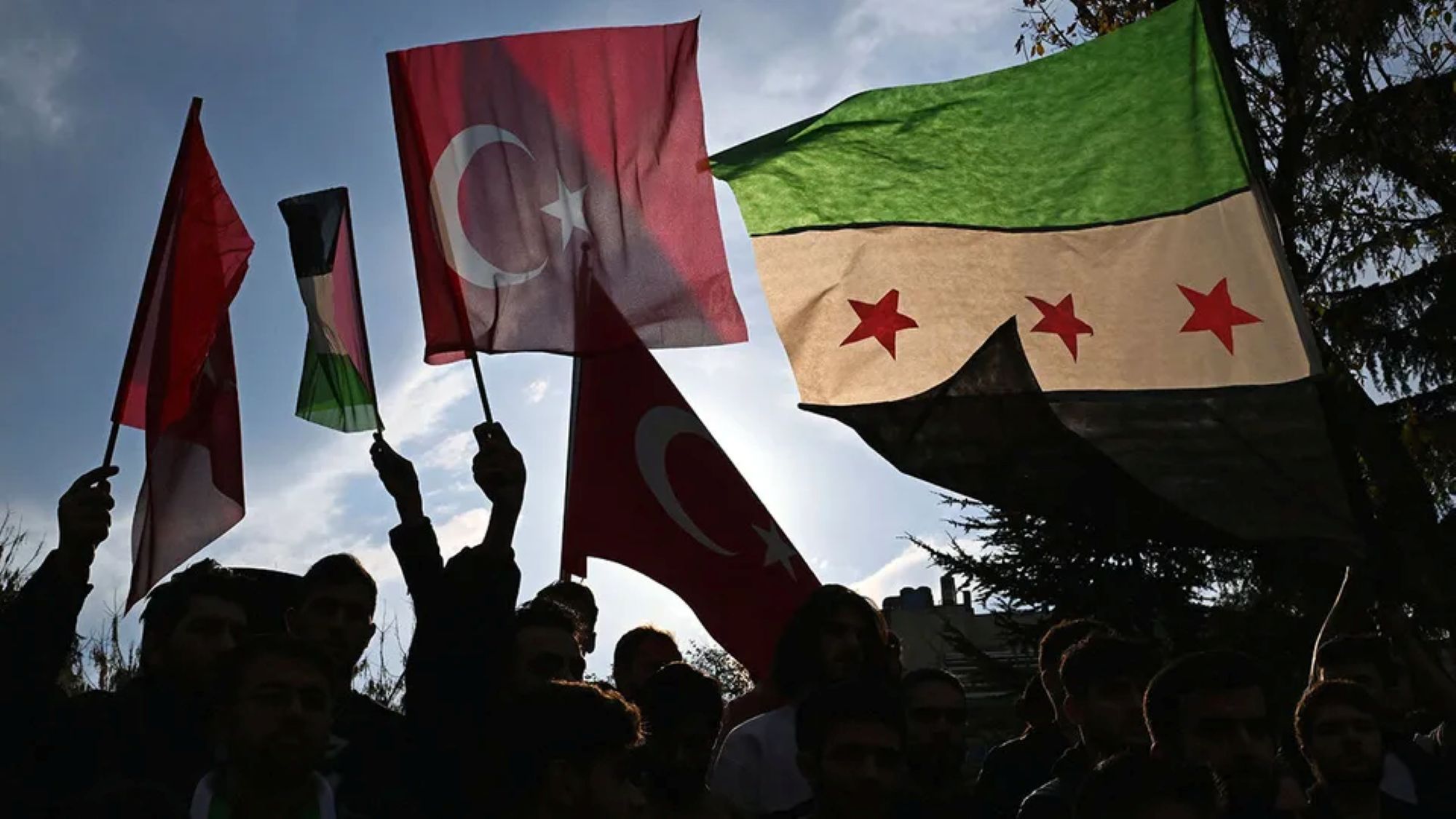
Rebuilding Syria in Türkyie’s Image
After a 14-year civil war, the fall of the Bashar al-Assad regime in Syria in December 2024 marked the collapse of a long-standing regional power dynamic and the emergence of opportunities for strategic realignment. Iran, traditionally the foremost threat to regional stability in the Middle East, suddenly lost one of its most important allies and a key land connection to its proxy forces in Lebanon and Palestine. The dramatic decline of Iranian influence leaves a power vacuum in Syria which other regional actors have rushed to fill through financial aid and diplomatic engagement with the interim government. Of the invested countries, Türkyie stands to benefit the most from guiding Syria’s new leadership and is cultivating a strong constructive relationship with the interim government to secure its influence. As reconstruction efforts develop, Türkyie’s political ascendency over Syrian leadership will improve stability for both countries and potentially the region.
The Syrian interim government was formed in March 2025 under Ahmed al-Sharaa, leader of the Sunni Islamist group Hay’at Tahrir al-Sham (HTS). Although HTS has been formally disbanded, al-Sharaa appointed a third of the country’s parliament himself, mostly other former HTS members. Al-Sharaa’s complete reorganization of government institutions and the placement of HTS members in key positions of authority alludes to his expectation of retaining power. Internationally, he has made an effort to communicate an idealistic vision for Syria’s future. In an address to the UN General Assembly in September 2025, al-Sharaa promised to advance a new policy agenda intended to foster his country’s integration into the international economy and to build diplomatic relationships. He explained that with the new interim government and his vision of domestic reconstruction, Syria has transformed into an “opportunity for peace, for Syria, and the region.”
The Turkish government and HTS had an amicable history, facilitated in large part by shared Sunni ideology. Türkyie moved immediately to capitalize on this established relationship by engaging members of the new interim government, offering interim leaders increased legitimacy. For Türkyie’s strategic interests in the region, a positive relationship with the new Syrian government is the most direct method of gaining influence in Syria and the Middle East for the foreseeable future.
Türkyie’s Security Interests in Syrian Policy
Reconstruction efforts in Syria provide Turkish President Tayyip Erdogan with an opportunity to achieve long-standing goals for Türkyie, including facilitating the return of Syrian refugees to their homes and preventing Kurdish autonomy through a strong, centralized Syrian government. Türkyie shares the longest land border with Syria and consequently has absorbed millions of refugees since the beginning of the Syrian Civil War in 2011. Despite boasting an initially receptive position toward asylum seeking Syrian nationals, the refugee crisis has since become a central point of contention in Turkish political elections. Erdogan’s government has suffered a dramatic decline in popular approval, a reflection of an increasingly nationalist public opposed to the presence of refugees in Türkyie. Opposition parties are pressuring Erdogan’s administration to make tangible steps toward repatriating Syrian refugees, which would necessitate a stable Syria and cooperative partner in Damascus. Erdogan emphasized the refugee crisis in conversations with other global powers involved in the Syrian reconstruction process, noting the urgency of achieving adequate financial and political stability in the country to justify returning refugees.
Supporting a central, unified government in Syria correlates with Türkyie’s interest in preventing Kurdish autonomy ambitions. Over the last decade, Türkyie has engaged in frequent military action against Kurdish militant groups in Türkyie and Syria vying for an independent region for ethnic Kurds. Türkyie regards the Kurdish-led Syrian Democratic Forces’ (SDF) substantial control of Syria’s northeastern region, and any potential Kurdish autonomous state, as a threat to Türkyie’s internal peace. A centralized Syrian government with the capacity to consolidate authority over the Kurdish northeast region and neutralize Kurdish militancy would alleviate the need for substantial resources currently funneled to the Syrian border to monitor and combat militants. Türkyie would expect Kurdish integration with a new Syrian government to entail clear Syrian control over the northeastern territory and ethnic Kurds’ absorption into the Syrian nationality. Emphasis on political consolidation and ending decades of violent turmoil also drives Türkyie’s recent and ongoing peace negotiations with the Turkish Kurdistan Workers’ Party (PKK) following the group’s call for a ceasefire in March of 2025. Türkyie has welcomed the negotiations, perceiving an opportunity to set a precedent for reconciliation between Kurds and their governing entities. Should the SDF follow the PKK’s lead disbandment of Kurdish resistance forces, which transcend national borders and upset domestic peace in Türkyie, is an attainable success for Ankara.
Türkyie’s Growing Influence in Syria
International financial support for Syria’s interim government and reconstruction process has been led by Gulf states and Türkyie. Each country has differing security interests in improving the stability of, and gaining influence over, the new government. However, Türkyie’s geographic proximity, shared border, and historic role as one of Syria’s largest trade partners fosters a unique partnership that affords Türkyie political weight other investors do not enjoy. Turkish exports to Syria have skyrocketed since the interim government’s establishment and, in August 2025, the two governments signed the Türkyie-Syria Joint Economic and Trade Committee (JETCO). The new trade agreement solidifies the governments’ close economic cooperation and alludes to a future of mutually beneficial economic interdependence. Turkish investment in Syrian energy and infrastructure spiked through commitments to provide natural gas, electricity, and large scale building projects. Türkyie’s economic investment and improvement of general infrastructure will help stabilize Syria and boost the general population’s welfare. These improvements reflect Türkyie’s endorsement of al-Sharaa’s leadership and national reconstruction agenda, helping attract more diverse international investment to a post-Assad, al-Sharaa-led Syria.
The Syrian interim government accrued substantial political legitimacy through al-Sharaa’s November meeting with President Trump. Notably present at the meeting was Türkyie’s Foreign Minister, Hakan Fian. Fian’s involvement in conversions regarding sanctions and Syrian security alludes to the degree of mutual benefit of Turkish-Syrian cooperation. His participation exemplifies Ankara’s capacity to guide Syria’s political choices and alliances as al-Sharaa pursues a developing agenda for Syria and reenforces the growing integration of Türkyie into Syria’s new government.
Potential Obstacles to a Constructive Relationship Between Ankara and Damascus
Syria is riddled with internal factionalism between ethnic, political, and religious groups. Internal dissent and competition may inhibit the new government’s ability to consolidate power and effectively enforce its authority. To facilitate unification and help centralize power, al-Sharaa has initiated a process of integrating factions into one national military. The Syrian National Army (SNA), a coalition of militant groups and Türkyie’s official proxy during its campaign against Assad, has resisted integration on the basis of Kurdish inclusion in a new government or central military. SNA considers the Kurds as its foremost adversary and has shown its objection by continuing to engage in armed conflict with the Kurds in northeast Syria against the preference of the interim government. If left unresolved, ongoing conflict between Türkyie’s established proxy and al-Sharaa could eventually generate discord between Damascus and Ankara.
Syrian Kurds have reached a tentative agreement with the interim government regarding military reintegration with a central government. If the Kurdish militant group were to be formally absorbed into the national military, Syrian and international expectations would pressure Turkish occupation of the buffer zone to be disbanded. In the absence of a Kurdish militant force along the Turkish border, the Syrian interim government would expect withdrawal of Turkish forces and proxies from the region, allowing Syria to regain authority over territory controlled by an external force for the last decade. For Ankara, however, maintenance of the buffer zone holds domestic implications as a critical component of ensuring its national security. Türkyie is unlikely to willingly relinquish control of the buffer zone, instead arguing that Damascus possesses insufficient capacity to control Kurdish militancy. Under such conditions, conflict is likely. The occupied zone, depending on how Damascus’ negotiations with the Kurds develop, could become a source of contention between Türkyie and the interim Syrian government.
If Ankara and Damascus can successfully navigate these potential points of contention, consensus will augment Turkish political support for al-Sharaa, build trust, and further align the country’s security objectives.
Implications
Türkyie’s economic and political influence over Syria’s interim government has continued to increase over the last year, potentially providing stabilizing effects for both counties and the region. If Türkyie can overcome the obstacles to a cooperative relationship with the interim government under al-Sharaa, consensus regarding military consolidation and the buffer zone would strengthen the Ankara-Damascus connection rooted in mutually beneficial policies. For the foreseeable future, Turkish security interests, such as facilitating the return of refugees to Syria and limiting Kurdish autonomy along its shared border, will encourage continued Turkish political and economic investment in Syria.
Turkish involvement in the Syrian interim government’s policies is a principal component of Syrian reconstruction and centralization, providing a necessary foundation for al-Sharaa to build an effective government. A strong, centralized Syrian government could exert increased control over destabilizing behavior within its borders that risk becoming transnational issues, including illicit drug production and conflict between militant groups. For its regional neighbors, a strong government in Syria enhances stability by reducing the flow of refugees, improving economic predictability to facilitate foreign investment, and meaningfully reintegrating Syria into regional politics. After more than a decade of civil war, a consolidated Syrian government with the authority to form international alliances, direct economic investment, and participate in regional security initiatives gives regional powers a chance to coordinate and promote stability efforts and limit Iranian influence.
The unfolding relationship between Ankara and Damascus has shifted from a subversive posture during the Syrian civil war to mutually beneficial cooperation as Türkyie perceives the interim government as a potential partner in improving Syrian stability. As a nascent power, Syria’s amenability to Turkish security preferences presents al-Sharaa with an opportunity to achieve power consolidation through support from a predictable alliance while contributing to regional stability.
Views expressed are the author’s own and do not represent the views of GSSR, Georgetown University, or any other entity. Image Credit: Getty Images