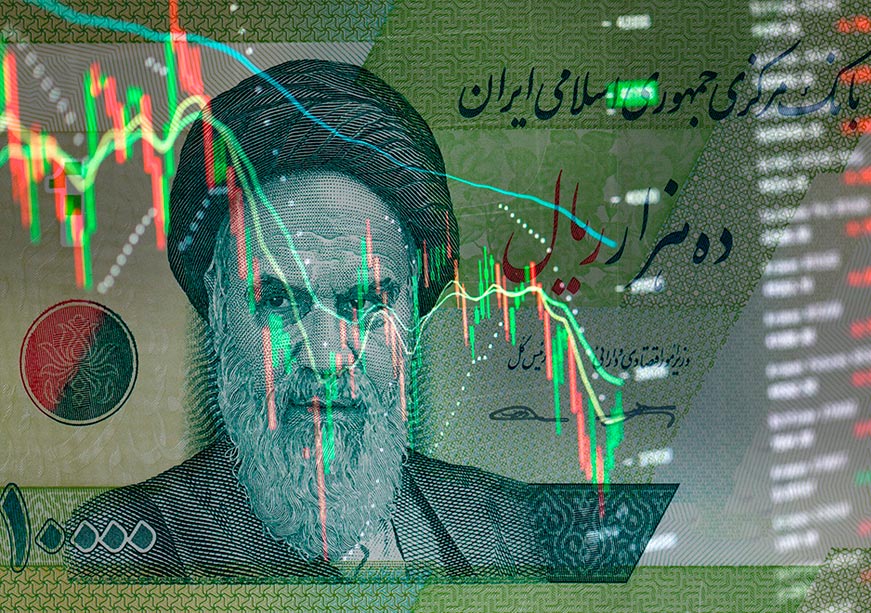
Iranian Regime Survival Through Currency Reform
Since 2023, Iran’s proxy network—the country’s primary forward defense strategy—has significantly declined through consistent Israeli campaigns. This degradation culminated in a twelve-day war with Israel. Israel assassinated key military officials and destroyed major military sites via air strikes. The conflict also coincided with U.S. bombings of Iran’s nuclear facilities in Fordow, Natanz, and Isfahan. Additionally, in response to Iran’s noncompliance with the 2015 Joint Comprehensive Plan of Action (JCPOA), European governments triggered the snapback mechanism of U.N. sanctions, further increasing Iran’s international isolation and deepening its economic troubles. Regionally, the implementation of a ceasefire in the Israel-Hamas conflict that drew in Hezbollah, the Houthis, and other Iranian proxies in Iraq marks the end of a disastrous two years for Iran and its forward defenses. Iran’s chief proxy, Hezbollah, has been significantly degraded amid the Israel-Hamas war, while the Assad regime’s collapse brought forth a new transitional government in Syria opposed to Iranian influence. Israel’s regional position has grown stronger, as Iran’s forward defense doctrine failed to protect the homeland from Israeli attacks throughout the twelve-day war. As a result, the Iranian regime faces growing domestic public perception that it is incapable of prevailing on and off the battlefield. Militarily, Iran’s proxy network collapsed, and, politically, the erosion of its forward defense strategy has exposed its diplomatic isolation and inability to deter adversaries abroad.
Iran’s response to its regional and economic crisis is part of a doctrine of strategic patience and dual survival that prioritizes endurance over genuine reform. Iran’s leadership is constructing a veneer of stability that sustains the regime in the short term at the expense of its long-term vulnerability.
Reinforcing Power at Home
A three-legged power structure defines the Iranian regime: the Supreme Leader’s orchestration of Iran’s political institutions, the Islamic Republican Guard Corps’s (IRGC) economic and political loyalty to the Supreme Leader, and a proxy-dominated forward defense strategy. With the last leg significantly damaged, the regime must reinforce the first and second legs via a reconsolidation of domestic political legitimacy and stability in order to ensure regime survival. The regime’s task is straightforward: buy time by holding off domestic opposition and challenges to its power, and await more favorable international conditions. Simply put, Iran is waiting for a U.S. leadership that is friendlier to sanctions relief and less supportive of its regional adversaries. These conditions would ease its isolation and preserve the Supreme Leader’s authority via the maintenance of the IRGC’s loyalty. Their loyalty rests on his ability to guarantee the institution’s political privilege and, most importantly, material interests. With a reconsolidated IRGC, Iran can reassert deterrence and rebuild its regional networks, ultimately allowing it to posture from a position of greater strength.
Currency Reform as a Symbol of Control
Within this context, the Iranian Parliament slashed four zeros from its national currency, the rial, as a calculated attempt to project resilience and defiance amid mounting economic and geopolitical pressure. The redenomination will convert 10,000 rials into one new rial over a two-year preparation period and three-year transition period. The Iranian government introduced this measure to demonstrate a veneer of control amid economic decay. This domestic move is part of the Supreme Leader’s broader doctrine: consolidate domestic stability to ensure the regime’s long-term survival. Elite unity, particularly within the IRGC, is of utmost importance in a time when the regime has lost material power to its existential enemy, and the Supreme Leader must reinforce the perception of central competence and control to prevent bureaucrats, clerics, and particularly IRGC leaders from withdrawing their support. Currency redenomination is a part of this domestic reconsolidation.
The parliament’s stated purpose of this policy is to make transactions simpler, as the exchange rate now hovers around 1,150,000 rials per U.S. dollar. Redenomination makes life for Iranians less complicated, with prices in the millions and inflated, high-denomination banknotes commonplace. On top of this economic upheaval, the international community’s tightening of sanctions on Iran and Iran’s dismal performance in the Twelve-Day War have created additional pressures on the Iranian regime. This currency reform is a form of political communication, a symbolic assertion that the regime can still command domestic perceptions, narratives, and daily realities of economic life in spite of increasing internal and external pressures.
The purpose of this currency reform is to manage public perceptions of Iran’s economic crisis rather than to address its root causes, as reflected in the somber assessments conveyed by top Iranian economic officials. This reform emerges from a long-standing policy debate that spans three governments and three parliaments. Currency redenomination is contentious within Iranian politics: 144 lawmakers voted in favor, 108 against, and 3 abstained. Opponents pointed to its cosmetic rather than practical effects. Shams al-Din Hosseini, the chair of the parliament’s Economic Commission, stated that, “Iran’s currency, in terms of zeros, is among the weakest in the world.” The Iranian Central Bank Governor, Mohammad Reza Farzin, echoed this sentiment, arguing that while annual inflation remained stable in the range of 30 to 40%, “the current trend is no longer possible and there is no choice but to implement this reform.”
The Iranian government’s formalization of public behavior, where shopkeepers issue prices in tomans (an informal unit equaling ten rials) and citizens disregard the extra zeros, signifies that the regime has had to adjust monetary policy to economic realities. Alongside Iranian geostrategic decline over the past two years, the regime’s inability to adequately address domestic economic concerns has contributed to a widening legitimacy gap between Iranian citizens and the state. Farzin adds that the increased inflation and declining ratio of the national currency value relative to foreign currencies have “caused a decline in national pride.” Ideological narratives are no longer sufficient to ensure popular legitimacy.
Alongside the rial trading as the world’s lowest-valued currency, Iran’s inflation exceeds 40%. Former deputy agricultural minister Ali Ghanbari forecasts that Iran’s GDP will contract by 2% by March 2026, compounded with a rise to a 54% inflation rate.
Managing Decline Through Symbolism
With these economic headwinds, the regime’s survival depends on managing perception. Historically, Iran has operated with a “dual strategy of survival”, where the regime consolidates unity at the elite level and maintains repression and control at the popular level. This logic became even more important following the U.S. withdrawal from the JCPOA, as rising economic pressure and internal divisions threatened the regime’s survival. Relative elite stability and the deterrence of popular revolts through increased Basij (a paramilitary IRGC-controlled volunteer force) patrols serve as key means of maintaining regime survival. Ultimately, however, the regime’s broader objective is to introduce a semi-autarkic economic model capable of withstanding prolonged economic isolation. Redenomination aims to align public perception with economic reality rather than address the structural causes of Iran’s economic woes. Iran seeks to sustain its semi-autarkic model through closer alignment with China and Russia and uses these partnerships to offset the effects of Western isolation. This policy goal manifests itself in energy and military collaboration, most notably with Iranian oil sales to China and unmanned aerial vehicle sales to Russia.
Domestically, the veneer of regime competence is important in maintaining the dual strategy. Within the broader doctrine of strategic patience, redenomination is one of many instruments to attain Iran’s short-term goal of survival amidst increasing pressure. Under this doctrine, Iranian officials refrain from taking immediate, unilateral actions that could escalate Western pressure, opting instead to manage it through heightened domestic repression. Even in cases where Iran takes ‘escalatory’ action, such as suspending their cooperation with the International Atomic Energy Agency (IAEA), Foreign Minister Abbas Araghchi has announced that cooperation would reemerge “at a later date.” When Iran suspended its provisional agreement with the IAEA, it framed the move as temporary, a show of strength that avoided provoking harsher consequences. This move operates as both a signal of control to a domestic audience and one where the regime does not completely rule out diplomatic re-engagement.
Symbolic control extends beyond monetary policy into the security realm. Iran faces a unique challenge of addressing a newfound fragility in its military leadership: many of its top leadership were injured or assassinated during the Twelve-Day War. Alongside the infrastructural damage to Iran’s missile and nuclear programs, the regime must also buy time to replace senior military leaders and address the extent of Israeli infiltration within its intelligence and security apparatus. Mossad’s infiltration of the Iranian security state played a key role in Israel’s ability to strike at sensitive Iranian nodes, both in personnel and infrastructure, and the regime faces the challenges of addressing these vulnerabilities and repairing the infrastructural damage caused by the War. The regime has already arrested hundreds of suspected spies and fast-tracked the passage of a law that would broaden the death penalty’s scope. It has executed nine people since the War’s culmination, including nuclear scientist Rouzbeh Vadi.
The Limits of Strategic Patience
To prevent further power degradation, the Iranian regime will likely quietly attempt to reestablish its domestic power and wait out the Trump administration, while hoping that the next administration will adopt a more favorable policy towards Iran. Redenomination is merely a part of the regime’s political toolkit to signal the continuity of state control in the midst of eroding real capacity.
In the long term, redenomination is an attempt to postpone Iran’s impending economic crisis. The status quo would either force Iranian capitulation to Western power or accelerate further confrontation, an option that the regime wants to avoid. Internally, the regime values regime endurance and narrative control above all else, including reforms that would improve living standards but threaten regime stability. The preservation of power is an end in itself, with the state’s ideological coherence and institutional authority of utmost importance. Particularly when the government is unable to deliver economic prosperity and military dominance, it centralizes its approach on managing perception via symbolic gestures. Narrative control replaces genuine reform, dependent on manufactured legitimacy.
Externally, Iran will continue with a ‘strategic patience’ doctrine, while maintaining ties with China and Russia. This strategy’s central risk, however, is that the regime may be unable to maintain an economic and political legitimacy narrative through cosmetic domestic reforms alone, particularly if economic conditions continue to worsen significantly. Alongside Iran’s foreign policy failures, an inability to provide basic economic provisions to its people could permanently fracture the political compact between elites and society, and unity amongst elites themselves and lead to tangible, unavoidable issues such as widespread protest.
Iran is a regime in transition: wounded at home and abroad, while reliant on rhetoric to project strength. The regime’s need to preserve cohesion is an increasingly formidable challenge; the regime’s survival depends on consolidating authority while waiting for more favorable international conditions. Unless the Iranian regime moves beyond cosmetic fixes and confronts its economic decay through tangible steps, its strategy of controlled stagnation will merely postpone its domestic legitimacy crisis.
Views expressed are the author’s own and do not represent the views of GSSR, Georgetown University, or any other entity. Image Credit: Observer Research Foundation