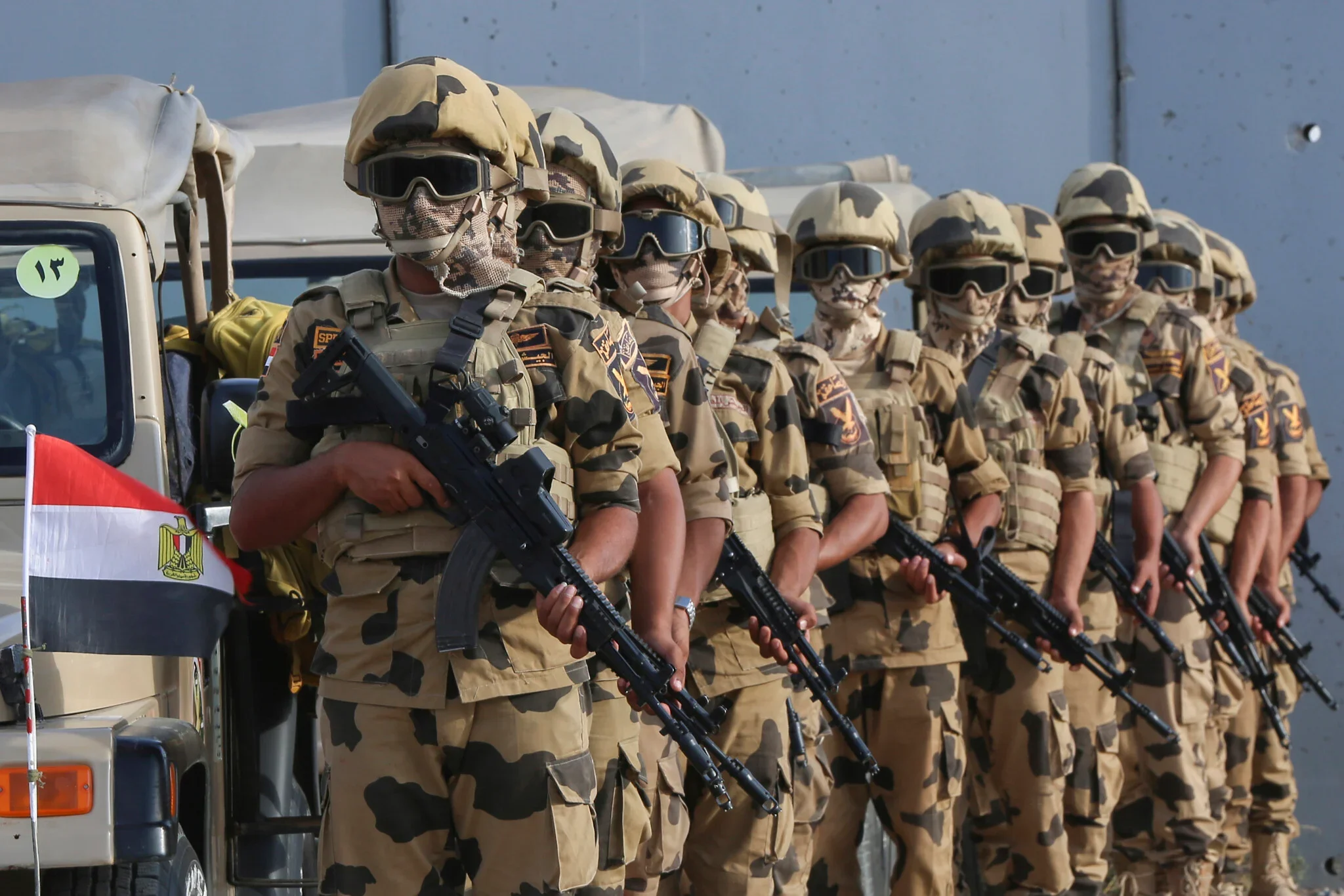
Egypt Is Rebuilding Its Defense Industrial Base—It Should Not Forget Maintenance and Sustainment
In late 2021, Egyptian defense firm Benha Electronic Industries participated in the third biennial Egypt Defence Expo. On display at the firm’s stand stood a domestic ESR-32B radar—a sophisticated system that marked a milestone in Egypt’s latest effort to rebuild its domestic defense industrial base.
Egyptian President Abdel Fattah el-Sisi is directing this effort to foster native defense production. In pursuing this goal, President el-Sisi and his senior military and civilian advisors should not forget a bitter lesson from previous periods of Egyptian defense industrialization: strong maintenance and sustainment is essential. Whereas maintenance refers to the repair and upkeep of military equipment, sustainment is the wider logistics apparatus that supports that equipment. Both capabilities underwrite military effectiveness and strategic autonomy.
Building Without Maintaining: Egyptian Defense Production under Abu Ghazala
Poor maintenance and sustainment have hurt Egypt even at the height of domestic defense production. In the late Cold War, Egypt was the only Middle Eastern nation with significant arms production save Israel. Field Marshal Abdel-Halim Abu Ghazala, Minister of Defense and Military Production, between 1981 and 1989, oversaw the most productive and lucrative period of Egyptian defense production. In this golden age of the Egyptian arms industry, the U.S. Central Intelligence Agency estimated that 27 domestic arms factories employed nearly 100,000 laborers and supplied $350 million worth of goods to the Egyptian Armed Forces and $200 million to the export market in a single year. Yet production under license agreements limited the transmission of knowledge and skill to the Egyptian defense industry and maintenance and sustainment capabilities were minimal. Another declassified U.S. intelligence assessment notes this fact: the Egyptian Armed Forces struggled to find spare parts for its platforms in the late 1980s. Maintenance procedures were poor, and equipment sat unused due to a lack of trained repairmen and technicians.
Economic decline in the 1990s unraveled Egyptian defense production. In the preceding decade, Abu Ghazala forged co-production agreements with U.S. and European suppliers that left the Egyptian defense industry dependent on its foreign partners and uncompetitive without government subsidies. The Egyptian Armed Forces, which controlled the entire defense industrial base after 1994, converted many arms factories to commercial goods producers. In the next two decades, the Egyptian Armed Forces added these civilianized arms factories to its lucrative business empire. Maintenance and sustainment issues went unresolved.
Contemporary Reforms and the Maintenance and Sustainment Gap
The current defense industrial buildup could be different. Beginning in the 2000s, Egyptian officials began partnering with smaller international defense manufacturers rather than relying solely on co-production agreements with the United States that offer minimal technology transfer. Spurred by the halt in U.S. military aid between 2013 and 2015, President el-Sisi is now pushing for greater localization of defense production and a diversification of suppliers. Since then, Egyptian defense firms have unveiled domestic infantry fighting vehicles, unmanned systems, light tactical vehicles, and multiple launch rocket vehicles in successive Egypt Defence Expos. Progress in naval maintenance is also notable. The Egyptian government took over the Alexandria Shipyard in 2003 and has invested $280 million in its facilities since 2014, reducing reliance on U.S. maintenance contractors. The trend towards domestic military equipment bodes well for Egyptian force readiness, as domestic platforms are less dependent on critical components that often must be sourced from abroad.
The civil-military status quo has also shifted. President el-Sisi has encouraged the professionalization of the Egyptian Armed Forces and a defense procurement overhaul. Former President Hosni Mubarak curtailed the Egyptian Armed Forces’ political ambitions with major procurement programs and purposefully kept sustainment weak. A professionalizing Egyptian Armed Forces under President el-Sisi might have the political license to more effectively steward its maintenance and sustainment capabilities.
Despite Egypt’s defense buildup and more permissive civil-military conditions, serious maintenance and sustainment challenges persist. The Egyptian government allocates an estimated 15 percent of U.S. military aid to sustainment, well below the U.S. recommendation. Low sustainment spending is likely partially responsible for the poor utilization rates of Egyptian military equipment. M1A1 Abrams tanks assembled near Cairo under a landmark co-production agreement with the United States sit unused for months before delivery to Egyptian Army armored brigades and an average Egyptian Air Force F-16 musters half the number of sorties as its U.S. Air Force counterpart. The Egyptian Armed Forces simply do not reap the full utility from their platforms. Improved maintenance and sustainment are central to unlocking those complete capabilities.
Egypt Should Emulate Türkiye
Egypt officials’ own neighborhood proves that improved maintenance and sustainment is achievable. Türkiye, which also fields a large conscript-based armed forces and was once vulnerable to arms embargos, has strong maintenance and sustainment capabilities that underpin its greater self-sufficiency and combat readiness.Whereas Abu Ghazala placed co-production agreements and arms exports at the center of defense production policy in the 1980s, Turkish officials embarked upon a different path. After the U.S. arms embargo between 1974 and 1978 led to a shortage of key components, Turkish policymakers upgraded local parts production and repair and maintenance networks. These maintenance and sustainment facilities in turn formed the initial foundation of leading Turkish defense companies that have achieved export success. As a result, the Turkish government is no longer dependent on the United States for maintenance and sustainment, and strong maintenance and sustainment have contributed to the Turkish Armed Forces’ combat readiness and regional power projection. Egyptian advocates of defense reform should use Türkiye as evidence that prioritizing the support apparatus behind military capabilities can pay dividends.
The Need for a Well-Maintained Military
Egypt now confronts a strategic environment that demands improved maintenance and equipment readiness. The Egyptian Armed Forces utilization and sustainment weaknesses almost certainly hamper its ability to launch effective operations despite an abundance of internal and external security threats. The Egyptian Armed Forces has fought the Islamic State’s affiliate in the Sinai Peninsula since 2013 and conducted naval operations in the Red Sea. The Egyptian Air Force and Army special forces launch operations in support of the Libyan National Army, despite the faction backing the Rapid Support Forces in Sudan which Egypt opposes. The discovery of natural-gas fields in the eastern Mediterranean and the perception of an existential threat from Ethiopia’s construction of the Grand Ethiopian Renaissance Dam on the Blue Nile has simultaneously pushed Egypt’s power projection requirements farther afield than in previous decades. If the paramilitary Central Security Forces fail to enforce public order, the Egyptian Armed Forces undertake what may be their most important mission: protecting the Egyptian government from internal upheaval. The Egyptian Armed Forces cannot depend on U.S. aid to ensure el-Sisi has the option to use or threaten credible military force, especially in the case of another domestic upheaval or counter-insurgency campaign.
The diversification of Egyptian military procurement since the Arab Spring presents an opportunity to strengthen maintenance and sustainment. The Egyptian Armed Forces became the largest customer of French arms manufacturers in 2021, and Egyptian officials have inked additional deals with Russian and German defense firms in recent years. Egypt can enlist these suppliers’ help in creating the equivalents of the Alexandria Shipyard for the Egyptian Ground Forces and Egyptian Air Force that can function adequately without foreign support. Major defense primes are hungry for access to the significant Egyptian market. President el-Sisi should exploit the leverage that lucrative Egyptian defense procurement contracts offer to secure local production of spare parts and training for Egyptian maintenance, repair, and operations personnel. Stronger maintenance and sustainment would increase the number of aircraft, naval vessels, and land platforms that Egypt could field in a crisis and prevent any single supplier from restricting Egypt’s freedom of action in a war or domestic upheaval.
Although maintenance and sustainment alone will not unlock the fullest potential of the Egyptian Armed Forces, more extensive reforms to the non-commissioned officer corps, training, and tactical decision-making are likely too extreme for a government with fragile civil-military relations. If President el-Sisi and his civilian cabinet want a military whose true capabilities are commensurate with Egypt’s national security needs, at the very least, the country can no longer afford poor maintenance and sustainment.
Views expressed are the author’s own and do not represent the views of GSSR, Georgetown University, or any other entity. Image Credit: The Times of Israel