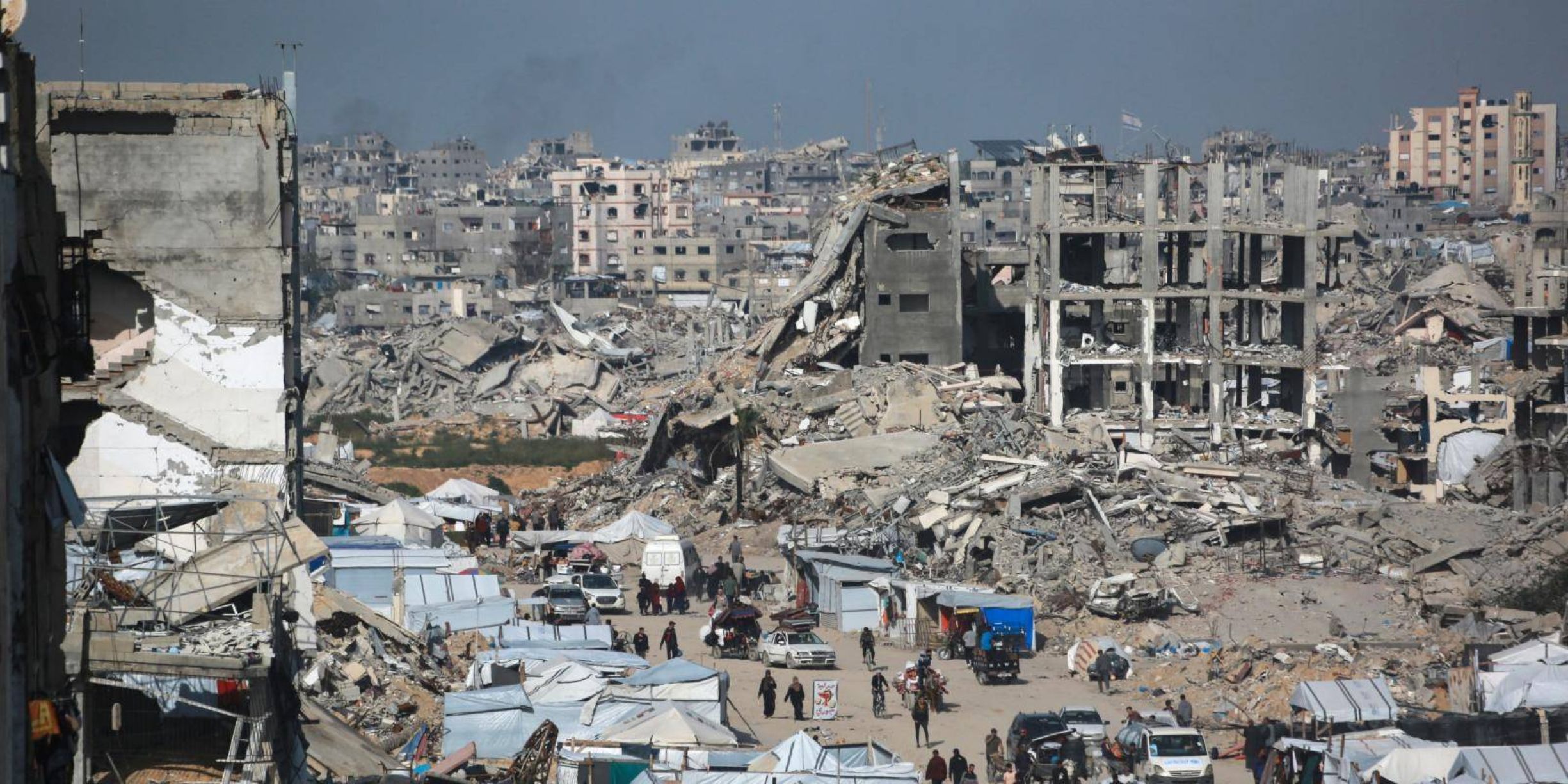
Disarmament Is Not a Starting Point in Stabilizing Gaza
In the aftermath of the October 2025 ceasefire between Israel and Hamas, international efforts to stabilize Gaza have converged around a common organizing principle: the disarmament of Hamas as the prerequisite for peace. United States-backed proposals through President Donald Trump’s Board of Peace frame the relinquishment of weapons as the essential first step toward reconstruction. Under the current proposal, Hamas and other armed factions would hand over their weapons in phases to a new Palestinian technocratic government, with reconstruction and Israeli military withdrawal contingent on compliance. The underlying logic is straightforward: disarmament is a necessary starting point for stability.
This assumption ignores the fact that militant groups have no reason to agree to a deal that leaves them powerless. Weapons are not the root cause of instability; they are a symptom of the absence of political order and security. Stability in Gaza requires a central political authority capable of enforcing order and reducing incentives for violence. This outcome necessitates the conditional inclusion of Hamas in the post-conflict political process, thereby making its continued reliance on weapons unnecessary.
The Disarmament-First Fallacy
Armed groups maintain their weapons for three reasons: first, an armed capacity provides leverage over its adversaries; second, weapons guarantee survival in the absence of a credible governing authority; and third, disarmament without a political pathway risks exclusion from the post-conflict order. Stabilization approaches that do not address these incentives will fail to deter armed groups from maintaining, or even intensifying, existing hostilities.
For example, Iraqi militias that had a path to political power, such as the Kurdish and Shia militias tied to political parties, agreed to participate in the political process and had some of their fighters enter state institutions. Militias that were excluded from the political process, such as ex-Baathist Sunni insurgents and Sadrists, kept fighting. For the ostracized armed groups, their opposition to disarmament was a rational rejection to their disillusion, as they lacked any guarantee of political participation and would lose the means to defend themselves against state and non-state enemies alike.
For groups excluded from legitimate political processes, disarmament is a gamble made under extreme uncertainty. As an armed actor, if the costs of continued resistance remain lower than the risks of disarmament, they will continue to defy processes that compel them to give up their weapons. Without any credible guarantees in exchange for disarmament, they will likely view disarmament as surrendering without survival.
Hamas: More Than a Militia
Disarmament-first approaches misdiagnose the object of Gaza stabilization policy efforts. Hamas operates both as an armed group and as the governing authority in Gaza. Consequently, disarming Hamas is an operation with security and political implications.
Since seizing control of Gaza in 2007, Hamas has created a parallel state apparatus that penetrates virtually all civilian life. It has organized ministries responsible for duties ranging from finance to internal security, while employing approximately 30,000 civil servants whose livelihoods are directly tied to the continuity of its rule. Even in the aftermath of the 2023 Gaza War, Hamas has rapidly reasserted control over policing and taxation, with its security forces returning to the streets and its administrative bodies regulating markets, albeit via coercive enforcement.
Hamas remains the territory’s primary economic regulator. Beyond its weaponry, Hamas has longstanding social welfare networks and an internal policing apparatus that acts as the central mechanism for Gaza’s civilian population. Hamas possesses the two defining characteristics of governance: a monopoly on force and a monopoly on services.
As a result, the civilian population remains economically dependent on Hamas. As such, the disarmament of Hamas risks collapsing the existing governing order upon which civilian survival depends, and cannot occur in the absence of the formulation of another governing authority.
Why Hamas Will Not Disarm
Disarmament presents three risks for armed groups: (1) survival risk; (2) absence of a credible authority to guarantee the peace; (3) political exclusion. For Hamas in Gaza, the costs of these three risks continue to outweigh the benefits.
First, the survival risk remains immediate. Militias will only demilitarize when they are confident that their opponents will not kill or imprison them once disarmed. Hamas faces this dilemma, where Israeli officials continue to target Hamas members, alongside the threat of intra-Palestinian rivalries exploding once they lose their defense mechanisms.
Second, the absence of a credible governing authority reinforces risk. Current discussions under phase two of the Gaza Peace Plan have yet to formally operationalize any governance structures or the mandate of a technocratic committee that could administer Gaza. Beyond this issue, within Gaza, there is no other actor that possesses the legitimacy and coercive capacity necessary to enforce order. The only other actor that could operate at scale is the Palestinian Authority, although it lacks local legitimacy and the coercive infrastructure necessary to assert independent control in Gaza. To illustrate, 80% of Gazans view the Palestinian Authority as corrupt, imposing a legitimacy deficit that widespread international recognition cannot displace on its own. Without an authority that can credibly manage the disarmament process, ensure order, or reliably govern Gaza, there will be a power vacuum that Hamas could not survive without arms. This risk disincentivises disarmament for Hamas.
Third, disarmament, as of now, would result in political exclusion. Ceding its weapons would also remove Hamas’ bargaining tools in securing relevance in negotiations over Gaza’s future. The error of the present negotiations is explicitly linking reconstruction and governance transitions to Hamas’s disarmament, which is asking Hamas to surrender its leverage without any stake in the postwar order.
Additionally, Hamas’s commitment to armed resistance is an ideological component of its existence. Since the group’s identity and perceived legitimacy are synonymous with military opposition to Israel, disarmament presents a foundational threat to its raison d’etre. The current negotiations have not shifted the incentives for Hamas, and have instead attempted to repeatedly ask the group to capitulate without any credible guarantees.
The Failure of Coercive Disarmament
There are two approaches to disarm an armed group: guarantee it a future in the new system or use force to crush any hope of fighting back. The latter option, one of military degradation, has been Israel’s preferred approach since the beginning of the Gaza War. However, their ability to significantly weaken Hamas’s conventional capabilities has not translated into political compliance. Instead, Hamas has refused to disarm or dissolve in a manner that Israel prefers.
Throughout the war, Hamas shifted from centralized command structures toward decentralized cells capable of sustaining low-intensity operations. As for any armed group at a conventional disadvantage compared to a state enemy, victory for Hamas is maintaining endurance and survival. In contrast, for state actors, victory entails convincing the armed group that continuing hostilities is futile, a standard that is almost impossible to achieve through brute force alone.
Even if Israel fully destroys Hamas’s will and capabilities, Hamas is the one entity in Gaza that has some degree of legitimacy and governance capacity. Its full removal, without the establishment of a fully legitimate and authoritative governing entity, would likely spark a flurry of smaller, messier conflicts that keeps Gaza as a space of permanent volatility.
The coercive option, in the short term, may provide swifter results in degrading an armed group’s organizational capacity. However, without a comprehensive political solution, the aftermath of widespread destruction will generate the conditions for persisting insurgency. The Gaza War reflects this phenomenon, as Hamas maintains coercive and social influence despite its extensive losses in force projection.
What Actually Works: Conditions for Disarmament
States must ask what conditions would incentivise armed groups to disarm rather than on what timeline can disarmament be imposed on groups. The former question reveals that disarmament works best when embedded within a political and security framework that alters the incentives of armed actors.
The first condition is a political pathway. Granting a viable role in the post-conflict order shifts the incentive to continue insurgent activity, thereby framing disarmament as a political bargain. Such a guarantee of political participation and institutional representation must occur before the relinquishment of weapons so as to ensure continued relevance.
The second condition is a security guarantee. This security guarantee must come from internal and external opponents of the armed group, with a credible enforcement mechanism from a third-party that can prevent any violations from either party. The purpose of this security guarantee is to replace weapons as the primary means of self-preservation with agreements that can eventually build trust between all parties involved.
The final condition is that governance must occur before disarmament. To effectively disarm, demobilize, and reintegrate an armed group, there must be a political authority capable of enforcing order and delivering basic services. If state capacity remains weak, disarmament efforts will likely fail, with armed groups providing governance to fill the power vacuum.
Rethinking Gaza Stabilization
Any stabilization strategy that conditions reconstruction on immediate Hamas disarmament cannot function due to the unchanged incentives for armed actors. Instead, stakeholders should adopt a framework that ties demobilization with political and security developments. For example, the proposed Mladenov plan’s stipulation that Hamas should first relinquish its heavy weaponry must accompany guarantees that Hamas’s civil servants will attain a stake in the transitional government. Additionally, senior leaders will receive immunity in exchange for avoiding insurgent activities that could undermine the new state’s authority.
Stability must also rely on conditionality as leverage. International aid donors should tie reconstruction aid and economic recovery with incremental compliance benchmarks, with Hamas conversely receiving governance transition perks in exchange for demobilization. Aid should function as an instrument to shift actor behavior, and conditionality must offer credible benefits for compliance.
The central task of the governance-first strategy is constructing a credible Palestinian governing authority that can monopolize force and deliver basic services. Without this, any attempt to disarm Hamas will create a vacuum that either Hamas itself or other armed actors can fill. Providing Hamas a stake in this post-conflict governance system will provide it a rational incentive to shift behavior away from armed resistance. To preserve the authority’s credibility, Israel must commit to not undermining the authority through preemptive armed force. Only if an armed group first undermines the agreement by attacking Israeli forces should Israel military operations continue. However, such responses should require coordination with the governing authority to prevent its institutional collapse. An attack would be constrained against the violating armed group to prevent undermining the newfound order.
Conclusion
The disarmament-first approach rests on a fundamental analytical error: the removal of weapons as the primary pathway to stability. The value of disarmament for Hamas depends on the political conditions that shape the group’s calculus. Changing the value of the weapons, therefore, requires changing the political context. Military degradation is an insufficient strategy. It will not achieve Hamas’ compliance, nor create the conditions for stability that a broader settlement would pursue.
Stability requires governance. Armed groups, including Hamas, exist when they can fulfill functions that no alternative authority can provide, particularly security and economic regulation. Until an overarching authority can replace those functions, disarmament will remain irrational for any actor concerned with survival.
Therefore, stabilization must prioritize the construction of a legitimate political and security order capable of absorbing and ultimately supplanting armed actors. Only within such a framework can weapons lose their value. Until Gaza is governed by an authority capable of replacing armed resistance with political participation, Hamas’s demand for weapons will endure as the international community’s demand for disarmament will reflect an endemic misunderstanding of the situation.
Views expressed are the author’s own and do not represent the views of GSSR, Georgetown University, or any other entity. Image Credit: Chatham House