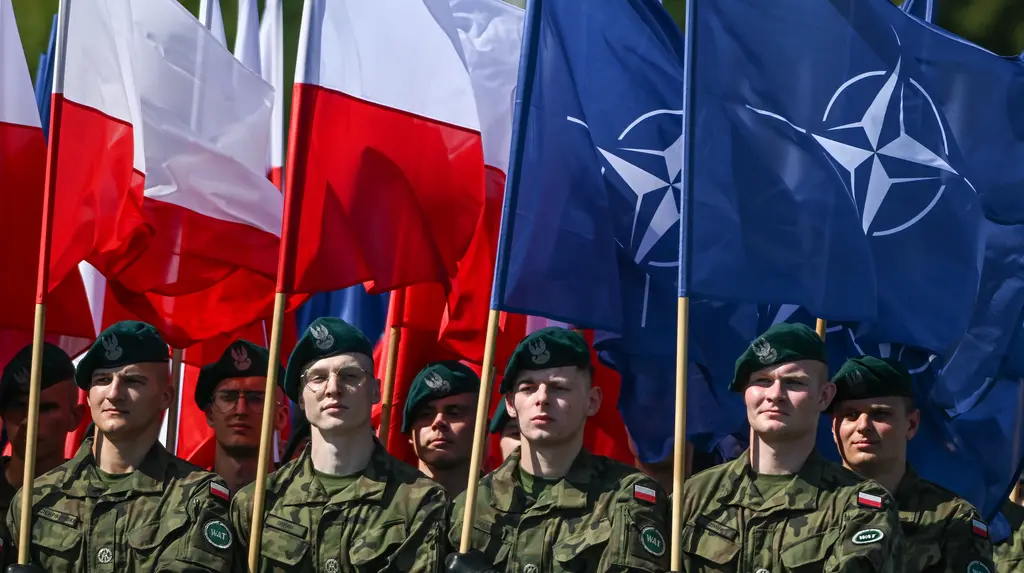
Poland, Not Paris, is the Answer for NATO’s Nuclear Deterrence Dilemma
In recent years, the nuclear calculus in Europe has shifted dramatically. Due predominantly to Russia’s 2022 invasion of Ukraine and the unpredictable and unreliable second Trump presidency, some European countries have expressed interest in acquiring nuclear weapons, while others have demonstrated cooperation with current nuclear-capable countries. Continued aggression from Russia, NATO’s Eastern members’ proximity to full-scale armed conflict, and a self-interested United States that is actively diverging from its leadership in European defense have led European policymakers to pursue an independent nuclear deterrent that supplants the current Washington-led and managed deterrent framework.
Debating these concerns, in early 2025, European leaders concluded that “the continent would be better off with an independent nuclear deterrent – and leaders from Germany, Poland, and the Baltics signaled an intention to explore alternative solutions.” Poland has proven itself to be an outspoken proponent for joining the nuclear project and even developing its own nuclear weapons in the future. Despite belonging to opposing political parties that frequently quarrel, this conviction has united President Karol Nawrocki and Prime Minister Donald Tusk. Prime Minister Tusk has spoken with great vigor and firm conviction about Poland’s intent to invest heavily in nuclear power plants and to actively harness that capability in a future military context.
France’s recent announcement to “boost its nuclear arsenal and extend the deterrent to cover other European countries” is a step forward in nuclear posture for Europe. However, France’s initiative falls short of nuclear deterrence for NATO on the European continent.
If the defensive alliance aims to provide a comprehensive, capable nuclear deterrent led and managed by Europe, one country should host all of NATO’s nuclear capabilities. Poland, with its strategic maturity beyond ideological differences at home, rising defense investment, advancements in nuclear infrastructure, and geographic proximity to Europe’s primary threat, should become a host nation for NATO’s nuclear weapons.
Why Nuclear Talks Now? An Escalatory Russia and Unpredictable United States
Although Russia has threatened Europe with nuclear weapons for decades, Moscow’s rhetoric has escalated since Russia’s 2014 illegal annexation of Crimea and subsequent 2022 full-scale invasion of Ukraine. In November 2025, Russia formally revised its nuclear doctrine, “lowering the threshold for nuclear weapons use from an existential threat to Russia to a threat to its territorial integrity.” Russia’s move to lower the threshold was years in the making, propped up by an intense campaign of threats and signaling to use nuclear weapons against Ukraine in the months after the invasion.
As Russian threats against Europe rise, the United States is simultaneously becoming a less predictable ally and a less reliable guarantor of European security. The U.S. all but plainly stated in the 2026 National Defense Strategy that U.S. forces are postured to defend against Russian threats to the U.S. homeland and prioritize American interests, not those of Europe. Although recent comments by Under Secretary of War for Policy, Elbridge Colby, deny a retreat from Europe, it would be folly for Europe to rely heavily on the United States to deter Russia and defend against a future attack.
Further, in an era of heightened U.S.-People’s Republic of China (PRC) competition, the U.S. will likely focus its efforts on retaining nuclear superiority over the PRC, the latter of which is rapidly developing a new generation of nuclear weapons. With a U.S. that’s occupied tracking the PRC’s buildup and allocating resources to match, if not outpace its adversary, allies in Europe receive little coverage from the U.S. to deter Russian aggression. To fill this gap, European policymakers have openly discussed shifting away from U.S.-led nuclear deterrence for the continent, instead pursuing a complementary nuclear deterrent, most likely extended from France.
French President Macron’s Dissuasion Avancée
In early March, French President Emmanuel Macron announced his Dissuasion Avancée initiative, marking a significant evolution in French defense and nuclear deterrence strategy. France’s new doctrine includes extending its nuclear capabilities and coverage to some European allies to protect vital shared interests through nuclear deterrence. Despite Macron’s initiative, the strategy to extend capabilities is a lackluster offer, limited in scale and scope.
Currently, France retains fewer than 300 nuclear warheads. Its arsenal is sized for the defense of French vital interests, and is neither designed nor intended for alliance-wide extended deterrence. Macron continues to deny interest in joining NATO’s Nuclear Planning Group (NPG), the senior authoritative body responsible for setting nuclear policy and force structure related to arms control. France’s absence from the NPG, coupled with the lack of an explicit guarantee to provide coverage to allies, means Paris retains the sole decision-making power to launch nuclear weapons.
Furthermore, Macron’s initiative has been offered to only eight European allies—the United Kingdom, Germany, Poland, the Netherlands, Belgium, Greece, Sweden, and Denmark. This offer is disproportionately selective to the 31 NATO members on the European continent, who would not receive a comparable nuclear deterrent to that favored by Paris. Given France’s selective posture, it is unclear how much political goodwill exists in Paris to risk its own security for Berlin, Brussels, or Warsaw in the event of an attack.
Not addressed by Macron but surely considered by European allies is the likelihood of a far-right politician gaining power in the 2027 presidential election. A far-right, Russia-sympathetic Front National party victory in the 2027 French presidential elections may prompt France to limit or rescind Macron’s Dissuasion Avancée initiative as it reorients its foreign policy.
It is a provocative and premature move by France to initiate an extension of nuclear capabilities to European allies when its own arsenal pales in comparison to Russia’s, its persistent unwillingness to join and coordinate within the NPG, and potentially divergent or self-interested priorities that do not guarantee a nuclear response if an ally is attacked. Europe cannot sit idly by, taking shelter under a fragmented nuclear umbrella extended from France. Such a framework falls short of comprehensive, credible deterrence for the Alliance and relegates European security to the political will of a single nation rather than the collective. A coordinated, comprehensive, alliance-wide nuclear deterrence strategy led by Europe for Europe would be the ultimate guarantor of shared security interests.
The Case for Poland as a NATO Nuclear Host Nation, Independent of the United States
Poland is a compelling option to serve as NATO’s host nation for a comprehensive, alliance-wide nuclear deterrent. Poland’s geographic proximity to Europe’s primary aggressor, its significant defense investment, dynamic economy, and growing military capabilities demonstrate strategic foresight and a serious commitment to defense and security.
Geographically, Poland shares a 260-mile border with Belarus and a 330-mile border with Ukraine, the latter of which hosts Russian tactical nuclear weapons. Kaliningrad, the exclave of Russia located on Poland’s northern border, houses nuclear-capable Iskander missiles and recently completed renovations on a nuclear weapons storage bunker. An alliance-wide nuclear deterrent force based in Poland would leverage NATO’s defense against an attack from the east and expand its coverage to NATO’s northern to southernmost members.
Poland allocated 4.7% of its GDP to defense, the highest proportion among all NATO members. This prioritization of security is reflected in an unprecedented 200 billion Zlotys ($54.42 billion) budget for 2026. Warsaw’s defense investment and advancement have rapidly outpaced other nations, which would, on average, take years—if not decades—to achieve a comparable level. Moreover, Poland has been on the purchasing end of some of Europe’s biggest arms deals, proving a serious commitment to building up against a Russian threat.
In terms of capabilities, Poland is currently in the delivery pipeline to receive 32 F-35A jet fighters, each equipped to carry the B61-12 thermonuclear gravity bomb. The F-35 “is the first 5th-generation nuclear-capable aircraft ever, and the first new platform (fighter or bomber) to achieve this status since the early 1990s.” Although F-35As are currently outfitted in accordance with the U.S.-led nuclear framework, NATO could see the nuclear-capable stealth fighter reconfigured for a future Europe-developed nuclear bomb. Poland, in collaboration with Westinghouse-Bechtel, is actively constructing its first nuclear power plant, with the Polish government expressing interest in its potential military use.
The Framework and Its Challenges
Developing new nuclear weapons for NATO-wide use and a move to base this deterrence stronghold in Poland would be fraught with challenges. Such an effort would require an alliance-wide effort to jointly invest, develop, construct, and maintain nuclear weapons in Poland, with Poland alone serving as the agreed-upon host nation. Poland would not, in any independent or authoritative capacity, develop, own, or authorize the execution of such weapons as an independent state. NATO as a whole, through the NPG, would retain collective command and control over the arsenal, including its material, personnel, storage, transportation, and other logistics. This framework would provide a nuclear deterrent for all European NATO members, amplifying the capabilities of France and the United Kingdom, and supplanting the U.S. extended deterrent as Europe’s primary security guarantor. This move would shore up a credible and comprehensive nuclear deterrent for the whole of the Alliance on the continent, but most importantly, for NATO’s eastern flank, which is geographically vulnerable to Russian threats and which currently lacks adequate coverage under existing nuclear weapons bases.
NATO’s move would undoubtedly violate the Nuclear Non-Proliferation Treaty (NPT) of 1969, which Poland ratified to become a non-nuclear-weapon state. NPT’s Article X allows any member state to exit on 90 days’ notice with citation of extraordinary circumstances that threaten national security. There is potential for Poland to claim this circumstance, with endorsement from the United States and NATO allies, citing extraordinary threats from Russia to Europe’s security. An acquiescent Washington would likely shield the alliance from international condemnation and sanctions. However, this would likely mean the end of NATO as a U.S.-led alliance, shifting instead to a NATO-led and managed solely from Europe.
Despite its challenges, the trajectory of debate and discussion on the future of European security rests on a comprehensive nuclear deterrent. Russia’s sustained nuclear threats against Europe and a United States that threatens or actively reorients its priorities have left Europe flailing to guarantee its collective security. France’s initiative is limited in both scale and scope and does not ensure collective security. Poland, in contrast, has the geographic advantage that could extend deterrence across the entire Alliance, and most importantly, its eastern flank. Poland’s political will remains strong, its defense investment steep, and its economy and infrastructure capable, if not ideally suited, to serve as a host nation for NATO’s nuclear weapons, marking a bold step forward in European nuclear deterrence led and managed by Europe, for Europe.
Views expressed are the author’s own and do not represent the views of GSSR, Georgetown University, or any other entity. Image Credit: Kyiv Independent