Adaptive Networks: Why Supply-Side Enforcement Cannot Stop Fentanyl
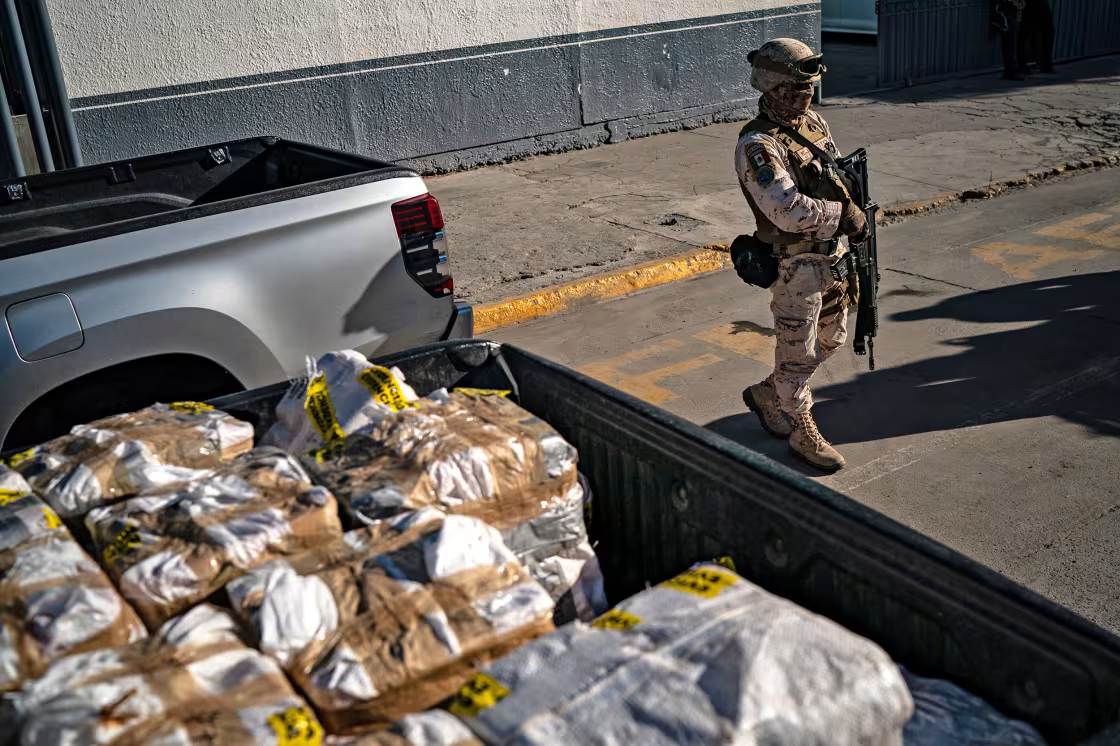
The Trump administration has made countering fentanyl a core tenet of its national security policy. In January 2025, President Trump signed a day-one executive order designating cartels and other drug trafficking groups as foreign terrorist organizations. Eleven months later, the White House released another executive order designating illicit fentanyl as a weapon of mass destruction, authorizing the use of military force in counternarcotics operations. Together, these unprecedented actions designate a clear external threat to the American people.
Yet, the intricacy of the illicit fentanyl trade poses a unique challenge for this approach to enforcement. The fentanyl supply chain constitutes a “complex adaptive network”—a system of interconnected elements that continuously adjust their behavior according to changes in the system. In other words, the actors involved are smart—they have proven able to adapt to sustained efforts to disrupt, dismantle, and interdict trafficking operations on numerous occasions. As a result, supply-side enforcement strategies have inherent limitations.
The Trump administration’s escalation against drug trafficking draws upon the belief that sustained force can ultimately curb the volumes of fentanyl reaching the United States. In fact, it may produce the opposite effect. As a complex adaptive network, the fentanyl trade is capable of rapidly adapting to disruptions imposed by authorities. As enforcement pressure intensifies, drug traffickers are likely to reconfigure their operations across each node rather than abandon their illicit trade entirely. The result is a diffuse network that is increasingly resilient to interdiction, ultimately harming long-term enforcement outcomes.
The Diversification of Precursor Chemical Sources
Understanding the fentanyl trade first requires examining its upstream inputs. The synthesis of fentanyl starts with precursor chemicals, most of which originate from manufacturers based in the People’s Republic of China (PRC). The two most prominent precursors used to synthesize fentanyl are N-Phenethyl-4-piperidone (NPP) and 4-anilino-N-phenethylpiperidine (ANPP). These chemicals are shipped to North America, where transnational criminal organizations (TCOs) synthesize the drug in clandestine laboratories. TCOs also frequently procure other drug-making equipment from the PRC, such as laboratory-grade glassware, stamping dies, and pill presses.
Despite their tense relationship, the United States and the PRC have found common ground in their desire to stamp out drug trafficking. The latest joint U.S.-PRC efforts have focused on restricting the flow of precursor chemicals to North America. In November 2023, the establishment of the U.S.-PRC Counternarcotics Working Group pushed the PRC to enact further export controls on precursor chemicals and manufacturing equipment. Both fentanyl seizures and overdose deaths have declined since 2023, with many attributing this shift to joint U.S.-PRC efforts to disrupt the supply chain.
The Trump administration has sought to intensify pressure against Beijing, imposing sweeping tariffs on the PRC until it can halt the remaining flow of precursor chemicals to North America. However, the geographic concentration of precursor manufacturing in the PRC does not make the supply chain easy to eliminate. Chemical production is a highly globalized industry, meaning procurement operations can shift when tighter regulations are imposed within a particular jurisdiction. Accordingly, U.S. officials report that TCOs have diversified their chemical and equipment procurement to alternative markets, such as India, in direct response to export controls.
Simultaneously, drug traffickers are adapting to the shortage of prominent precursors by manufacturing new chemical variants—or “analogs”—of fentanyl. When controlled precursors are unavailable, TCOs use unregulated precursors or “pre-precursors” to sidestep enforcement efforts, while adding easily attainable adulterants like xylazine to offset any potential loss in drug potency. This adaptation reduces the effectiveness of policies focused on controlling specific precursor chemicals or reducing drug potency.
The decision by TCOs to diversify their precursor sources and synthesis methods attempts to disperse risk across several potential points of failure. Relying upon the most common precursors would represent a single point of failure that, if attacked, would result in the collapse of the whole system. To more effectively address this adaptation, the Trump administration could pursue bilateral cooperation with major manufacturing hubs like the PRC and India to control chemical exports as synthesis methods evolve, while using multilateral channels to preempt potential markets where precursors and equipment can be sourced from in the future.
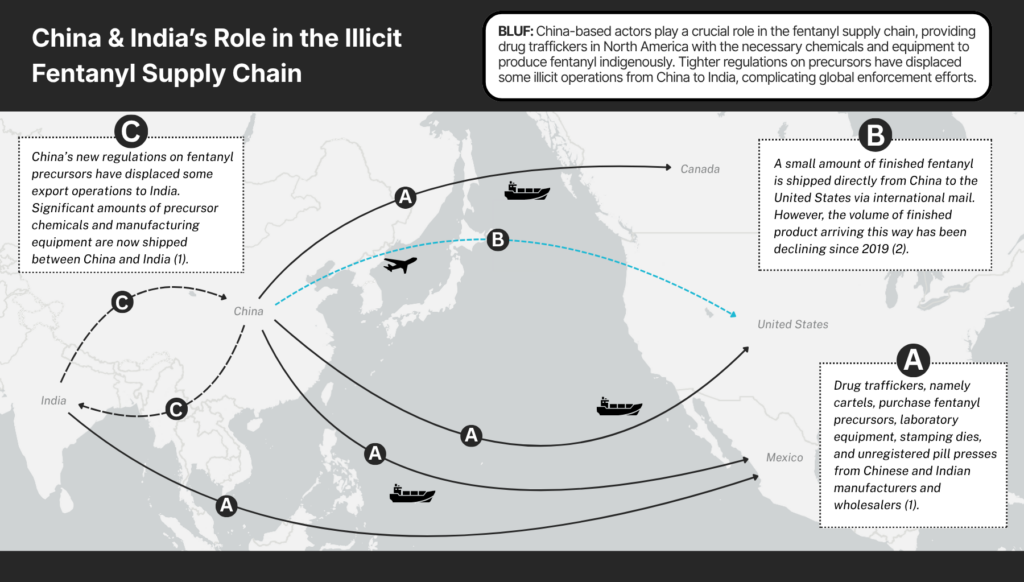
Sources: 1) Drug Enforcement Agency, “Fentanyl Flow to the United States,” January 2020; 2) Drug Enforcement Agency, “2019 National Drug Assessment,” December 2019, 18-19; Graphic created by Noah Harvey.
How Mexican Cartels Resist Interdiction
Today, most U.S.-bound fentanyl is manufactured indigenously in North America. The Mexico-based Jalisco New Generation Cartel (CJNG) and Sinaloa Cartel are the most prominent North American TCOs involved in the manufacturing, trafficking, and distribution of fentanyl. Both cartels operate across all 50 U.S. states and dozens of countries worldwide.
Precursor chemicals and manufacturing equipment are received through cartel-infiltrated ports in Mexico before being transported to clandestine laboratories. These facilities can vary widely in scale, ranging from industrial “super labs” to residential kitchens. Pure fentanyl powder is then transported to so-called “pill mills” where fentanyl is pressed into tablets and disguised as legitimate pharmaceutical drugs. Traffickers often use specific unregistered pill presses, stamping dies, and light blue dye to produce counterfeit pills that resemble Oxycodone M30 tablets, making the product easier to market to prescription opioid users in the United States.
President Trump has repeatedly suggested conducting military strikes against the Mexican cartels. However, the U.S. tendency toward decapitation strikes may prove counterproductive against cartels. Both CJNG and the Sinaloa Cartel use decentralized, franchise-based command structures that mimic those of insurgency networks. The use of semi-autonomous, compartmented cells enhances operational security and reduces the effectiveness of targeted interdictions by limiting cascading failure across nodes. As a result, cartel operations have proven to be surprisingly resilient to previous U.S. and Mexican efforts to disrupt fentanyl trafficking.
Targeted interdictions have previously produced unanticipated second-order effects. For instance, the U.S.-backed raid by Mexican authorities targeting CJNG leader Nemesio “El Mencho” Oseguera Cervantes triggered widespread destruction and violence. Following his death, cartel members targeted federal troops, attacked rival sects of CJNG, and disrupted critical infrastructure countrywide. While this operation successfully “decapitated” key cartel leadership, the swift reorientation of CJNG leadership shows that it is unlikely to produce meaningful system-wide effects on fentanyl trafficking in the long term.
Emerging Smuggling Pathways Challenge U.S. Border Enforcement
Historically, most fentanyl entered the United States concealed in the mail or via express consignment carriers, but today, most finished fentanyl is smuggled through legitimate ports of entry. In January 2026 alone, 113,513 pedestrians, 201,621 cars, 20,137 trucks, and 28 trains crossed the U.S.-Mexico border each day. The sheer volume of cross-border traffic enables smugglers to conceal fentanyl in routine flows of people and goods. Thoroughly screening this volume of traffic is impossible without severely disrupting legitimate commerce.
The Trump administration has imposed stricter border enforcement by deploying additional personnel, enhancing border wall security, and authorizing law enforcement to detain illegal aliens for the maximum duration permitted by law. However, enforcement aimed at foreign nationals may only have a limited impact on fentanyl smuggling: According to U.S. Customs and Border Protection (CBP), roughly 80 percent of individuals arrested for smuggling fentanyl are U.S. citizens. Cartels often recruit U.S. citizens for their smuggling operations, as their legal status subjects them to less scrutiny at ports of entry.
In January 2026, CBP promised to expand its use of non-intrusive scanning technology at the busiest southern border crossings. If screening continues to tighten at ports of entry, cartels are likely to reroute fentanyl flows through less regulated pathways, with drones likely to emerge as a key alternative. In fact, cartels already use drones for surveillance, lethal attacks on rivals, and cross-border smuggling operations. For instance, in October 2025, CJNG flew an off-the-shelf drone loaded with explosives into the fortified compound of the state prosecutor’s office in Tijuana, demonstrating how easily commercially available drones can be leveraged for cartel operations. Drones offer an attritable, low-risk way to continue smuggling when conventional pathways are hardened with security countermeasures. Moreover, repeated airspace disruptions along the southern border, such as the incident over El Paso earlier this year, expose how U.S. border enforcement is unprepared to deal with the drone threat. If CBP is committed to enhancing security on the ground, then it must also prepare to address the emerging threat in the sky.
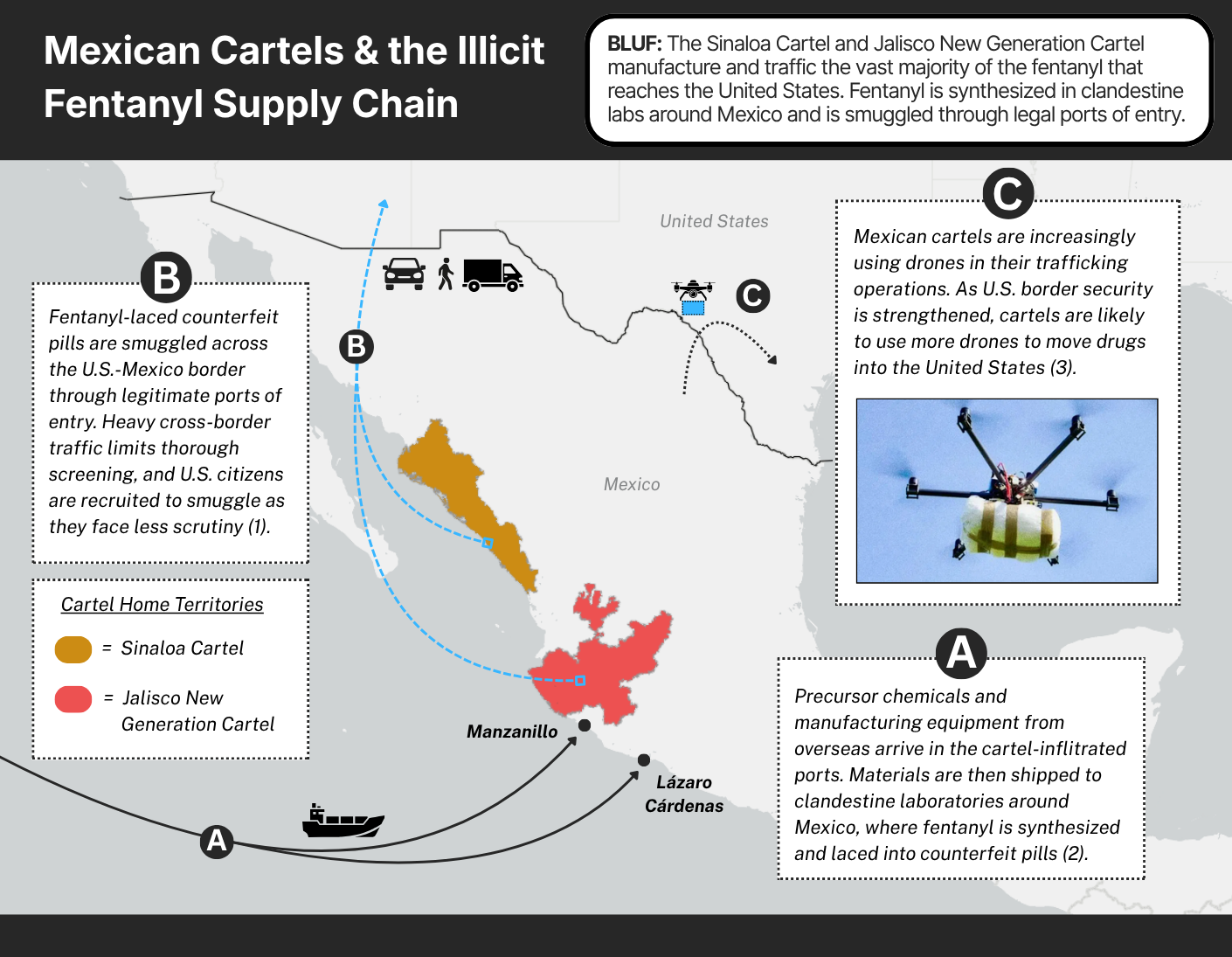
Sources: 1) Chris Dalby, “The Fentanyl Trade Through Mexico, Explained in 8 Graphs,” InSight Crime, February 19, 2019; 2) American Immigration Council, “Facts About Fentanyl Smuggling,” July 14, 2025; 3) Michael Sinclair, “Death from above: How criminal organizations’ use of drones threatens Americans,” Brookings Institute, March 11, 2021; Graphic created by Noah Harvey.
How Illicit Financial Flows Sustain the Fentanyl Trade
Given that TCOs generate billions of dollars annually from fentanyl trafficking, deceptive and illegal financial activities represent a critical center of gravity for illicit actors seeking to secure and retain their profits. Accordingly, illicit financial activities are present in every step of the supply chain and connect each node in the system.
According to the U.S. Department of the Treasury, chemical manufacturers and TCOs leverage shell companies, money mules, and financial intermediaries to obfuscate transactions behind layers of middlemen and funds transfers. At the retail level, drug traffickers increasingly rely on peer-to-peer money service businesses, such as Cash App and Venmo, to sell finished fentanyl to consumers. Schemes to launder fentanyl profits can range from relatively simple to highly sophisticated. In some cases, cartels use money service businesses and depository institutions to layer transactions and transfer illicit proceeds directly back to Mexico. More complex operations involve foreign professional money laundering organizations (PMLOs) that market money laundering as a service. PMLOs employ sophisticated techniques, such as trade-based money laundering, bulk cash smuggling, and cryptocurrency transfers, to move and repatriate funds back into the legitimate financial system.
Financial flows are significantly more difficult to disrupt than physical flows. While authorities can regulate U.S.-based financial institutions, much of the illegal activity occurs in foreign jurisdictions like the PRC and Mexico. U.S. authorities occasionally levy sanctions against specific foreign financial actors, but such measures alone are unlikely to have a significant effect on the fentanyl trade at large. TCOs are also increasingly using cryptocurrencies to sell fentanyl to consumers and launder profits. The use of multiple jurisdictions and virtual currencies reduces the visibility of illicit financial flows, limiting the ability of U.S. authorities to monitor and interdict them. The result is a highly networked, difficult-to-detect system that connects each node in the supply chain with secure methods of moving money between illicit actors.
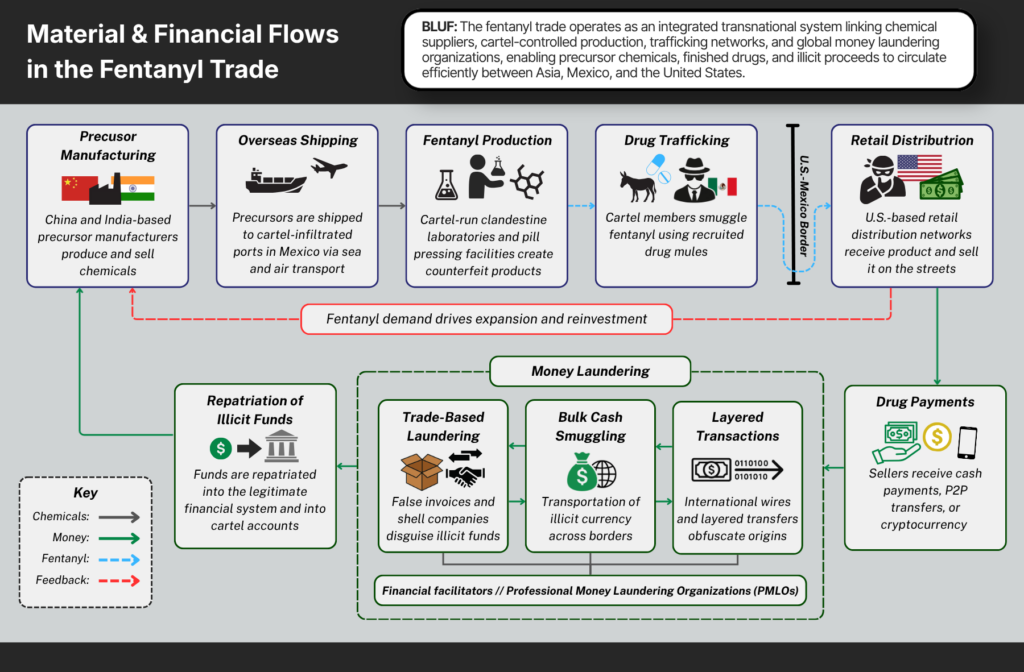
Sources: Financial Crimes Enforcement Network, “Fentanyl-Related Illicit Finance: 2024 Threat Pattern & Trend Information,” April 2025; Graphic created by Noah Harvey.
Conclusion
The record thus far suggests that supply-side enforcement tends to displace—but not eliminate—illicit supply chains. When authorities target one node, drug traffickers are likely to reconfigure their operations by shifting suppliers, adapting manufacturing techniques, and adopting new smuggling methods. As long as the fentanyl trade remains lucrative, illicit actors will almost always find a way to adapt.
Ultimately, market forces are what sustain the feedback loop driving the fentanyl crisis. Even if the Trump administration were to somehow eradicate the illicit supply chain, the unmet demand for narcotics within the United States may create a vacuum for a new synthetic opioid to emerge, such as nitazenes—an emerging chemically distinct compound up to 40 times stronger than fentanyl. Demand-focused solutions generally receive less high-level attention in Washington, yet prevention and treatment could help reduce the desire for fentanyl while simultaneously curtailing the profitability of the illicit trade entirely.
Still, demand-side strategies are hardly the silver bullet some claim. Today, illicit drugs are a persistent challenge in American society, and any effective solution must consider both the internal and external drivers fueling the crisis. Accordingly, an interagency task force uniting enforcement and public health elements with a specific counter-fentanyl mandate would help sustain the decline of overdose deaths in the United States. Only by addressing the problem across multiple domains can policymakers hope to disrupt the adaptive networks that underpin the fentanyl supply chain.
Views expressed are the author’s own and do not represent the views of GSSR, Georgetown University, or any other entity. Image Credit: NBC News