A War Not-So Forgotten: How External Powers Continue to Prolong Sudan’s Civil War
What began in April 2023 as a power struggle between two generals over control of Sudan’s security sector has edged toward a full-scale regional conflict. The Sudanese Armed Forces (SAF), led by Abdel Fattah al-Burhan, and the Rapid Support Forces (RSF) under Mohamed Hamdan Dagalo (known as Hemedti) are not fighting this war alone. External actors, each pursuing their own strategic interests in the geopolitically significant country, have transformed the conflict into a military stalemate and de facto partition. Sudan’s civilians bear the brunt of this escalation, and as the conflict prolongs it threatens to spill over an already fragile Horn of Africa region.
External involvement extends combatants’ military capacity—dragging out the war—and exacerbates diplomatic deadlock. Gulf states are supplying drones and advanced weapons to opposite sides; Saudi Arabia backs the SAF, while the United Arab Emirates (UAE) backs the RSF. Neighboring states—including Egypt, Chad, Ethiopia, Kenya, Uganda, Libya, and others—provide fighters, weapons, and diplomatic cover to support their party of interest. As an increasing number of states stake a claim in the conflict, so too do their own regional rivals, creating a complex web of interests that become nearly impossible to disentangle through diplomatic means.
The Civilian Toll
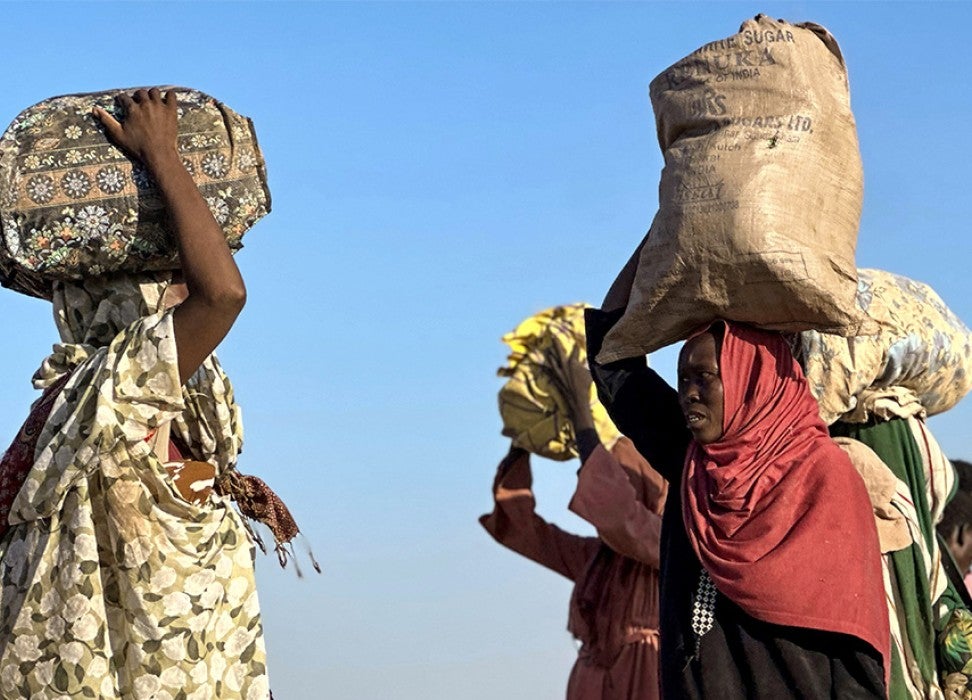
Nearly three years into Sudan’s civil war, the scale of devastation wracking the country is almost impossible to grasp. More than 14 million people—over a quarter of the country’s population— have been displaced, creating the world’s current largest humanitarian and displacement crisis. Twenty-five million people face severe food insecurity as humanitarian aid remains deliberately blocked from entering the country. Acute malnutrition and converging outbreaks of dengue fever, cholera, and malaria are killing children at high rates. The UN has decried the suffering as “1000 days of agony.”
The eighteen-month siege of El Fasher, which concluded in October 2025, produced credible reports of mass executions, sexual violence, and ethnically-based massacres. The atrocities were so extensive that the Yale Humanitarian Research Lab documented blood spatters large enough to be visible using satellite imagery. The conflict has reportedly killed more than 150,000 civilians since it began, and, despite heavy combat losses and limited territorial gains, neither party has shown a genuine willingness to negotiate.
Red Sea Sphere of Influence
Sudan’s abundant natural resources and strategic location help explain why so many outside actors have found reason to intervene. The country sits at the intersection of the Sahel and Horn of Africa regions, with 500 miles of Red Sea coastline setting it just across Saudi Arabia. The UAE, Russia, and China have all expressed interest in developing naval and port facilities at Port Sudan, offering access to increasingly vital Red Sea shipping lanes and the Indian Ocean. The country possesses significant gold and oil reserves and is a major supplier of agricultural products such as gum arabic and sesame seeds on the global market. For regional powers vying for influence over strategic chokepoints and resources, Sudan’s future leadership has become too valuable to leave to chance.
The conflict has produced two loose coalitions, each propping up a different side of the war. The SAF is supported by Egypt, Eritrea, Iran, Saudi Arabia, Turkey, and Qatar. Saudi Arabia, Egypt, Turkey, and Qatar consider the SAF the more legitimate of the two forces and are wary of promoting a rogue military group. These states believe the SAF will facilitate the status quo, preserving their strategic and economic interests in spite of increasing UAE influence in the region.
On the other hand, the UAE is the primary supporter of the RSF, using Chad’s Amdjarass airport as a hub to funnel weapons and supplies to Hemedti’s forces. The RSF also receives backing from Libya, Ethiopia, Kenya, and Russia’s paramilitary Africa Corps (formerly known as the Wagner Group). The RSF attracts more support from states that seek to overturn the country’s political order, focused on limiting the influence of Islamist political forces from the former al-Bashir regime. Other backers are motivated by countering their rivals, like Ethiopia and Eritrea.
Russia and China have advanced their interests by offering material support to both sides. Russia, true to form, has hedged its bets by working with both combatants in pursuit of a naval basing agreement at Port Sudan. As per its traditional policy for African conflicts, China has maintained a stance of neutrality. This official position is complicated by the sale of Chinese-manufactured weapons by third parties to both the SAF and RSF, which serves to benefit China’s economic interests in the country. While most foreign actors publicly call for peace, their private dealings reveal deeper ambitions—and their preferred outcome for Sudan’s future governance.
The Gulf Proxy
The most consequential external dynamic in Sudan’s war has been the rivalry between Saudi Arabia and the UAE stemming from competing claims to regional hegemony. The two Gulf powers have repeatedly found themselves on opposite sides of regional conflicts, notably in Yemen’s separatist war, where Saudi Arabia supports the internationally recognized government while the UAE provides support to southern secessionists. Efforts by both countries to extend their influence into the Horn of Africa have also fueled existing tensions between Somalia and Somaliland, and Eritrea and Ethiopia.
The UAE supports the RSF for both political influence and resource advantage. In Sudan’s conflict, multiple human rights groups have found credible evidence of the UAE violating international arms embargoes by supplying the RSF with advanced U.S. and Chinese weaponry. In return, the RSF funds its operations through extensive gold exports to Abu Dhabi. Since the start of the war, it is estimated that over 90% of Sudan’s gold exports have gone to Dubai. However, the UAE’s declared imports from Sudan routinely exceed the country’s official exports. Neighboring states’ gold exports, such as Kenya, Chad, Libya, and Ethiopia, have risen significantly during the war, suggesting that much of the product has been smuggled or channeled through illicit networks. Beyond access to gold, the RSF has also reportedly promised to reestablish contracts for the UAE to develop Port Sudan. The UAE also supports the RSF’s exclusion of Islamist actors from governance—a stance Emirati officials consider a red line for negotiations.
Saudi Arabia has increased material support to the SAF as the UAE-RSF alignment has intensified. Riyadh has similarly procured more advanced arms for the SAF, including reportedly underwriting weapons purchases from Pakistan. As part of Vision 2030, Saudi Arabia seeks to develop its Red Sea coastline into a tourist and trade hub while diverting some international oil exports away from the Strait of Hormuz. From this perspective, Saudi Arabia sees the SAF as a more stabilizing force for the region, and Riyadh rejects efforts by the RSF to fracture the country via parallel government structures. The SAF’s coalition includes several Islamist political factions and militias, a complicated stance for Saudi Arabia that has designated the Muslim Brotherhood as a foreign terrorist organization and banned Islamist parties from its own domestic politics. In Sudan’s case, it seems Riyadh has worked to balance these inconsistencies by condemning Islamist militant groups but tolerating their role in politics, in contrast to the UAE’s zero-tolerance stance.
Ironically, the UAE and Saudi Arabia have both promoted themselves as peacemakers for this conflict. First, Riyadh and Abu Dhabi cooperated to bring parties together in the failed Jeddah talks in 2023. Then, both parties organized rapprochement through the Quad framework—alongside the U.S. and Egypt—in an effort to mediate an end to the conflict. The group’s declaration in September 2025 that “an end to external military support is essential to ending the conflict” sparked some temporary optimism that all parties would cease support for combatants. However, outside military support has only intensified this year, and Saudi-UAE tensions behind the scenes have only grown as a de facto partition takes shape in Sudan. As long as Sudan’s belligerents continue to enjoy well-resourced patrons willing to bankroll the conflict, neither side has a compelling incentive to negotiate seriously.
Neighbors with Interests
The regional picture is no less complicated. Egypt remains the SAF’s most committed backer, driven by deep military ties, anxiety around growing influence of the UAE in the region, and concerns over refugee flows and conflict spillover. Cairo has provided covert basing for SAF drone operations, and Egyptian pilots have allegedly flown missions against RSF convoys and weapons shipments. The SAF and Egypt’s military leadership have a longstanding military relationship and share regional interests, including cooperation on Ethiopia’s Grand Ethiopian Renaissance Dam (GERD), which both countries view as a threat to their access to the Nile. Egypt has also absorbed more than one million Sudanese refugees since the start of the conflict and sees the continuation of the war as a direct threat to its national security and broader regional stability.
Chad has supported the RSF by serving as a hub for weapons, but as the conflict escalates this alliance has become increasingly untenable. Since the start of the war, Chad’s Amdjarass airport has served as a key UAE weapons transfer hub to the RSF. The brutal fighting has also driven nearly one million refugees into Chad, despite the country facing its own internal conflict and limited state capacity. The RSF’s targeting of the Zaghawa ethnic group in Darfur raises the risk of military intervention by Chad, as its government is dominated by Zaghawa coethnics. The conflict has also expanded into Chadian territory; in March 2026, a drone strike originating from Sudan killed 17 people attending a funeral in Chad, prompting Chad’s President Deby to promise retaliation.
Ethiopia has become increasingly involved in the conflict in recent years. Like Egypt and Chad, it has absorbed refugee flows from Sudan and South Sudan, straining its already limited capacity in the aftermath of its own civil war. Ethiopia has also provided safe haven for RSF training within its borders. The support stems in part as a counterweight to Egypt’s support of the SAF, in addition to the SAF’s support for Ethiopian paramilitary groups like the Tigray People’s Liberation Front (TPLF). Some analysts speculate that the RSF has, in return, promised concessions related to Ethiopia on the GERD, positioning itself as an ally against Egypt-SAF alignment.
Ethiopia and Kenya, both supporters of the RSF, have published quarterly gold production figures double those of the previous year. These figures suggest that both countries may be serving as conduits for RSF-linked gold networks sustaining the war. While Kenya has not provided official military support, it has offered significant diplomatic cover and legitimacy to the RSF. In September 2025, the RSF announced its parallel government structure at a ceremony in Nairobi, and reports indicate that Kenya has issued diplomatic passports to RSF leaders—despite them being implicated in genocide—sparking widespread outrage among civil society and human rights groups in the country.
When Sudan Fractures, So Does the Horn
The humanitarian spillover from Sudan’s war is already severe and worsening. The displacement crisis is especially concerning given the fragility of Sudan’s neighbors; Chad, South Sudan, the Central African Republic, and Ethiopia are absorbing refugee flows they do not have the capacity to manage. The international response to the crisis has been abysmal: the UN’s $900 million appeal for assistance to Sudan’s displaced population remains funded at about 21% as of 2026. The Trump administration’s closure of USAID, previously one of Sudan’s largest donors, has also been devastating to the humanitarian response, contributing to the vacuum in funding for health and nutrition assistance.
The opportunity for expansion of extremist groups created by Sudan’s collapse is another serious concern. Reports indicate that both the Islamic State and al-Qaeda have urged fighters to join the conflict in Sudan in an effort to re-establish or create new strongholds in the region. The combination of external involvement from the Gulf and minimal intervention to end the Sudanese people’s suffering have contributed to a vast, displaced, and disillusioned population, creating fertile recruiting ground for extremist networks. Sudan’s strategic position bridging militant networks in the Sahel and the Horn of Africa also makes it an ideal crossroads for linking transnational crime syndicates, terrorist organizations, and other armed groups seeking access to ungoverned and resource-rich areas.
Even more worrisome is the degree to which Sudan’s war is weaving together conflicts that might otherwise remain separate. Rising tensions between Ethiopia and Eritrea over Red Sea access, Egypt’s dispute with Ethiopia over the GERD, and the ongoing standoff between Somalia and Somaliland all might be exacerbated by the influx of weapons, fighters, and funding from Sudan’s conflict. Sudan’s war has even been touched by the Russia-Ukraine conflict, with Ukraine providing drones to the SAF to counter the Africa Corp’s support of the RSF. The Horn’s many pre-existing fault lines are being destabilized by the overlapping patron networks sustaining Sudan’s war. Some analysts warn that if Sudan’s crisis continues, it could devolve into a regional “megawar,” akin to Africa’s World War in the 1990s.
No One’s Peace Plan Is Actually About Peace
Diplomatic efforts to resolve the conflict thus far stalled. The country is effectively partitioned, with the RSF establishing a parallel government in the west and the SAF controlling most of the east. So what might break this diplomatic deadlock?
The most destabilizing factor remains the continued flow of external arms to belligerents. Successive Biden and Trump administrations have failed to exert meaningful pressure on Abu Dhabi or Riyadh for their ongoing support, prioritizing their relationship with the Gulf States to drive stability in the Middle East. President Trump’s Senior Advisor on Africa, Massad Boulos, restarted negotiations on Sudan via the Quad format in February 2026, but it remains to be seen if the reported humanitarian truce will hold. Recent sanctions by the U.S. Treasury against Hemedti and several of his Emirates-based holding companies that sustain the flow of weapons are also a welcome step to undermining these funding streams, though much more multilateral work could be done. The crisis in the Strait of Hormuz might push Gulf states to refocus on their own security rather than channeling resources to Sudan.
The African Union (AU), meanwhile, has shown little initiative to lead negotiations to end this war. In response to the RSF’s declaration of a parallel government, the AU issued a statement calling on African states to refuse to recognize a fragmented Sudan. This was a strong statement of rebuke, but throughout the conflict the AU has struggled to translate condemnation into collective action from its membership to address the crisis. A credible AU-led process, insulated from the veto power of regional patrons, could provide a more durable diplomatic framework. However, as more African states become entangled in the war financially, militarily, and diplomatically, it will become increasingly difficult to produce acceptable mediators.
Perhaps most important to restoring long-term peace to Sudan will be to elevate the country’s civilian pro-democracy movement, which has been consistently sidelined and undermined by military actors. In 2018, the movement overthrew President Omar al-Bashir’s regime, but the country’s democratic transition has been derailed by persistent military intervention and revanchist forces. Throughout the war, Sudan’s pro-democracy movement has organized emergency response networks, aid distribution systems, and continued to plan for a future transitional government. Largely relegated to observing peace negotiations, the civilian movements’ work to build an inclusive government transition and resolve internal disagreements merit greater attention from international actors.
Views expressed are the author’s own and do not represent the views of GSSR, Georgetown University, or any other entity. Image Credit: OHCHR