David vs. Goliath: How Emerging Technology Allows Small Powers to Effectively Combat Great Powers
High Cost ≠ High Quality
The Iranian Shahed-136 drone, a one-way attack drone, costs between $20-50,000. The cost of one Patriot interceptor, used by the United States, costs $4 million. The return on investment of utilizing expensive, advanced counter-drone technology is cumbersome, especially as small and medium powers, like Ukraine, are increasingly employing commercial drones with basic, yet lethal, modifications on the warfront.
The age of staggering, multi-million-dollar weapons systems on the battlefield is coming to an end. Across the shattered cities of Ukraine and the jagged mountains of Iran, a profound shift in warfare is being driven by commercially available drones. These drones cost as little as a few hundred dollars, at most, and are available on virtual storefronts such as Amazon. The rapid proliferation of low-cost unmanned aerial vehicles (UAVs) has, and will continue, to alter the calculus of military power, further enabling medium and lower-power state and non-state actors to effectively contest, harass, and effectively defeat their adversaries without employing sophisticated conventional advantages.
Reshaping the Balance
For most of contemporary military history, technological superiority has been synonymous with superiority writ large. Great powers like the United States, Russia, or the People’s Republic of China (PRC), have built their strategic edge and found battlefront victories by the utilization of cutting-edge and expensive technologies: aircraft carriers, ever-evolving generations of fighter jets, precision-guided cruise missiles. These systems have been largely inaccessible to smaller or medium powers, given their astonishing price, the amount of specialization necessary to operate said equipment, and their overt sophistication. Historically, the side that could field the most expensive and most advanced hardware was often bound to dominate on the battlefield. As a result, the size of defense budgets became the primary indicator of battlefield success.
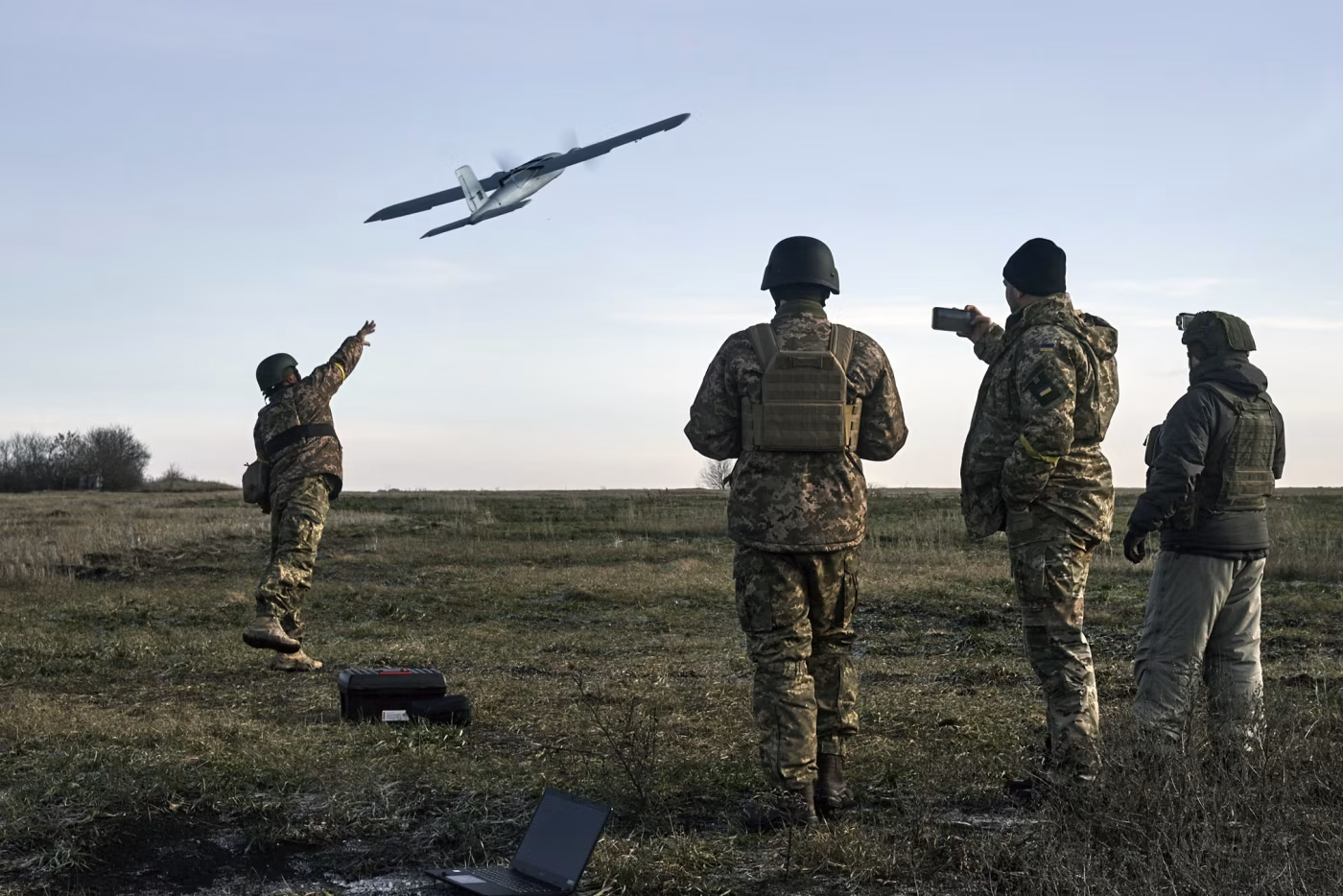
Low-cost UAVs have completely rebalanced this equation. At $20,000-$50,000 per unit, the Sahed-136 is favored by Russia and reverse-engineered by Iran. Its cost pales in comparison to the Patriot interceptor used to destroy them. As a response to Russian forces, Ukraine has deployed commercial-grade first-person view (FPV) racing drones converted into precision guided munitions, costing (per unit) around $400-$1000. This case proves that when a $400 drone destroys a $4 million tank, military power is turned upside down.
To-to-Toe With Goliath: Ukraine’s Success in Russia
There is no conflict in recent history that has demonstrated the battlefield utility of low-cost UAVs more effectively than the war in Ukraine. Since Russia’s invasion in February 2022, both Ukraine and Russia have employed drones at an unprecedented scale in conventional interstate war. In just March, Ukraine claims to have shot down 33,000 Russian drones, proving that despite being outmatched in conventional munitions and manpower, UAVs are a meaningful compensation. Low-cost UAVs have emerged as an effective, and now primary weapon system.
Ukrainian forces rapidly developed a multi-tiered drone structure to combat Russian forces. Commercial DJI quadcopters were initially modified for reconnaissance, which allowed for commanders to observe enemy positions in real time, a capability that was once reserved for great powers to conduct advanced intelligence, surveillance, and reconnaissance (ISR) by divisional-level intelligence assets. FPV drones were adapted to carry RPG warheads or grenades, and used to strike armored vehicles, crew-served weapons, and personnel with terrifyingly incredible precision. Larger, fixed-wing systems like the Ukrainian designed Punisher and Bober (Beaver) have struck Russian logistics nodes, ammunition depots, and command posts deep within occupied territory.
By 2023 and into 2024, Ukraine began executing long-range drone strikes on Russian territory, targeting critical infrastructure. It struck oil refineries, military airfields, and radar installations. These missions were carried out by long-endurance UAVs, and demonstrated that a nation historically without a long-range missile capability could effectively project force onto one of history’s greatest world powers. These strikes, and Ukraine’s subsequent success, has impacted Russian military and civilian morale, and has significantly disrupted fuel and logistics.
Russia has used Iranian-supplied Shahed loitering munitions to attack Ukrainian critical infrastructure. It has attacked Ukraine’s electrical substations and heating plants in an effort to destroy civilian morale through the winter months. The effectiveness of this campaign, and the staggering cost Ukraine and its allies have borne to intercept it, has underscored the disproportionate cost-exchange that drones impose on the defender.
Acting with Precision
The Ukrainian case demonstrates not just the utility of drones, but the accessibility . The components for a functional FPV attack drone, such as motors, flight controllers, or video transmitters, are sourced from the global commercial market. The PRC firm, DJI, has originally dominated the supply chain and shaped the “drone divide,”making the underlying technology necessary to act as force multipliers widely available. Ukrainian volunteer networks and nonprofit organizations, civil technology organizations, and crowdfunding campaigns have produced hundreds of thousands of FPV drones. There are no longer existing barriers to entry for precision strike capabilities across any emerging battlefield.
This democratization has significant implications for non-state actors and asymmetric conflicts globally. Low-cost UAVs are employed across many conflicts in the Middle East. Hezbollah, Hamas, the Houthis, as well as militia groups in Iraq and Syria have all been employed with commercial or low cost UAVs. Beginning in late 2023, the Houthi campaign against Red Sea shipping has had substantial geopolitical consequences. It has operated with a fraction of the military budget of any conventional navy, yet has succeeded in disrupting one of the world’s busiest maritime trade routes, rerouting container shipping and causing significant delays in global trade. This conflict, too, has shown that great-power military capabilities no longer guarantee protection from serious conflicts or threats. Technologically unsophisticated adversaries have utilized low-cost technologies as force multipliers and have used drones as the great equalizer.
The Human and Its Innovation
The Ukrainian case also illuminates the critical role of decentralized tactical innovation. The Ukrainian military fielded its drone capability through a chaotic, organic ecosystem of frontline soldiers, innovative civilian engineers, determined volunteer organizations, and vast diaspora networks. Drone operators have developed new techniques in merely weeks, rather than years that conventional military acquisition cycles require. When Russian forces began to fit their tanks with “turtle shell” steel cage armor to defeat Ukrainian FPV drones, Ukrainian operators adapted within days, developing modified munitions.
This adaptation cycle has proven to be just as important as the technology itself. It requires a fast-paced, ever-evolving military culture that empowers junior leaders and accepts failure in return for rapid learning. For many conventional militaries, this is unthinkable. Great powers accustomed to rigid procurement hierarchies, doctrine review processes spanning across years, and bureaucratic challenges leading to further delays are ill-suited for the innovation that technological advancement requires. This dynamic highlights an enduring institutional challenge as much as a technological one.
Shifting Doctrine
The evidence from Ukraine demands serious reconsideration of military investment priorities. Defense establishments globally, especially those of great powers, continue to concentrate their resources exclusively in exquisite, high-cost platforms that risk strategic obsolescence. Several doctrinal imperatives arise:
- Cost-exchange ratios must become a primary design criterion. A weapons system is only strategically viable if the cost of its employment does not exceed the cost of its defeat. If it does, military effectiveness is lost.
- Drone mass matters, especially as Ukraine’s most effective drone operations have relied on both individual precision strikes and volume. Quantity, paired with acceptable quality, is an effective force multiplier.
- Institutional attention is necessary. FPV drones are consumable munitions, rather than reusable platforms. Robust domestic manufacturing, simplified supply chains, and training pipelines are required to produce drone operators faster than they are lost.
Looking into the Future
The United States is playing catch-up in the race to use commercially available, low-cost UAVs. The United States has used the conflict with Ukraine as a “lessons learned” case, proving the necessity for low-cost weapons in the face of its ongoing conflict with Iran. For the first time in U.S. history, the Department of War has confirmed that its forces have utilized LUCAS one-way attack drones against Iranian targets, further highlighting recognition of the urgency to shift to low-cost UAVs in conflict.
Great powers will likely continue to employ low-cost UAVs in conflicts against small-to-medium powers that utilize commercially available munitions. The Russia-Ukraine war painted a very alarming picture for great powers like the United States and the PRC, and as conflicts continue, they must adapt to maximize military effectiveness.
Views expressed are the author’s own and do not represent the views of GSSR, Georgetown University, or any other entity. Image Credit: Wall Street Journal / Libkos / Associated Press