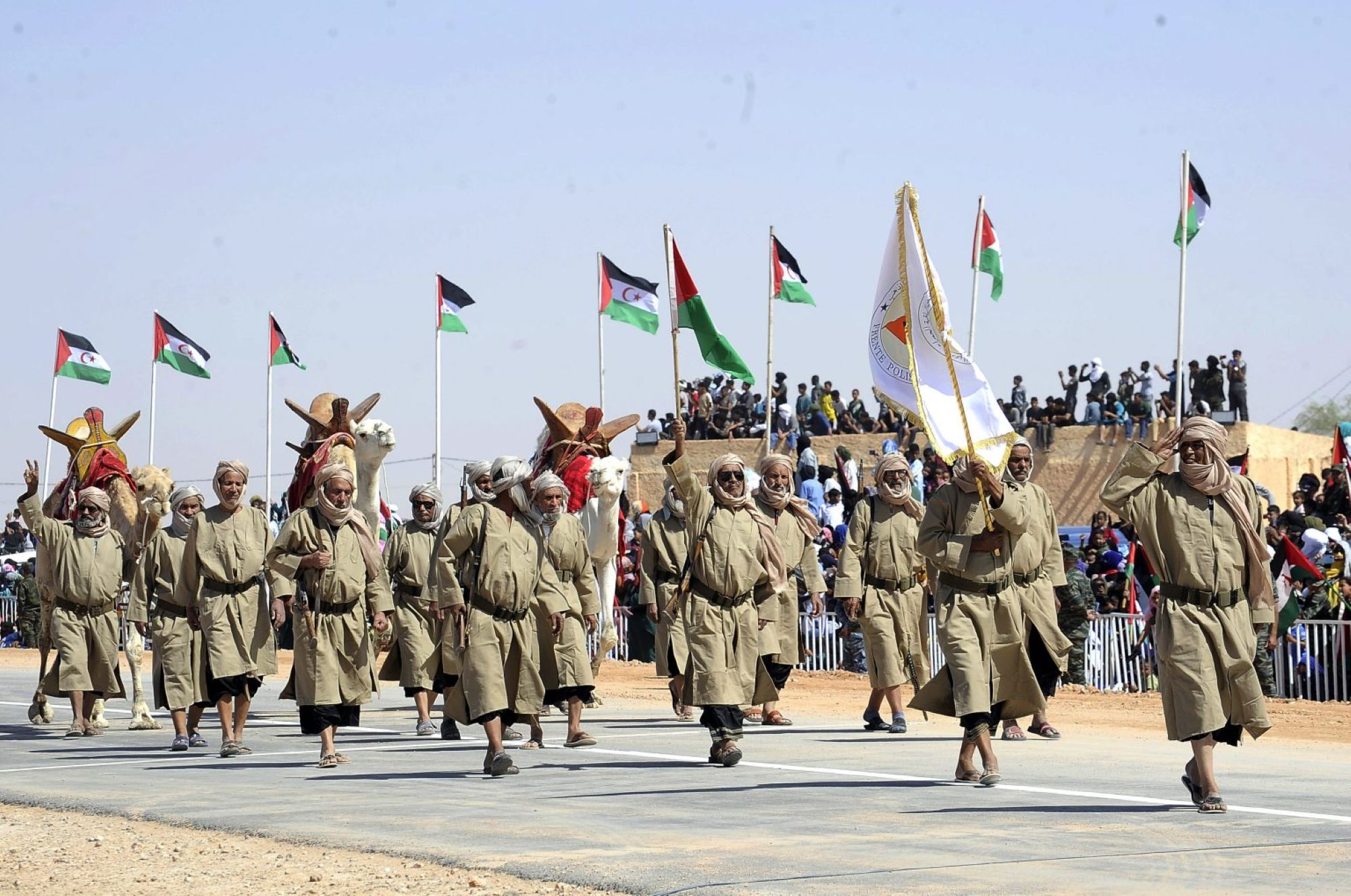
Blind to the Berm: Western Sahara, Morocco, and the World’s Quiet Abandonment of Self-Determination
In January 1981, Morocco began constructing what the Sahrawi people would call the “Wall of Shame.” The Moroccan Western Sahara Wall now stands as both the longest operational military barrier and the longest continuous minefield in the world. This sand berm, and the conflict surrounding it, receives little international attention despite the consequential precedent the international community is setting in its approach to the dispute. In October 2025, the United Nations Security Council (UNSC) formally designated Morocco’s Autonomy Proposal as the preferred foundation for peace in Western Sahara, redefining the institution’s historical approach to self-determination for the Sahrawi people. Despite an active insurgency vying for independence and legal precedent contradicting Morocco’s sovereignty over the region, Morocco has leveraged weak international institutions and the decline of post-Cold War liberalism to incrementally manufacture legitimacy for its control over Western Sahara. The conflict highlights how the international community has shifted from selectively enforcing liberal principles to actively redefining them, undermining the legitimacy of international institutions and creating a destabilizing precedent for territorial dispute resolution.
Competing Narratives for Self-Determination
The decolonization of Western Sahara, rather than resulting in an exercise of self-determination, created a regional struggle for control between the native Sahrawi peoples, Spain, Morocco, Mauritania, and Algeria. Spain first colonized land within modern Western Sahara in 1884, eventually integrating the territory as a province within Spanish Sahara in 1958. In 1965, the United Nations (UN) called upon Spain to decolonize the territory in accordance with the Declaration on the Granting of Independence to Colonial Countries and Peoples of 1960. In 1966, Resolution 2229 (XXI) of the UN General Assembly approved the governments of Morocco and Mauritania to serve as consultants in the decolonization efforts and subsequent self-determination referendum per Special Committee recommendations. Years of bureaucratic negotiations and delays resulted in Sahrawi pro-Independence demonstrations in 1972 and the 1973 formation of the Sahrawi Frente Popular de Liberación de Saguía el Hamra y Río de Oro (Polisario Front), fighting for Western Sahara’s independence. Special Committee reports from the time highlight Morocco’s and Mauritania’s competing claims for authority over Spanish Sahara, with Algeria advocating for indigenous self-determination. Spain made little progress in formally decolonizing Spanish Sahara until 1975.
Morocco’s commitment to act on its claims in Western Sahara changed Spain’s calculus in offloading the colony and launched a decades-long campaign to alter the definition of self-determination. Spain held its first census on the territory in December 1974 in preparation for a planned self-determination referendum, which it announced to take place during the first half of 1975. In October 1975, due to months of delays in negotiation between Spain and Western Sahara’s neighbors, the International Court of Justice issued an advisory opinion on the legal status of Spanish Sahara, concluding that preexisting ties between native Sahrawi tribes and Morocco/Mauritania did not constitute a reasonable basis for either state to assume territorial sovereignty. Three weeks later, the Moroccan government organized a relocation of approximately 350,000 Moroccan civilians into Western Sahara called the “Green March,” aiming to maximize Morocco’s leverage in negotiations with Spain over the territory by increasing its de facto land ownership and diluting the political power of indigenous Sahrawis. The UN Security Council (UNSC) unanimously condemned Morocco’s actions, however, Spain relinquished the colony a week later by splitting administrative authority between Morocco and Mauritania through the Madrid Accords. On February 27, 1976, one day after Spain completed its withdrawal, the Polisario Front declared its independence as the “Sahrawi Arab Democratic Republic” (SADR).
Throughout the 1980s and 1990s, the narrative for SADR independence appeared to be gaining traction. In August 1979, Mauritania recalled its claims in Western Sahara and withdrew its forces from the territory after signing the 1979 Algiers Agreement with the Polisario Front, committing both sides to a respect toward each other’s sovereignty. In 1982, the Organisation of African Unity (OAU), a precursor to the African Union, accepted the SADR as an official member state, affirming its rights to sovereignty and non-interference from other states. In June 1990, the UNSC adopted the UN Secretary General’s proposal aimed at finally settling the status of Western Sahara, establishing a ceasefire between the Polisario Front and Morocco and again pushing for a self-determination referendum. Resolution 690 (1991) of the Security Council established the UN Mission for the Referendum in Western Sahara (MINURSO) to implement the Secretary General’s plan, including the enforcement of the ceasefire and the organization of the referendum.
Morocco’s persistent defiance of the international community’s normalization of the SADR’s independence acted as a significant obstacle to self-determination for the Sahrawi people in Western Sahara. Despite accepting the “Settlement Proposals,” which served as a basis for the UN Secretary General’s 1990 peace plan, Morocco rejected the use of the Spanish 1974 census as the basis for voter identification and prolonged negotiations over which tribes should be able participate in a self-determination referendum. The Polisario Front, concerned about Morocco’s intention of including 100,000 Moroccan settlers in the referendum, withdrew from the voter identification process in 1995. Three subsequent peace agreements, the 1997 Houston Accords, the 2001 Baker I Plan, and the 2003 Baker II Plan, each failed due to disagreements about whose votes should count in a referendum and what options voters should be presented: full independence, local autonomy under Moroccan control, or complete integration with Morocco. The Moroccan government argued that a Western Sahara province under Moroccan control with local autonomy could fulfill the right to self-determination, rejecting the notion of an independent state.
Failing to win authority over the territory based on its historical connections, Morocco securitized its argument for the ownership of Western Sahara by claiming that it is the only actor capable of stamping out violent extremism manifested as the Polisario Front. The Polisario Front, much of which resides in refugee camps in Tindouf, Algeria, allegedly receives backing from the Algerian and Iranian governments to destabilize the region counter to Moroccan, European, and U.S. interests. Calls for the United States to designate the Polisario Front as a Foreign Terrorist Organization have grown due to the group’s ties to other extremist organizations like the Islamic State, Hezbollah, and the IRGC. This conflict reframing has benefitted Morocco, allowing it to leverage the world’s prioritization of the Global War on Terror to reshape the international community’s perspective and redefine self-determination.
Redefining Self-Determination
After decades of heated negotiations, renewed fighting has led the international community to abandon the possibility of an independent SADR in Western Sahara. Between 2007 and 2020, efforts to identify a comprehensive resolution between the Moroccan government and the Polisario Front were futile. Following an escalation in 2020 around Guerguerat, a village in east Western Sahara, both the Polisario Front and the Moroccan government withdrew from their almost 30-year ceasefire. One month later, the United States officially recognized Morocco’s sovereignty over Western Sahara in return for Morocco’s normalization of ties with Israel. Since then, international recognition of the SADR as an independent state has continued to plummet from over 80 countries at its peak to now around 40. In October 2025, the UNSC voted 11-0 (with 3 abstentions) on Resolution 2797 (2025) in favor of using Morocco’s Autonomy Proposal as the baseline plan for future negotiations, admitting a turning point in the international community’s understanding of Sahrawi self-determination.
Whereas traditional conceptions of post-colonial self-determination sparked the potential referendum for the Sahrawi people to pursue independence, the international community has now accepted an alternative: an integration into a more powerful state with the expectation of local autonomy. Self-determination is a malleable concept in international law; Morocco argues that the Sahrawis’ right to self-determination can be fulfilled through the election of local authorities. The 1975 International Court of Justice (ICJ) advisory opinion argued that, consistent with General Assembly Resolution 1514, they have the right to pursue independence because they are a post-colonial people. Morocco’s persistence in undermining the ICJ’s ruling has incrementally shifted the world’s opinion in their favor, finally resulting in new precedent identifying states as the true distributors of self-determination rather than the international community.
Many argue that the dispute over Western Sahara is nothing more than emblematic of the international community’s hypocrisy as exhibited around the world since the UN’s founding. Conflicts over the past 80 years have contradicted the efficacy and the ethical consistency of multilateral institutions like the UN due both to institutional dysfunction and member states’ unwillingness to enforce their supposed authority. Catastrophic territorial disputes around the world have received lackluster responses from the UN in cases where a permanent member of the Security Council holds significant interest. The veto power of the five permanent members of the UNSC makes it virtually impossible to implement comprehensive peacebuilding initiatives in geopolitically contested states or to effectively punish violations of the UN charter. UN General Assembly resolutions, while serving as a valuable mechanism for reducing information failure in the geopolitical environment, rarely include enforceable frameworks for peace.
Resolution 2797 signifies a turning point in international politics because, rather than merely failing to enforce the UN principles, the international community is actively rewriting them. Most past conflicts perceived as major failures of the international community include an actor working unilaterally, with multilateral institutions failing to respond or doing so ineffectively. For example, Russia’s annexation of Crimea only received institutional condemnation in Resolution 68/262 (2014). Likewise, the UNSC condemned the expansion of Israeli settlements in the West Bank in Resolution 2334 (2016), though stopped at authorizing a peacekeeping mission or military intervention. While the UNSC did assign administrative responsibilities to the United States during its questionable occupation of Iraq in Resolution 1483, it stopped short of endorsing the invasion or dictating any one state’s plan for a new government.
Resolution 2797’s push for Morocco’s Autonomy Proposal illustrates that the international community is now comfortable adjusting UN principles in pursuit of a fragile peace, if that peace fits within the framework of state primacy. Rather than simply enduring global realist ambitions with ineffective condemnations and unenforceable resolutions, the UN is now changing its principles to pursue favorable outcomes for states. This precedent threatens to deteriorate not just the principle of self-determination, but also others like territorial sovereignty, the pacific settlement of disputes, and respect for international institutions’ authority.
The Future of Western Sahara and the International Order
While one may concede that Morocco’s Autonomy Proposal is the most feasible framework for lasting peace in Western Sahara, it comes at the cost of delegitimizing international institutions and at the risk of escalating the Polisario Front’s insurgency, potentially heightening tensions between Morocco and Algeria. Morocco has altered the ethnic makeup of Western Sahara to the point that most of the residents are already culturally Moroccan, reducing the friction of establishing limited authority over the territory. There is a small chance that, like the Baker II Plan, the UNSC’s endorsement of Morocco’s Autonomy Proposal or of any other peace plan will remain fluid. However, the consequences for accepting the Baker II Plan were few in comparison to Morocco’s Autonomy Proposal; the Baker II Plan provided for a potential process by which to establish a new state, while Morocco’s Autonomy Proposal legitimizes Morocco’s authority over the territory and thereby increases the political cost of future intervention due to sovereignty concerns.
This new conception of self-determination may be further applied to other territorial disputes around the world, likely contributing to an increased intensity of conflict. The Trump administration has hinted in the past that Ukraine would need to exchange its territory for an end to its war with Russia, potentially subjecting Ukrainians who prefer living under the Ukrainian government to a new Russian administration. Considering continuous expansion of Israeli settlements in the West Bank and the Israeli occupation of the Golan Heights and southern Lebanon, it is likely that a new standard for self-determination will be used to challenge the status quo on recognized Israeli territory. Recent U.S. intervention in Venezuela may provide for a reapplication of this strategy in the Guyana-Venezuela dispute over the Essequibo region, though Guyana’s friendly disposition toward the United States might preserve its territorial sovereignty. Because the right to self-determination, as perceived by multilateral institutions, has now deteriorated to become associated with states’ interests, aggressor states are less likely to compromise to achieve sustainable peace.
As the multi-polar world reemerges, UN principles are likely to continue evolving. Great power competition mandates an acceptance of the anarchical system, where members of the international community will only commit themselves to principles which are in their interests. This trend will continue to threaten UN legitimacy and will further erode its guiding principles. Despite a history of unfair and inconsistent application, these principles have provided guardrails that reduce the likelihood and intensity of conflict. As argued by Matias Spektor, the world may come to miss the hypocrisy of international institutions led by the West if the values which drove them fail to survive.
The rise of a coalition of middle powers could serve to defend the international community’s principles from great power competition by uniting middle powers behind the necessity of diplomatic principles for self-preservation. As world powers vie for influence throughout the world, they will be forced to compete over spheres of influence by calculating for the interests of less powerful states. Unlike the Cold War period, where power competition drove global conflict as world powers supported regime change in contested states, a modern coalition of middle powers could incentivize more diplomatic behavior from world powers due to the increased difficulty of clandestine activities and the growth of economic interconnectedness.
Views expressed are the author’s own and do not represent the views of GSSR, Georgetown University, or any other entity. Image Credit: Atlantic Council