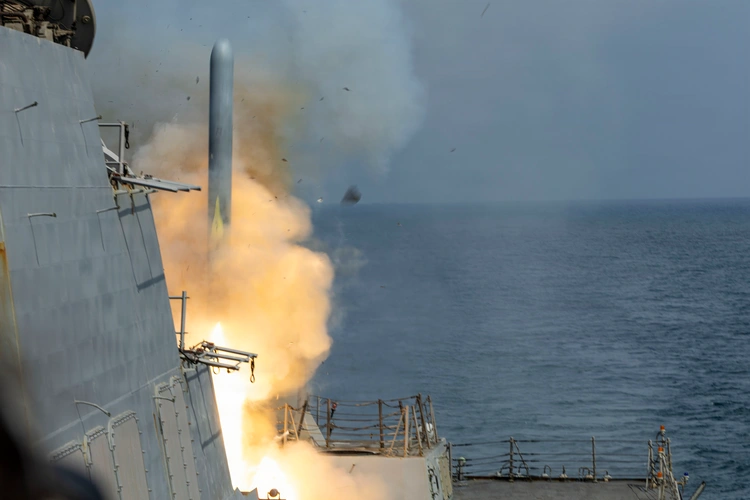
Operation Epic Fury and the Tomahawk Shortage: A Supply Chain Warning for a China-Taiwan Contingency
Tomahawk Land Attack Missiles are one of the U.S. Navy’s most reliable tools for delivering long-range, precision strikes from ships and submarines, often serving as the first option in high-intensity conflict. However, the United States faces a near-term Tomahawk missile stockpile gap that risks eroding deterrence in the Indo-Pacific at a pivotal moment, just one year before the Davidson Window, when the People’s Republic of China (PRC) is assessed to have its most favorable conditions to move against Taiwan. The 850+ missiles expended in Operation Epic Fury are unlikely to be replenished quickly under current production levels—roughly 90 missiles annually—which remain constrained by single-source dependencies and critical mineral shortages. While the Department of the Navy’s request for a 1,168% increase in procurement reflects necessary long-term investment, it does little to resolve the immediate shortfall, creating a window of vulnerability against a peer adversary like the PRC.
Operation Epic Fury Highlights the Demand for Tomahawks in Distributed Strike Operations
According to the Center for Strategic and International Studies, “The 850 Tomahawks launched in Operation Epic Fury are the most fired in a single campaign,” outnumbering Operation Iraqi Freedom (802 Tomahawks), Operation Desert Fox (325), and Operation Desert Storm (288). This surge reflects not only a sharp increase in consumption but a fundamental shift in how Tomahawks are employed.
Rather than being used in short, concentrated bursts, Epic Fury has demonstrated that Tomahawks are increasingly used in sustained, distributed strike operations. Launched from ships and submarines at extended stand-off ranges exceeding 1,000 miles, Tomahawks enable the U.S. to conduct immediate precision strikes in contested environments while minimizing risk to pilots and high-value air assets. This evolution reflects changes in the threat environment: more capable and layered air defense systems, such as those fielded by Iran, including variants of Russian- and Chinese-designed systems and indigenous integrated air defenses, have increased the risks to manned aircraft operating in contested airspace.
These risks are not theoretical. Iranian forces have successfully engaged U.S. aircraft, including the shootdown of an F-15 Strike Eagle that triggered a high-risk personnel recovery operation, and an A-10 that was forced down, with the pilot ejecting only after reaching Kuwaiti airspace. Assessing such risks, U.S. commanders are relying more heavily on survivable, sea-based, long-range strike options to maintain operational tempo without exposing aviators. Therefore, the demand for Tomahawks in contested environments has only increased.
Assessing the Current Supply: Subcomponent Bottlenecks
The current Tomahawk stockpile is estimated to be roughly 3,000 missiles. This topline number, however, obscures a growing readiness problem. As a result of past government decisions to slow, pause, or cancel orders, RTX, the sole manufacturer of Tomahawks, has maintained a minimum production rate of 90 units per year. At this rate, it would take over nine years to replenish the 850+ expenditures from Operation Epic Fury. This level of expenditure represents a meaningful drawdown of available inventory, and if similar consumption rates are required in future contingencies, particularly in a larger and more complex Indo-Pacific theater, demand could quickly outpace both available supply and the rate of replenishment.
Additionally, RTX faces structural supply-chain bottlenecks for the key subcomponents of Tomahawks, specifically solid rocket motors (SRMs) that enable propulsion systems and critical minerals that enable guidance systems. These bottlenecks contribute to nearly 25-month lead times and delays, as these inputs are constrained by foreign or finite supply and a limited pool of specialized subcontractors, creating clear single points of failure that cap production and increase vulnerability to disruption.
However, the Department of War (DoW) has taken significant steps to address long-term supply chain vulnerabilities across the Tomahawk program and its key subcomponents.
Through its new Acquisition Transformation Strategy, the DoW has sought to rebuild the “Arsenal of Freedom” and stabilize demand signals by awarding companies with larger, longer-term contracts for proven systems. This approach is designed to give the industry the confidence to invest in expanding production capacity. In February 2026, the DoW operationalized this strategy by entering an up-to-seven-year contract with RTX to increase Tomahawk production to more than 1,000 per year, a significant increase from the current rate of 90.
To support this effort and to reduce single-source failures, the DoW has also made significant investments in diversifying the industrial base and increasing the scale and speed of SRM and critical minerals production. These initiatives represent a meaningful and necessary shift toward strengthening the industrial base, but they are unlikely to resolve immediate constraints facing Tomahawk production.
Propulsion Bottleneck: SRMs
Northrop Grumman and L3Harris collectively dominate the SRM industrial base, a duopoly shaped by 1990s Pentagon policy that favored sustaining one or two viable firms over a fragmented field of subsidized competitors. Within this already consolidated market, however, L3Harris maintains a de facto monopoly on SRMs specifically manufactured for Tomahawks, creating a thin supply chain with clear production bottlenecks.
To address its vulnerable supply chain, the DoW has deepened its partnership with L3Harris through a $1 billion preferred equity investment in its Missile Solutions business under the Acquisition Transformation Strategy, its first direct-to-supplier arrangement. This approach enables future multi-year procurement agreements (pending congressional approval) while providing the capital to expand production and modernize facilities, including new facilities in Arkansas (expected by 2027) and Virginia (expected by 2031).
However, beyond scaling the dominant supplier, the DoW has incentivized new entrants like Anduril, X-Bow, Ursa Major, Firehawk, and Castelion to enter the SRM market and broaden the supplier base. Anduril has been the first non-traditional to enter the SRM market, receiving $58 million in funding under the Defense Production Act to expand its SRM production and test-firing over 700 SRMs since January 2024, with its annual production projected to be 6,000 SRMs by the end of 2026. X-Bow has been awarded over $250 million across five DoW contracts and has developed and prototyped low-cost SRMs through innovative additive manufacturing processes such as 3-D printing. Ursa Major has secured multiple funding contracts and development contracts for its SRM system, produced on a single production line that reduces workforce requirements, and currently sustains a production rate of 200 SRMs per year. Like Anduril, X-Bow, and Ursa Major, Firehawk and Castelion are also developing SRM solutions. However, despite the influx of new entrants, not all produce SRMs compatible with Tomahawk systems.
In parallel, the DoW has encouraged primes like Lockheed Martin and General Dynamics (neither of which has previously produced SRMs) to enter the market through new strategic partnerships and contracts aimed at adding resilience to the domestic supply chain. These efforts have advanced the joint development of a new SRM supply source, with the General Dynamics Ordnance and Tactical Systems production facility in Arkansas expected to begin qualification builds in 2026.
Complimenting these efforts, RTX’s partnership with Avio to build a new SRM factory (expected in 2028) in Virginia strengthens vertical integration and secures preferential access to constrained production capacity.
Taken together, these investments have the potential to reduce single-point failures, contingent on SRM manufacturers demonstrating effectiveness, production stability, and compatibility with Tomahawks; however, with most capacity not coming online until 2027 or later, near-term shortages will continue to create vulnerabilities.
Guidance Bottleneck: Rare Earth Permanent Magnets
Materials and minerals enable capability, but in the Tomahawk program, they also constrain it. Each missile depends on an estimated 18 critical minerals, from aluminum alloys that provide airframe structural integrity to permanent magnets (REPMs) that power motors, actuators, and guidance electronics, including SRMs, behind its precision. Sustaining production depends on a complex, multi-tiered network of critical minerals suppliers.
This network, however, is not equally distributed. The PRC maintains near-total control over 15 critical minerals, including rare earth elements (REEs), and is weaponizing its dominance. REE supply is among the least diversified globally and is especially critical because its downstream product, REPMs, are essential to the precision of Tomahawk guidance systems. The PRC accounts for roughly 60% of global REE mining and nearly 90% of separating and refining capacity, and is the world’s leading producer of REPMs. This concentration creates a bottleneck and a single point of failure for RTX and its Tomahawk production, which the PRC has exploited.
By imposing targeted export controls on critical minerals, including REPMs, the PRC is deliberately constraining and disrupting the U.S. defense industrial base, reducing manufacturing capacity and slowing production, while simultaneously accelerating its own military buildup in an attempt to gain a relative advantage amid rising Indo-Pacific tensions. This bottleneck and single points of failure create supply chain vulnerabilities that warrant concern.
Experts at the Council for Foreign Relations argue that securing the U.S. critical minerals supply chains requires making domestic innovation the centerpiece of critical minerals strategy, using materials engineering to bypass supply chain choke points, scaling recycling and recovery, closing financing gaps for emerging technologies, and integrating these efforts with allies.
The DoW has begun to operationalize elements of this approach by prioritizing domestic and allied supply chains and expanding refining capacity to reduce reliance on the PRC and ease REPM bottlenecks, including those in Tomahawk guidance systems. In July 2025, it launched “10X,” a public-private partnership with MP Materials Corp., investing $1.25 billion to scale domestic magnet production and recycling, with capacity expected to reach 10,000 metric tons annually by 2028. Further, a November 2025 partnership between the DoW, MP, and Maaden aims to expand refining capacity in Saudi Arabia, leveraging its energy base and infrastructure to diversify supply. These efforts are reinforced by targeted Defense Production Act investments, additional diversification initiatives, including Defense Advanced Research Project Agency-led research and development, and investments in suppliers such as Lynas Rare Earths and ReElement Technologies Corporation.
Beyond investment and capacity expansion, policy tools are also being used to accelerate the shift away from Chinese REPM supply chains. The FY26 National Defense Authorization Act gradually restricts the sourcing of REPMs from covered nations, including the PRC, pushing procurement toward domestic and allied suppliers by 2027. Early indicators suggest positive movement in this direction. According to data released by China’s General Administration of Customs, U.S. imports of REPMS fell to a total of 994 tons in January and February 2026, a 22.5% decline year over year, reflecting the early success of DoW and industry efforts to reduce reliance on Chinese supply chains.
Despite significant progress to diversify the industrial base and accelerate the scale and speed of REPM production and refinement, most domestic and allied capacity will not come online until 2028 or later, creating a lag between decoupling efforts and available supply. As the PRC continues to dominate the market and U.S. reliance on Chinese inputs declines, this transition period introduces new supply chain vulnerabilities and single points of failure. Limited REPM availability will continue to constrain the production of Tomahawk guidance systems, slowing the pace and scale of missile output despite sustained investment.
Why This Matters for Deterrence: Can the Industrial Base Meet the Moment?
The Department of the Navy’s Fiscal Year 2027 request for Tomahawks signals both urgency and risk. According to Pentagon budget materials, the Navy is requesting 1,512 Tomahawks (at an estimated cost of $3 billion), more than the total requested over the past decade. This surge reflects recognition that current stockpiles and production rates are insufficient for the demands of modern conflict, but it also raises a critical question: can the industrial base deliver at the scale and speed required when its most critical inputs, SRMs and REPMs, remain constrained?
This question is made more urgent by the strategic timeline of great power competition with the PRC. A growing body of analysis identifies 2027 as a key inflection point, with U.S. and allied planners assessing that the PRC aims to have the capability to conduct a successful invasion of Taiwan by that year. More simply put, the window in which deterrence must hold is not abstract or in the long-term, but it is immediate. The U.S. and its military must be able to generate and sustain combat power now.
More importantly, the moment when the U.S. may need maximum missile availability aligns almost exactly with the moment when the industrial base is still catching up. SRMs remain limited by a thin, still-maturing supplier base, while REPMs are constrained by global supply chains dominated by the PRC. Even with significant investment, most new SRM production capacity will not come online until 2027 or later, and REPM supply chain diversification is projected closer to 2028. This lag is not just a production challenge, but a deterrence risk.
Deterrence depends on credibility over time, not just initial capability; therefore, the ability to sustain munitions like Tomahawks, not just employ them initially, ultimately determines whether deterrence holds. In a Taiwan contingency, Tomahawks would be central to degrading Chinese Anti-Access/Area Denial (A2/AD) and enabling follow-on operations at stand-off range by targeting PRC integrated air defense systems, long-range missile launchers, radar and sensor networks, and command-and-control nodes. By degrading the A2/AD architecture from stand-off ranges, Tomahawks reduce risk to U.S. forces, preserving combat power, and limiting exposure in a contested environment.
As Operation Epic Fury demonstrates, these weapons are now being consumed at scale in sustained campaigns. If constraints on SRMs and REPMs limit procurement and slow replenishment of Tomahawks, the United States risks reduced strike volume over time and a loss of operational flexibility, undermining the ability to reduce risk to U.S. forces through stand-off operations, forcing greater reliance on shorter-range or more vulnerable platforms and entering a conflict with insufficient depth to sustain operations, ultimately weakening deterrence.
The Tensions Between Quantity, Quality, and Time: Recommendations
Logistician Henry Eccles reminds us that “quality, quantity, and time cannot all three be optimized simultaneously.” Today, the U.S. is confronting that reality: it cannot generate Tomahawk quantities at the speed required for modern conflict, constrained by shortages and single points of failure across the supply chain. Policymakers must therefore decide what to substitute, what to prioritize, and where to accept risk. While long-term investments to diversify the industrial base and scale production must continue, they will not resolve immediate vulnerabilities that weaken deterrence.
To address near-term shortages, the DoW must deliberately manage Tomahawk expenditures for the remainder of Operation Epic Fury to preserve its limited stockpile. If the ceasefire lapses and operations resume, this will mean an immediate shift in employment: substitute stand-off Tomahawk strikes with air-launched stand-in strikes where feasible, prioritizing Tomahawks for high-value, heavily defended targets that require long-range, sea-based capabilities, and accept the risks of shifting from stand-off to stand-in operations, including greater aircraft exposure within contested airspace and reduced reliance on survivable maritime strike options.
In the medium term, mitigating SRM-driven vulnerabilities requires expanding competition within the existing industrial base. While new entrants are developing and manufacturing SRMs, few currently produce Tomahawk-specific subcomponents, leaving a critical gap in the supply chain. The DoW must therefore prioritize incentivizing firms with domestic manufacturing capacity to develop Mk 135-compatible SRMs and compete with L3Harris. Efforts by companies like Anduril represent an important step, but closing the capacity gap will depend on both speed and scale. To achieve this, the DoW must increasingly leverage Defense Production Act authorities to invest more in prototyping firms and early-stage manufacturers, accepting higher technical and quality risks in exchange for diversifying the supplier base, accelerating innovation, and avoiding long-term dependence on a single provider. These risks, however, will be mitigated over time as dedicated capacity comes online, including new L3Harris facilities and the RTX-Avio partnership.
For REPM-driven vulnerabilities, the DoW must concentrate scarce supply where it matters most. Using Defense Production Act authorities, it must redirect REPMs from lower-priority commercial uses toward defense applications, particularly Tomahawk guidance systems. This effort must be paired with expanded recycling and recovery from decommissioned systems, generating additional supply without the delays of new mining or refining. Together, these steps maximize near-term availability while longer-term supply chains mature.
A Dangerous Misalignment: Tomahawk Demand vs. Industrial Capacity
Operation Epic Fury exposes a critical gap between the United States’ reliance on Tomahawk missiles and its ability to replenish and sustain them at scale. Supply chain vulnerabilities and single points of failure, particularly in solid rocket motors and rare earth permanent magnets, constrain production and create a near-term risk to deterrence that is amplified by the strategic timeline of competition with the PRC. The window in which deterrence must hold is immediate, yet the industrial base will not reach scale until 2027 or later, creating a dangerous misalignment between demand and capacity.
As the PRC accelerates its own military expansion and leverages its dominance in critical supply chains, this gap risks translating into real operational disadvantage. While long-term, diversified investments will strengthen the industrial base, they will not close the immediate gap. Remedying the problem, therefore, requires difficult tradeoffs to prioritize speed, reallocate scarce inputs, and sustain combat power in the near-term. Absent urgent action, the U.S. risks entering a decisive window of competition without the industrial capacity to credibly deter the PRC. If deterrence fails in a Taiwan contingency, it will not be because the United States lacked capability, but because it could not sustain industrial base capacity when it mattered most.
Views expressed are the author’s own and do not represent the views of GSSR, Georgetown University, or any other entity. Image Credit: DVIDS