Rwanda’s Perpetual Conflict in the DRC
In December 2025, the Democratic Republic of the Congo (DRC) and Rwanda signed a peace agreement in Washington, D.C., with the United States serving as host and sponsor of the talks. The agreement, dubbed the “Washington Accords” marked a formal attempt to end a conflict that has simmered between the two nations for nearly three decades. At its core, the agreement sought to restore peace and open a path toward economic stability, with the DRC’s vast mineral wealth serving as both a central incentive and a long-contested prize.
However, as leaders shook hands in Washington on December 4, Rwanda-backed Congolese rebels known as the March 23rd Movement (M23) launched a renewed offensive in South Kivu, a province in eastern DRC. Six days later, M23 captured Uvira, leaving at least 400 dead while displacing over 200,000 people in the operation. The offensive added another strategic city to M23’s growing territorial control over eastern DRC.
For Rwanda, the immediate collapse of the Washington Accords was not a diplomatic failure; it was a strategic success. Rwanda desires an unstable DRC in order to secure regional hegemony in the Great Lakes through military, political, and economic dominance. Rwanda has cultivated M23 as its power tool for decades to further its goals, illustrating little interest in achieving a lasting peace.
The Evolution of Rwanda’s Regional Strategy
Rwanda has a history of intervention in the DRC that the small and moderately powerful nation has crafted to its advantage. In 1996-97, Rwanda and Uganda supported Laurent Kabila’s overthrow of DRC President Mobutu Sese Seko, installing a regime they believed they could control. When Kabila ejected Rwandan and Ugandan allied forces from the country, turning against his sponsors, the Second Congo War (1998-2003) drew in seven African nations and killed an estimated 3.3-5.4 million people, making it the deadliest conflict since World War II. Throughout this period, Rwanda established a regional strategy that persists today: support Congolese rebel movements to maintain territorial influence, framing its partnerships as “defensive measures” against perceived threats.
Rwanda’s modern regional strategy is rooted in the aftermath of the 1994 genocide, which formed competing state-sponsored armed groups in the region. The genocide began in early 1994 as extremist Rwandans from the Hutu ethnic group slaughtered hundreds of thousands of the Tutsi ethnic minority due to grievances surrounding economic and political representation. Paul Kagame, an ethnic Tutsi, led the Tutsi Rwandan Patriotic Front (RPF) in a military campaign to stop the genocide and remove Hutu extremists from power. Following the RPF’s takeover, a mass exodus of Hutu refugees fled into eastern DRC, among them Hutu extremists and former genocide perpetrators who would go on to establish the Democratic Forces for the Liberation of Rwanda (FDLR). The FDLR has launched raids and terror attacks into Rwanda to enact vengeance for loss of Hutu power and to combat evolving Rwandan influence in the DRC. The FDLR has emerged as a critical ally to the Congolese government in opposing M23’s expansion in eastern DRC. What began as an ethnic conflict between two groups within Rwanda evolved into an interstate competition for regional dominance.
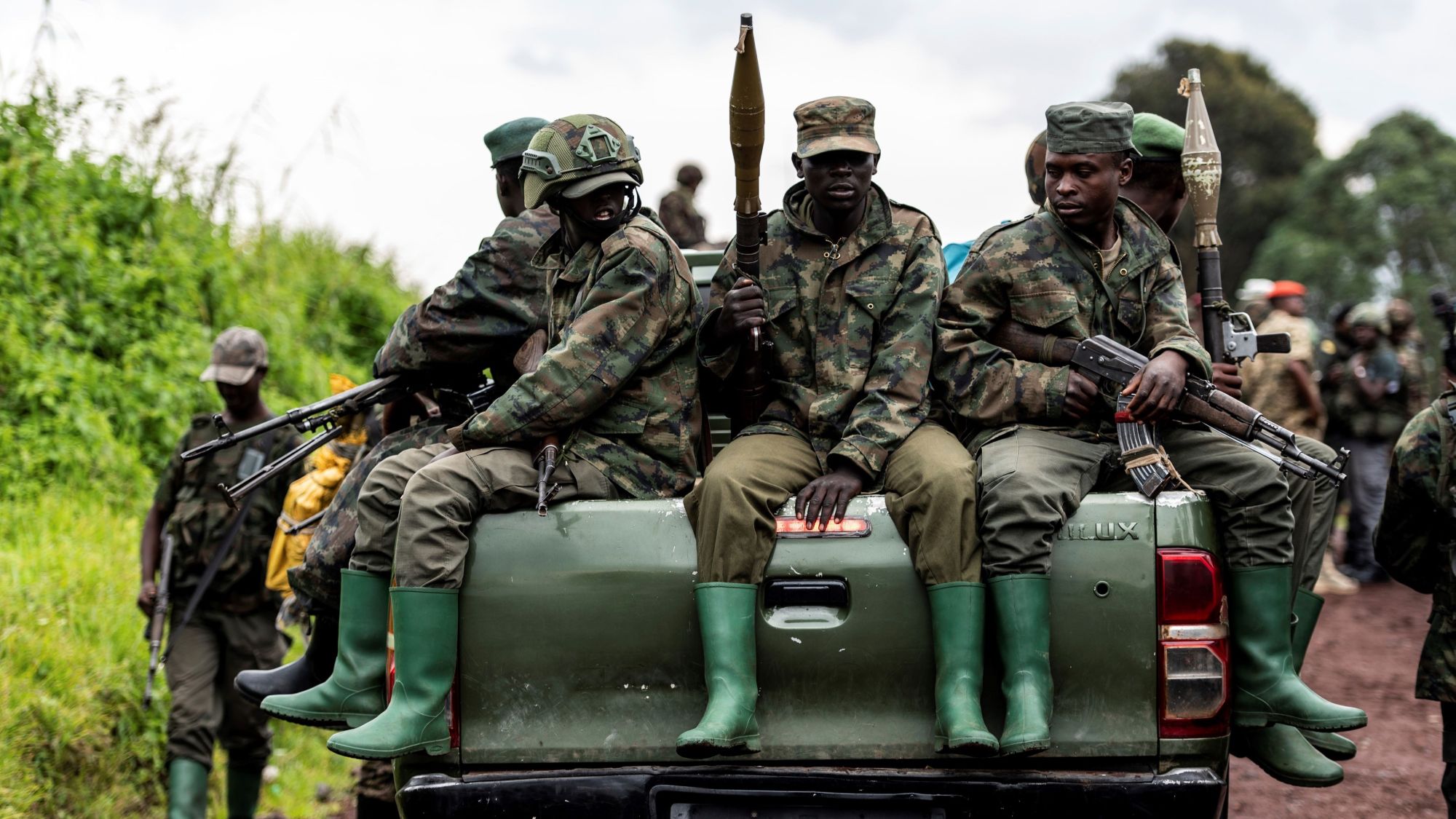
M23 is the most critical Rwanda-backed Congolese rebel movement. Since 2012, Rwanda has provided material support, training, and some command and control of M23 forces. M23 is based right on the border of Rwanda, allowing free movement between the two territories. This free access, in addition to the flowing supplies of arms and material, allowed the M23 to survive, though made the group reliant onRwanda. This support evolved further in 2022 to regular Rwandan military troop deployments numbering in the thousands. Rwanda’s involvement surpasses marginal military support; Rwandan officials informed UN investigators in 2025 that Paul Kagame directed M23 to seize Goma. This insight illustrates that Rwanda controls M23 for strategic gain, rather than allowing M23 to operate independently as a rebel group with Rwandan support.
Rwanda’s implementation of its security strategy is inconsistent with purely defensive operations. The July 2025 UN Group of Experts report found that Rwanda’s military engagement goals were not to neutralize the FDLR but rather focused on “conquering additional territories” to secure “mineral-rich territories and fertile land.” Rwanda has continuously denied these allegations and in recent years has argued that its forces were never in the DRC’s territory. Paul Kagame likely began Rwanda’s intervention in the DRC as a post-genocide security imperative, but it appears that it has transformed into a comprehensive strategy for regional dominance requiring continued instability.
Military Supremacy Without Hegemonic Capacity
Rwanda has achieved what no other small African nation has: military dominance built on battlefield effectiveness and organizational discipline rather than economic size or technological superiority. In recent years, M23 forces have effectively combated coalition forces, including UN peacekeeping missions, sent to stabilize the region. Rwanda continually denies their connection, much less their control, over M23. Rwanda is not a wealthy nation and its forces do not possess overwhelming weaponry, but its national forces are well-trained and experienced in jungle combat. Paul Kagame’s origins as a guerilla fighter have influenced the military’s ability to succeed against materially superior opponents.
This military supremacy has translated into unprecedented territorial control. By early 2025, M23 captured Goma and Bukavu, the provincial capitals of North and South Kivu and home to over three million people combined. The December offensive on Uvira extended control over the DRC’s south-eastern border, demonstrating Rwanda’s resolve to continue hostilities even while signing the Washington Accord peace agreements which were supposed to immediately halt further aggression.
This strategy reveals a critical issue in Rwanda’s security strategy: military supremacy without hegemonic capacity. The country has lacked the economic weight and political legitimacy to transform its battlefield control into stable regional leadership. M23 is foremost a rebel group, not a political force. The group assuming broad control would mean investment of money and military power that would cost Rwanda greatly. As Rwanda is the prime benefactor their prize would come at a cost. Rwanda would have to train and equip more M23 soldiers, and provide equipment and cash needed for an assumption of power over a large populace. Rwanda also cannot simply annex eastern DRC; the international backlash would be severe, crippling Rwanda’s internationally-reliant economy and staining its diplomatic prestige abroad. Rwanda’s inability to impose a lasting peace that itself or neighboring states would accept prevents it from achieving true regional hegemony, not because of military inadequacy, but an inability to govern.
This dynamic creates a structural incentive for perpetual low-intensity conflict. Rwanda reaps the benefits of a friendly nonstate actor within a regional competitor while maintaining enough relational ambiguity to lower the diplomatic cost of its involvement. Peace threatens Rwanda’s influence in the region by nullifying its greatest political strength: military prowess. M23’s recent offensives in the DRC signal a shift from temporary occupation to permanent control. The group has appointed governors, established tax systems, and built parallel financial infrastructure. In Goma and Bukavu, M23 officials down to the district level now collect taxes, adjudicate disputes, and provide basic services. Rwanda appears to believe it is now opportune to invest heavily in M23 control, despite the burden of investing in ambiguous improvements in governance. Rwanda’s support for M23’s institutionalization, rather than full acceptance of the Washington Accords, signals its intent to establish a buffer regime between Kigali and Kinshasa.
The Economic Imperative: A Billion-Dollar Dependency
Rwanda’s economy has become structurally dependent on eastern DRC’s minerals, creating powerful incentives to secure its interests regardless of diplomatic agreements. Rwanda’s mineral exports surged from $373 million in 2017 to $1.75 billion in 2024, a 369% increase in seven years. Gold alone reached $1.5 billion in exports. Yet, Rwanda has virtually no significant gold mines. Independent geological assessments estimate Rwanda’s legitimate gold production capacity at roughly 350 kilograms annually. Rwanda exported 19,397 kilograms in 2024. The gap, approximately 19,000 kilograms worth $1.2-1.5 billion, represents minerals that originated elsewhere. UN investigators, mining consultants, and even Rwanda’s own president have acknowledged these minerals come from DRC.
Newly developed infrastructure confirms Rwanda’s systematic extraction of resources from the DRC. M23 seized the Rubaya coltan mines in April 2024, gaining control of a mineral critical to the production of roughly 15% of the global tantalum supply. Satellite imagery captured convoys transporting minerals through the Kabuhanga border crossing into processing facilities in Rwanda to prepare for export. UN experts documented 120 tonnes of coltan smuggled monthly from Rubaya to Rwanda, generating at least $800,000 per month in taxes for the local M23 government.
M23 has established a comprehensive taxation system governing the estimated five million people living within its declared territory. Beyond mineral levies, the group collects household taxes, business fees, checkpoint charges, and land taxes. With commercial banks closed since M23’s capture of Goma, residents have no alternative but to participate in M23’s parallel financial system. The group reopened state banks under its own management and created regulatory bodies to oversee the economic apparatus.
If Rwanda lost access to critical minerals originating in the DRC through a genuine peace deal, the economic consequences would be severe; Rwanda would experience a critical reduction in its export income crippling the small nation’s ambitions for regional hegemony. Any peace deal requiring M23 withdrawal would therefore dismantle the economic architecture Rwanda has constructed around its regional presence.
Why Peace Threatens Rwanda’s Strategic Model
Rwanda’s regional strategy prohibits the compromise necessary for a sustainable peace deal aimed at stabilizing the region. Militarily, Rwanda’s withdrawal would eliminate the perceived security it draws from M23’s deterrent capability. Economically, restored DRC sovereignty and international oversight would end the mineral smuggling that generates a significant portion of Rwanda’s exports. Politically, Rwanda would face a stark choice it has avoided for decades: either accept DRC sovereignty over its own territory or face isolation as an aggressor state.
Rwanda has therefore developed a strategy of controlled instability. Conflict must remain intense enough to justify military presence and maintain proxy control of critical minerals, yet not so intense that major powers intervene militarily or sanctions become economically crippling. Rwanda’s strategy is clear: sign peace agreements and maintain overtures to relieve international pressure, then violate them strategically and ambiguously to maintain territorial control. The Washington Accords followed this template precisely; stakeholder countries signed the agreement on December 4, but M23 attacked Uvira on December 10.
This strategy isn’t unique to Kagame, but reflects structural realities in Rwanda. Rwanda emerged from the 1994 genocide as a small, landlocked nation surrounded by larger neighbors, sitting adjacent to one of the most resource-rich territories on earth. Kagame built Rwanda into a stable, militarily effective state through three decades of stable and capable governance. But stability at home has required instability abroad. A functional Congolese government could theoretically reassert control over its own resources, develop its own economy, and field military forces that would overwhelm Rwanda’s smaller army through sheer manpower.
Every element of Rwanda’s regional strategy – military positioning, economic access, and diplomatic legitimacy – hinges on a delicate balance of conflict intensity. Conflict must remain below international intervention thresholds but above genuine stability. Genuine peace would dismantle this carefully calibrated system.
The International Factor
The international community continues to treat this strategic instability as a conflict requiring mediation between parties with symmetric interest in peace. This is fundamentally incorrect. The DRC desires territorial sovereignty, while Rwanda wants continued access to minerals and control over neighboring territories to ensure its own security. These are incompatible goals. Until external actors address Rwanda’s economic dependence on DRC minerals, peace agreements will remain diplomatic theater.
Future peace initiatives should refrain from pursuing mineral-for-security deals that legitimize Rwanda’s exploitation of the DRC’s resources, and should rather implement consequences for Rwanda’s continued violations of international law to disincentivize further destabilizing behavior. The small nation emphasizes its international activities, from trade to humanitarian support, highlighting that its international connections are seen as vital to its future plans of growth. Both Rwanda’s domestic enhancement and its international prestige require acceptance and expansion of its international role. Preventing Rwanda from connecting with international opportunities and eliminating the possibility for Rwanda to trade its illicit resources would isolate the nation and force it to seriously consider a peace deal.
The international dimension of the Rwanda-DRC dilemma compounds the problem. Western governments condemn Rwanda’s actions while simultaneously signing mineral supply agreements with Kigali. The EU’s February 2024 Memorandum of Understanding with Rwanda for “sustainable raw materials” came even as UN reports documented the massive scale of Rwandan mineral smuggling. U.S. companies source precious minerals that transit through Rwanda despite their origin in the DRC. In February 2025, the U.S. Department of the Treasury sanctioned Rwanda’s Minister of State for Regional Integration James Kabarebe for “managing Rwanda and M23’s generation of revenue from DRC minerals,” yet the Washington Accords signed eleven months later include frameworks to “expand investment in regional critical mineral supply chains” through Rwanda.
These cases illustrate the international community’s complicity in Rwanda’s actions. Rwanda faces limited consequences for violations of international law because its extracted critical minerals flow into supply chains for smartphones, electric vehicles, renewable energy, and other technologies that Western governments desperately need. As the fight for these minerals between the United States, Russia, and China intensifies, focus on stabilization will continue to fade in the region. Rwanda can easily absorb the costs of diplomatic condemnation when its lucrative economic relationships throughout the international community continue. Western politicians’ lack of focus on conflict dynamics in Africa disincentivizes moral decisionmaking in favor of economically and politically advantageous behavior, resulting in further destabilization of the region at the cost of thousands of lives and an unknown turbulent future.
Rwanda has built a regional hegemony project that requires, rather than resists, continued conflict in eastern DRC. Rwanda’s strategy for achieving this regional hegemony relies on military dominance, exploitation of the DRC’s resources, and a lukewarm pursuit of symbolic peace agreements to hide its real intentions. Where before Rwanda cultivated chaos via M23, now it appears to be establishing a militarized buffer state that will continue the fight with more permanence. Until the international community confronts this reality, every peace agreement will fail for the same reason: the DRC seeks sovereignty, while Rwanda seeks a shaky security environment that enables its regional domination.
Views expressed are the author’s own and do not represent the views of GSSR, Georgetown University, or any other entity. Image Credit: World Politics Review