Romania’s Double Crisis: Fighting Interference, Losing Washington?
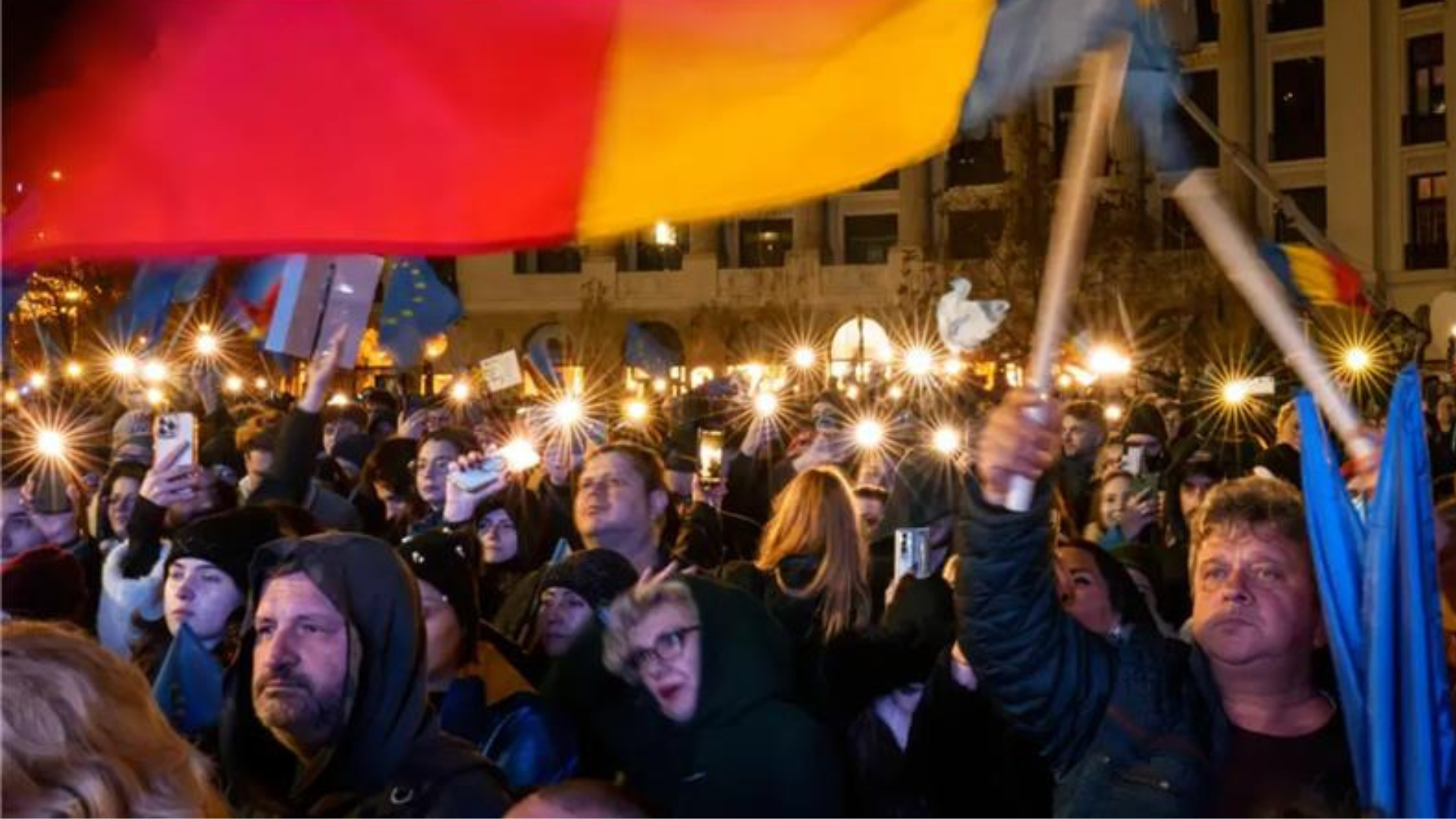
Romania made global headlines when, on 6 December 2024, its Constitutional Court unanimously decided to annul the results of the first round of the presidential elections on the grounds of Russian interference. Although the United States’ government was initially supportive of Romania’s efforts to assure a democratic process “free of foreign malign influence,” President Trump’s return to the White House brought a new vision for transatlantic relations. Consistent with the change in U.S. strategy toward Europe, Romania transitioned from being a model ally supported in its fight against Russian hybrid warfare to a pariah state criticized by the U.S. Vice President on the stage of the most important international security conference in Munich.
For the past year, Romania stood at a crossroads, as it navigated the unprecedented challenge of repairing its strategic partnership with the United States while defending the integrity of its democratic processes, facing Russian interference. This balancing act matters profoundly: an alliance under strain with Washington poses unacceptable risks for a frontline nation like Romania, whose security still depends on American commitment to NATO’s eastern flank.
Untangling a Troubled Election
The first round of the Romanian presidential elections on 24 November 2024 was unexpectedly won with approximately 23% of the vote by far-right populist Călin Georgescu, a candidate who was polling under 5% only days before the election took place. He managed to outvote the competitors of the two main political parties without support from any political party and without declared funding for his campaign. A TikTok-enabled infrastructure of 66,000 fake accounts, 7 million false likes, and 10 million fake followers and bots was the recipe that made Georgescu not only the candidate that almost won Romania’s presidency, but a case study showcasing the power of weaponized algorithms on a specific electorate.
On 28 November 2024, the Supreme Council for National Defense found that by violating electoral law, a candidate in the presidential election benefited from massive exposure due to the preferential treatment that the TikTok platform gave him. The Council members also found that there were cyber-attacks aimed at influencing the fairness of the electoral process. Before the runoff and because of pressure from civil society, the President of Romania decided to declassify the intelligence reports regarding the first round of elections. The declassified documents revealed a massive and “highly organized” campaign for Georgescu on TikTok, likely orchestrated by a state actor, implicating Russia. Based on these documents, the Constitutional Court unanimously decided to annul the presidential elections.
During police raids in February 2025, Romanian authorities discovered $3.3 million in cash, 25 kilograms of gold bars, 50 grenades, pistols, and ammunition at the house of Horațiu Potra, a mercenary with documented ties with the Russian Embassy in Bucharest that provided massive funds for Georgescu’s campaign. Georgescu was later detained and charged with incitement to actions against the constitutional order, support of fascist organizations, and other offenses. Subsequently, he was banned from participating in the 2025 presidential elections.
From Brussels to Washington: International Reactions to the Romanian Election Crisis
The EU leveraged Romania’s case as an opportunity to enforce its Digital Services Act (DSA), the EU-level regulatory framework that allows sanctions to be imposed on social media companies for allowing non-compliance with national electoral legislation. The European Parliament summoned the TikTok CEO to meet with members of the community to determine whether the platform complied with no infringement under the DSA.
Ten days after the Romanian Constitutional Court’s decision, the European Commission decided to open formal proceedings against TikTok. Ursula von der Leyen, the President of the European Commission, cited in the grounds for this investigation that it was based on “serious indications that foreign actors interfered in the Romanian elections by using TikTok.”
France was one of the first allies that supported Bucharest’s struggle against Russia’s hybrid attack. In his New Year’s speech in 2024, President Macron mentioned the election manipulation in Georgia, Romania, and Moldova as proof that Europe should not take its security for granted. In February 2025, VIGINUM—France’s service for vigilance and protection against foreign digital interference—published an extensive report explaining the process of algorithm manipulation and the instrumentalization of influencers as lessons from the Romanian presidential elections. This report assessed that “the information operations were also accompanied by a large number of cyber-attacks targeting IT systems related to the electoral process, thus demonstrating the deployment of a large-scale device designed to destabilize a major democratic event.” When Telegram CEO Pavel Durov claimed that France tried to silence conservative voices in Romania to favor Nicușor Dan, the French government reacted quickly, highlighting that the “recent accusations against France are merely a diversionary movement from the real threats of interference targeting Romania.”
Washington’s position changed drastically following the transition in power in January 2025. During his remarks at the OSCE Ministerial Meeting in Malta on 5 December, then-Secretary Blinken stated that, “Romanian authorities are uncovering a Russian effort – large in scale and well-funded – to influence the recent presidential elections.” On 6 of December 2024, the State Department stated that the U.S. was in solidarity with the Romanian people concerning the “integrity of their elections.” The U.S. Senate Foreign Relations Committee then issued a bipartisan statement on 16 December 2024 in support of Romania’s “fight for the integrity of its elections,” condemning “Putin’s manipulation of the CCP-controlled TikTok to undermine Romania’s democratic process.”
Vice President Vance’s speech at the Munich Security Conference in February 2025 challenged these statements and positions. The VP claimed that Romania “straight up canceled the results” of the presidential elections following “flimsy suspicions of an intelligence agency and enormous pressure from its continental neighbors.” The change in tone under the Trump administration was also observable in the Human Rights report for Romania, where the social media campaign, which was earlier presented as digital foreign interference, was described as an “organic election activity.”
Romania’s Response Strategy: Rebuilding Institutional Capability at Home, Relaunching Strategic Partnerships Abroad
J.D. Vance’s remarks in Munich brought a simmering tension between Bucharest and Washington to the forefront. The cancellation of the presidential elections and the decision to ban Georgescu from running again were portrayed by MAGA as a violation of the right to free speech. This reading of the Romanian episode was also likely impacted by the vivid memory of the 2016 U.S. presidential elections, when the MAGA movement described Russian interference as a “hoax.”
However, for Romania, a frontline state that depends both on the security provided by the Americans and on the funds provided by the EU, testing this new transatlantic bargain was not a comfortable one, nor was the necessary hedging between Washington and Brussels. The Bucharest government, together with President Dan, has therefore proceeded to relaunch relations with Romania’s most important strategic partner, the United States. As part of this effort, they employed a dual strategy: building institutional capability at home and finding win-win avenues for cooperation abroad.
The first pillar of the strategy has been focused on economic reforms and institutional resilience. In the first month of his presidency, Dan steered the formation of a new government, made up of all pro-European parliamentary parties, and outlined a government program focused on financial recovery and reform of the state apparatus to increase efficiency. After inheriting a very high deficit of about 9.3% of GDP, one of the highest in the EU, the new government committed to reducing the budget deficit in the second half of 2025. By early 2026, reports indicated that the deficit had been cut by more than 1% of GDP.
Also under the first pillar, President Dan vowed that he would name new directors for Romania’s intelligence agencies, prioritizing leaders from civil society instead of politicians. He steered the adoption of a novel National Security Strategy, which explicitly recognizes Russia as an existential threat to Romania. A new department for fighting against disinformation, which will be set up within the Romanian Presidency, will reportedly coordinate a whole-of-government approach for mitigating these risks.
The second pillar of the strategy has been focused on repairing the relations with the Trump administration. In the period leading up to the re-run of the presidential elections, the authorities in Bucharest attempted to establish high-level contacts within President Trump’s team. Dan added to traditional diplomatic channels by leveraging informal ones. Dragos Sprinceană, a Romanian-American millionaire with access to Mar-a-Lago and a member of the Republican Party, was named a special emissary of the Romanian Prime Minister.
Rather than reopening the wound of the annulled presidential elections, Romanian elites adapted to Trump’s transactional approach to foreign policy by promoting avenues of economic opportunity. As an example, the first high-level bilateral meeting was between Energy Minister Sebastian Burduja and the U.S. Energy Secretary Christopher Wright in April 2025. Despite internal political struggles of the annulled elections and fragmented governmental coalition, Romanian authorities have proceeded with the implementation of the pilot project in cooperation with the American company NuScale, setting Romania on course to be the first recipient of American nuclear energy technology based on small modular reactors by 2029.
At the NATO Hague Summit, Dan fully endorsed President Trump’s proposal for increasing the defense expenditure pledge to 5% of GDP. Furthermore, the Romanian Minister of Foreign Affairs announced that Bucharest would seek more co-production opportunities with American defense companies through the €16.68 billion EU SAFE loans program. In reaction to transatlantic tensions caused by President Trump’s position that the U.S. might annex Greenland, President Dan stated unequivocally that Romania “rules out the scenario of a forced choice between the U.S. and the European Union.”
Despite Romania’s efforts to repair the political relations, issues within the bilateral framework remained stalled as of March 2026. Although reportedly invited, President Dan has not yet been scheduled to visit the White House. The security dimension of the strategic partnership was also in danger of being undermined as a result of the Pentagon’s October 2025 decision to withdraw approximately 1,200 American troops from Romania. Lastly, a pending diplomatic matter involves Romania’s accession to the U.S. Visa Waiver Program, a decision taken by the Biden administration but subsequently put on hold by the current administration. Media reporting linked the decision to reevaluate Romania’s participation in the program with the annulment of the 2024 presidential elections.
Conclusions and Policy Recommendations
Bucharest has found itself caught between European allies that have recognized the gravity of Russian information warfare and election interference and a Trump administration that has viewed the annulment through the lens of its own domestic political grievances. The Romanian government has pursued a careful strategy: restoring credibility at home while giving Washington concrete reasons to renew cooperation.
As part of this strategy, Bucharest should shape an economically robust “deal” that relaunches the Romanian-American strategic partnership for President Dan to present to President Trump during his future visit to the White House. This package should leverage Romania’s strategic assets, including defense procurement commitments favoring American contracts and joint ventures for critical minerals extraction in the Carpathian region. This deal would aim to underscore Romania’s transactional value in line with the current administration’s priorities.
At the same time, the national authorities must prioritize institutional measures that would bolster Romania’s resilience against Russian information warfare. This could be achieved by working with the EU for the professionalization of governmental experts and equipping them with the tools to fight Russian foreign interference. Moreover, Romania should share its own lessons learned from the 2024 elections with states that are equally exposed to Russian information operations, especially the EU candidates from the Western Balkans, by establishing a European Election Security Hub in Bucharest aimed at sharing best practices amongst states with a similar threat perception vis-à-vis Russia.
As President Dan already mentioned, for frontline states like Romania, choosing between the United States and Europe is undesirable. Operationalizing this preference forward, Bucharest must continue to bolster its European partnerships to withstand hybrid threats and maintain a constructive dialogue with Washington to secure U.S. support for a resilient transatlantic alliance.
The author would like to thank SSP Professor Paula Doyle for her guidance and support provided in editing this piece.
Views expressed are the author’s own and do not represent the views of GSSR, Georgetown University, or any other entity. Image Credit: European University Institute