From Russia, With Tokens: AI, Labor Shortages, and the Uncertain Prospect of Russia-PRC Cooperation
Despite Russia’s history of leveraging its large population for military advantage, a serious demographic crunch threatens Moscow’s ability to sustain a strong economy and the world’s fourth-largest military. Russian techno-futurists have aimed to fill this yawning gap, offering artificial intelligence (AI) as an indispensable tool to preserve Russia’s great power status in the decades to come. Regardless of their optimistic predictions, real-world data suggests that AI will play a relatively minor role in alleviating Russia’s demographic decline in the near and medium term future.
Cooperation with the People’s Republic of China (PRC) could help Russia circumvent its limited resources, but this approach clashes with Moscow’s insistence on maintaining technological sovereignty and a certain unease about overreliance on the PRC.
Baby Bust and Labor Crunch
Russia’s demographic issues largely stem from the collapse of birth rates in the last years of the Soviet Union. The economic and political turmoil of the late 1980s and the chaotic 1990s that followed saw Russia’s birthrate cut in half: from 2.2 children per woman in 1987 to 1.2 children in 1999. A birthrate of 2.1 is considered the minimum to prevent population decline without migration. A moderate recovery in the 2000s proved short-lived, and the most recent figures suggest that deaths outnumber births by 50%.
Several decades of below-replacement birth rates have contributed to a declining native-born population and a rising median age. This decline would have been significantly steeper if not for Russia’s strategy of importing huge numbers of migrant laborers, a population estimated at 12-14 million. Even with this external influx, the labor force has been in decline since the post-Soviet peak of 76.2 million in 2011. Currently, Russia’s labor force is an estimated 72.5 million.
This decline is expected to continue. A 2021 analysis by Moscow’s Higher School of Economics estimated the number of 20-59 year olds in Russia will decline by nearly ten million between 2015 and 2035. This figure does not include the 650,000 Russian citizens who fled the country to avoid conscription or persecution, nor the hundreds of thousands of Russians who have been killed or permanently disabled in Ukraine. In July, Russia’s Minister of Labor reportedly told President Putin that the country will require at least 2.4 million additional workers by 2030.
Russia’s top officials, including Putin, have long recognized the threat that demographic decline poses. In 2006, Putin declared that demography is “the most serious problem in Russia today.” Despite this recognition, policy responses have been unsuitable, under-resourced, and ineffective. Pro-natalist policies in Russia, implemented through a combination of nationalist-religious propaganda and material incentives, have failed to meaningfully increase birthrates. Enormous amounts of migrant labor have only papered over the problem, while a nationalist backlash against overwhelmingly Central Asian migrant workers risks domestic political instability.
A substantial, sustained decline in the Russian labor force will likely prevent the formation of new enterprises and reduce expansion in existing businesses, leading to a long-term decline in economic growth. The number of those dependent on the state is expected to increase 25% relative to the number of workers between 2025 and 2050, increasing strain on government expenditure related to pensions and healthcare, and potentially crowding out spending in defense or infrastructure.
From a military perspective, a limited labor pool offers fewer recruitment options and forces the military to compete with private businesses for qualified personnel. This competition is evident through the Russian military’s eye-wateringly high salaries and bonuses to attract recruits. This approach decreases the share of the military budget that can be dedicated to research and development, procurement, or operations.
Lost economic growth, combined with the increasingly high costs to staff and operate one of the world’s largest militaries, severely strains Russia’s ability to maintain its great military status. Without a technological solution, the state would be forced to make disruptive and politically unpopular choices at home to maintain its great power status, such as raising taxes, cutting social programs in favor of military spending, or expanding migration policies that conflict with the nationalist and chauvinist underpinnings of Putin’s Russia. Russia’s AI optimists propose to cut this Gordian knot by thoroughly integrating the technology throughout the economy, enabling businesses to do more with less.
Bringing the Bots Home
A 2025 report from the Russian Presidential Academy of National Economy and Public Administration (RANEPA), created as part of a state directive, represents the most detailed and comprehensive view on how Kremlin-affiliated experts view AI as impacting the civilian economy. The report estimates that AI can perform the work of over 3.6 million people by 2030. Most of this derives from a projected 15-20% productivity increase. If true, this would be a tremendous boost to Russia’s long-term economic and demographic decline, nullifying the predicted labor shortage and improving the country’s economic outlook. Military recruiting would be easier and cheaper, allowing the Kremlin to dedicate a greater portion of defense spending to operations, procurement, and R&D.
However, there are serious questions about the assumptions that shaped these estimates, most importantly, whether AI will actually increase productivity by 15-20% by 2030. This increase would require AI to create an annualized productivity growth rate of 2.8 to 3.7%, which dwarfs Russia’s average productivity growth rate over the last decade: approximately 1%. More importantly, the predicted AI-enhanced productivity increase is significantly higher than estimates of AI’s current impact on workplace productivity. A U.S. Federal Reserve study on AI in the workforce, relying on data from late 2024, found that it accounted for a 1.1% boost in total economic productivity, and this is with around a quarter of workers claiming to use AI to some extent. In comparison, the RANEPA report estimates that penetration of AI within the Russian economy has not exceeded 10% in any sector.
These studies indicate that achieving RANEPA’s predicted productivity gains and the attendant reduction in labor shortage by 2030 would require an incredible uptake rate and the world’s most effective implementation of AI. Both of these are unlikely, though comparable gains might be made over a much longer timeframe. AI is capable of helping alleviate Russia’s serious labor shortage, but predictions that it will halt or reverse the country’s demographic decline are rooted in wishful thinking and techno-optimism, and have little resemblance to our reality.
Priorities, Priorities, Priorities
Beyond unrealistic expectations about AI, Russia’s difficulties developing and implementing AI stem from its material deficits and choice to prioritize military AI over civilian applications. Russia lacks the scientific base and capital structure necessary for the development of cutting-edge AI, as a Kremlin-initiated study concluded in 2021. Since then, Russia’s relative position has declined due to a small research base and wartime sanctions.
Underdeveloped domestic capital markets and a loss of access to global capital have made large-scale private sector AI investment rare in Russia. What capital is available is exceptionally expensive due to high interest rates. This makes state investment even more critical in the Russian context. Despite this, non-defense Kremlin investment in AI over the next five years will likely be under $500 million. By comparison, non-defense US government investment in AI for 2025 alone was over $5 billion. Stargate, a White House-organized program to pool the efforts of OpenAI, Softbank, and Oracle, has promised $500 billion in investment over the next four years.
Western sanctions have hindered Moscow’s development of cutting-edge AI. These sanctions prohibit the sale of advanced chips and graphical processing units (GPUs) needed for research and development. An anonymous expert associated with Sber, a leading Russian AI firm, claimed that Sber managed to acquire 9,000 GPUs in the first three years of the war. By comparison, Microsoft acquired 500,000 GPUs in 2024. Computer science professionals and researchers were among the hundreds of thousands who left Russia for war-related reasons, draining Russian firms’ human capital.
With key limits in civilian AI development, Russian government investment has been funneled towards military applications, which are increasingly prominent on the battlefield. Many battlefield AI functions are less technically demanding than their civilian counterparts, allowing Russia to make significant advancements with limited resources. For instance, the chips needed to enable automated guidance and target acquisition for drones are less advanced and more easily acquired through the gray market. Russia also has access to a tremendous quantity of battlefield experience to test architectures and optimize AI capabilities under real-world conditions.
While an emphasis on battlefield AI may help the Russian military stay competitive with its great power peers, it comes at the cost of falling further behind in the development of civilian models.
A Boost From Beijing?
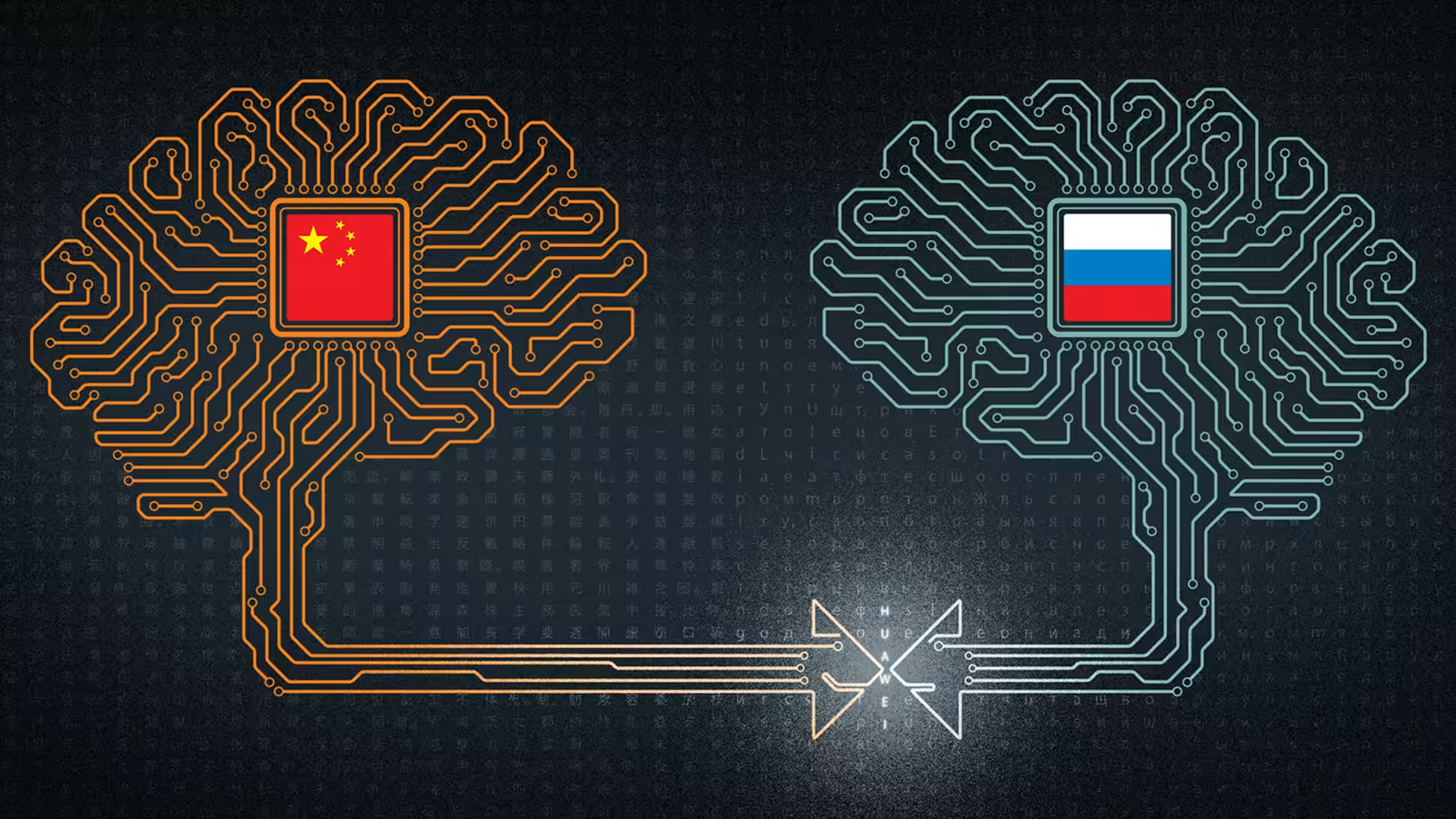
Russia may leverage its strategic ties with the PRC to help address its demographic challenges. The Kremlin may lean on PRC AI to circumvent its resource constraints, but mutual reluctance and mistrust between Beijing and Moscow make the PRC option uncertain. Russia and the PRC initiated close collaboration in AI at the beginning of 2025, which could allow Russia to benefit from the PRC’s much larger research community and investment in large language models (LLMs), like DeepSeek. In April 2025, Beijing announced it would provide early-stage AI startups with $8.5 billion, marking just one example of extensive state support. The release of DeepSeek, a PRC AI, frightened American technology companies in January 2025 for its sophistication and the reportedly low cost of development.
However, Russia’s willingness to rely on the PRC for AI is doubtful. The Kremlin has consistently emphasized “technological sovereignty”, understood as developing, operating, and controlling one’s own technology to minimize vulnerability to foreign coercion. This raises the question: Is the PRC seen as a potential source of foreign coercion?
Beijing and Moscow famously announced a “no limits partnership” several weeks before Russia’s full-scale invasion of Ukraine, and have deepened economic cooperation. There is evidence that the PRC allows its firms to provide vital war materials to Russia. Russia’s growing reliance on the PRC has stoked concern in Moscow that the country may be headed towards junior partner status. Hacker group Ares Leaks shared alleged Russian counterintelligence documents that report fears of PRC espionage and Beijing’s influence over its weaker partner. Whether Putin and his ministers share these concerns is likely to shape the extent to which Russia is willing to rely on PRC AI technology.
The rate at which AI models continue to develop will be a decisive factor in shaping Russian behavior. Some analysts and indexes argue that the rate of advancement for AI models is plateauing. If this is true, Russian leadership may prefer to prioritize its own models, even if they are presently inferior to their PRC counterparts. If breakthroughs and rapid growth continue, the Kremlin will be more likely to sacrifice some security to reap the benefits.
We should not assume that the PRC will necessarily be eager to share critical knowledge and technology around AI with Russia. As the PRC moves from playing catch-up with American AI models to competing with them, security concerns may assume a greater place in Beijing’s decision-making process. Relevantly, Russia’s vulnerability to foreign intelligence services is fairly well established.
In the weeks prior to Russia’s full-scale invasion of Ukraine, American intelligence services not only predicted that Russia would invade but also provided accurate information regarding the date of the invasion and the rough manner in which it would be conducted. In doing so, they demonstrated that they had access to high-level, secretive decision-making processes. The PRC itself has allegedly attempted to covertly access advanced Russian scientific research. Beijing may assume that if it can do so, the United States can as well, making it risky to provide Russia with valuable research or hardware. Both Russia and the PRC may therefore have concerns about cooperating with or relying on the other for AI.
Conclusion
Russia’s AI boosters see it as a cornerstone of the country’s strategy to address demographic decline, but their predictions are highly optimistic. Real-world data suggests that the benefits will be significantly more modest and realized over a much longer period. AI is more likely to serve as one of many small contributors, softening the impact of a shrinking and greying population. The Kremlin might circumvent resource limitations on its own AI development by making heavy use of PRC models, but this conflicts with Russia’s desire for technological sovereignty and apparent anxiety about PRC influence.
Views expressed are the author’s own and do not represent the views of GSSR, Georgetown University, or any other entity. Image Credit: Nikkei Asia