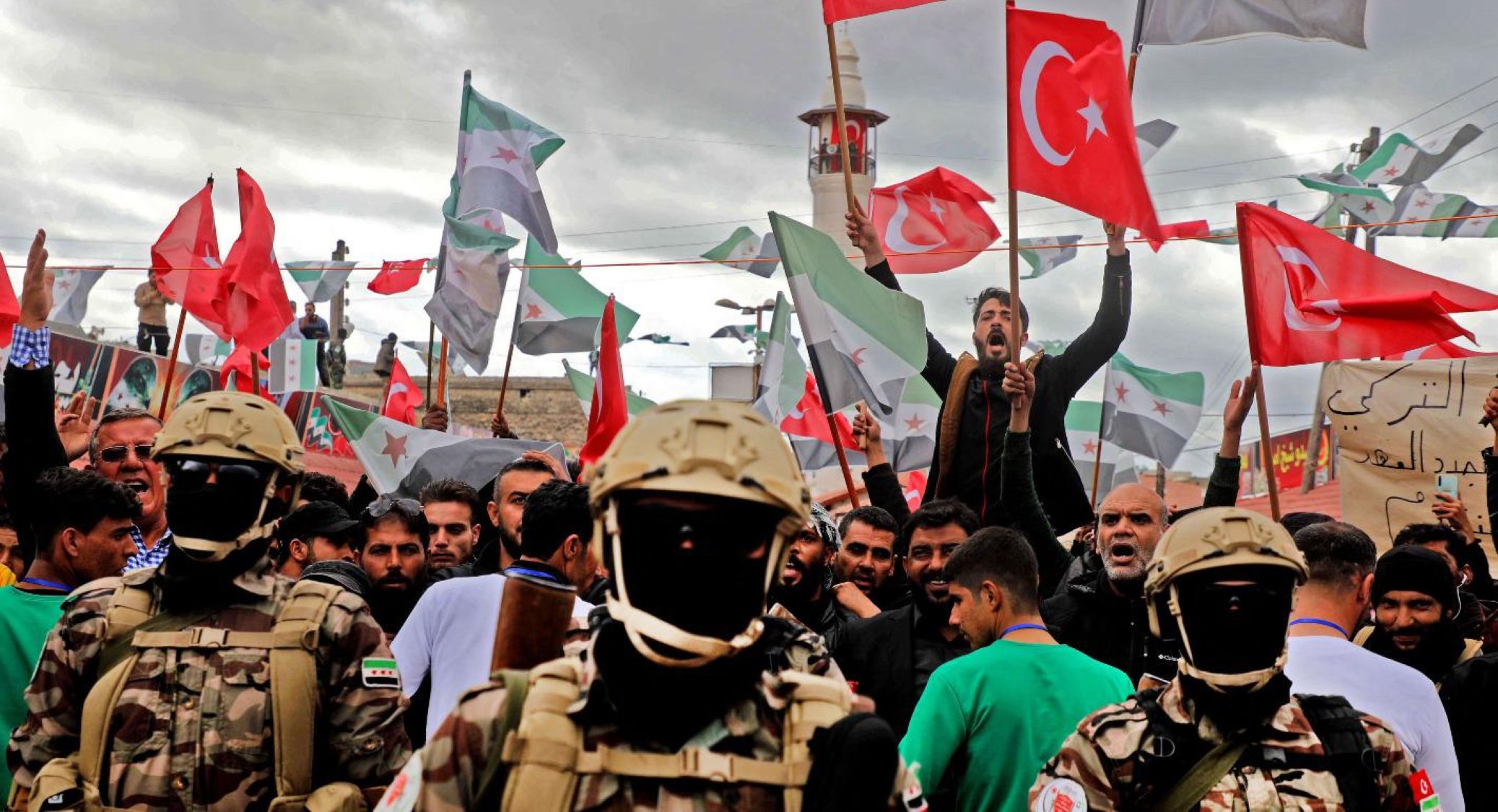
Are Turkey and Israel on a Collision Course?
The fall of the Assad regime in Syria has triggered two opposing sets of interests between Turkey and Israel. As a result, speculation is growing that Turkish-Israeli relations are on a path toward armed confrontation.
Israel favors fragmentation in Syria while Turkey prefers a strong centralized state. Despite their diametrically opposed goals, direct Turkish-Israeli conflict is highly unlikely. Neither power can bear the economic, political, or military costs of war. A proxy conflict is somewhat more plausible but still improbable. Turkey faces domestic pushback against further involvement in Syria and cannot politically risk another military entanglement given its struggling economy. Israel, for its part, would struggle to inspire its fatigued populace to engage in another war in the wake of its recent conflicts with Hamas, Iran, and Hezbollah. Lastly, the United States would almost certainly introduce a conflict de-escalation or prevention mechanism before relations devolve further.
Strategic Divergence Amidst a Changing Syria
The takeover by the Hayat Tahrir al-Sham-led (HTS) rebels in Syria has renewed the country’s hope for a peaceful future. At the same time, the rebel’s victory has also greatly shifted the balance of power calculus for major regional actors, especially Turkey and Israel.
For Turkey, the shifting landscape presents a long-awaited opportunity to resolve several long-standing strategic objectives. Firstly, there is now a feasible opportunity to settle the Kurdish question by ensuring the full assimilation of Syrian Kurds into the Syrian state – thereby weakening the Kurdistan Workers’ Party’s (PKK) influence within its own borders. Secondly, Turkey now has a partner in Syria to facilitate the return of Syrian refugees, and offers an opportunity to stimulate the Turkish economy through reconstruction. Lastly, President Erdoğan sees this opening as a chance to enhance his standing as a leader of the broader Muslim world. All these goals require a stable Syria.
Israel, on the other hand, views a weakened and fragmented Syria as essential to its national security. A unified Syrian state – particularly one run by former jihadists – poses a direct threat on its borders. Beyond sharing a border with an Islamist-led state, whose echelons come from the former Al Qaeda affiliate group Jabhat al-Nusra, a strong Syrian military apparatus capable of controlling the entire country would be a direct threat to Israel’s occupation of the Golan Heights. Since the fall of the Assad regime, Israel has sought to safeguard its hold on the Golan Heights by consolidating authority over the whole of the Golan Heights’ Quneitra Governorate.
As Turkey and Israel pursue divergent interests in Syria, their rhetoric has grown increasingly hostile. Turkish President Erdoğan has labeled Israeli Prime Minister Netanyahu the “biggest threat” to regional peace, while Israel has adopted a more aggressive security doctrine. In March 2025, the Nagel Commission, a body reporting directly to Netanyahu on defense strategy, warned that Syria’s rearmament demands a “zero tolerance” and “maximum response” policy while advocating for preventive action to extinguish threats before they grow too large. The report notes that such a policy is necessary due to Turkey’s growing military presence, which carries the possibility to accelerate Syria’s rearmament. The report warns of a growing risk of “direct Turkish-Israeli conflict” in the event that Syria becomes a de facto Turkish protectorate. In line with these warnings, in April 2025, Israel conducted strikes on several military targets in Syria, including an air base in Homs reportedly of interest to Turkey.
The Most Likely Scenario: Proxy War
If Turkish-Israeli relations continue on an escalatory path, the risk of a military confrontation will grow increasingly plausible – either direct or through proxies. While a direct clash between the two states should not be entirely ruled out, the more probable scenario is conflict through proxies in Syria. On one side would be Turkish-backed groups such as the Syrian National Army (SNA), a loose coalition of rebel factions with strong ties to Ankara and factions within the Syrian Transitional Government (STG), and other Sunni groups that are amenable to Turkey. On the other side would be elements from Syria’s minority communities, including certain Druze and Kurdish factions, which Israel has shown support to in the past as part of their “periphery doctrine.”
Observers might suggest that a proxy war, albeit a muted one, is already underway. While this may seem plausible, it is inaccurate. Neither state is directing its preferred factions to fight the other. For now, each is simply leveraging these groups to pursue their own interests, which are diverging in an increasingly escalatory manner. If this rivalry continues, however, it will inspire insecurities and the perception that national interests cannot be secured without engaging in proxy war.
Drivers of a Possible Proxy War
Since the HTS takeover of Syria, Israel has presented itself as the defender of Syria’s minority communities, especially the Druze and Kurds. Following several violent clashes between the STG and local Druze gunmen in Damascus in March, Israeli Defense Minister Katz said, “We will not allow the extreme Islamic regime in Syria to harm the Druze.” Following other clashes over the course several months, Israel carried out numerous drone strikes, ostensibly in an effort to protect the Druze. While Israel has provided political and limited military support for the Druze, its support for the Kurds, thus far, remains limited to rhetoric.
Meanwhile, expressions of unity between Syrian Druze and Kurdish groups have grown more frequent in recent months. In October, clashes broke out between the Kurdish-led Syrian Democratic Forces (SDF) and government forces in the Kurdish-controlled Ashrafieh and Sheikh Maqsoud neighborhoods in Aleppo. A United States-mediated ceasefire was declared the following night. The day after the ceasefire, Druze communities in Suweida rallied to show solidarity with the Kurdish community. This solidarity rally mirrors the Syrian Kurds’ rallying in Qamishli in support of the Druze community following the fighting between the Druze against STG forces and several government-aligned Bedouin tribes, that left at least 1,000 people dead.
On its own, these solidarity demonstrations do not indicate much beyond a shared sense of insecurity and fear in post-Assad Syria. However, amid an ambiguous Syrian fate – where Syrian national identity is yet to be articulated in non-exclusionary terms – such solidarity signals that minority groups are increasingly distrustful of the central government and inclined to pursue their own interests, perhaps seeking sympathetic internal allies and external patrons. Israel is well-positioned and willing to fill that role, especially for Druze, and perhaps for Alawites and Kurds as well.
Israel’s support for minority groups in Syria reflects strategic calculations that contrast sharply with Turkey’s. A weak, divided Syria is in Israel’s interest because it keeps Damascus domestically and militarily constrained, reducing the risk of future attacks on Israel. Israel’s support for the Druze is part of its long-standing alliance of minorities doctrine. In line with this doctrine, Israel seeks to establish buffer and autonomous zones in Syria, inhibiting the formation of a strong, centralized Syrian state that could pose a future threat on Israel’s border. For this reason, coupled with an increasingly militarily assertive strategic outlook post-October 7, Israel seized the buffer zone east of the Golan Heights within hours of the fall of the Assad regime.
Beyond geopolitical considerations, Turkish domestic politics indicate that engaging in proxy conflict is possible. In the past, major military campaigns in Syria were launched in close succession to significant domestic political events. For example, operations Olive Branch and Peace Spring bolstered Erdoğan’s image amongst the nationalistic elements of the country, facilitating the formation of a coalition with Erdoğan’s ruling Justice and Development Party (AKP) and the Nationalist Movement Party (MHP), thereby reinforcing Erdogan’s supporter base ahead of elections.
Currently, Erdoğan is orchestrating a “soft” coup to undermine the Turkish opposition parties, amid growing support for the jailed Republican People’s Party (CHP) leader, Ekrem Imamoglu. Should the CHP regain organizational strength and continue to increase its political influence, Erdoğan may use Israeli actions in Syria – such as increased airstrikes on Syrian government targets and more tangible support for the Druze – as a pretext to consolidate power through nationalist mobilization. Heightened Israeli military activity could provide justification for a harder stance on the Kurdish issue. Although the PKK has officially withdrawn from Turkey, its political ambitions remain firmly intact. Moreover, the PKK’s core has shifted to Syria and, from Turkey’s perspective, an autonomous or strong Kurdish presence will not be tolerated either within or directly on its borders. Consequently, Erdoğan may support SNA factions’ offensives against Kurdish positions in Syria and attempt to align elements of the STG more amenable to Turkish interests.
Possible, but Not Probable
Although proxy war is the most likely manifestation of a Turkey-Israel confrontation, it is not likely to unfold. First, Turkey has serious economic issues that temper ambitious or excessive foreign policy or military pursuits. The Turkish lira has already been under significant pressure from questionable monetary policies and persistent inflation. War with Israel could provoke formal or informal sanctions by the United States and reduce access to foreign markets. Additionally, a newly destabilized Syria would result in a new influx of refugees into Turkey and exacerbate the already dire refugee crisis in Turkey – which has triggered anti-refugee sentiments and economic complaints, hurting the ruling party AKP’s domestic image.
Secondly, Israel lacks the international legitimacy to pursue another war. In a Pew poll of U.S. adults, the percentage of Americans with an unfavorable view of Israel increased from 42% in 2022 to 53% in 2025. Another Pew poll found that in 20 of the 24 countries surveyed, nearly half or more of adults viewed Israel negatively. A YouGov poll similarly reported that 63-70% of respondents across six Western European publics hold unfavorable views of Israel. Compounding these statistics, in September 2025 alone, 10 predominantly Western countries formally recognized Palestine as a state. These coordinated recognitions were widely understood as a political response to Israel’s conduct in the war against Hamas and as a way for those governments to address rising domestic pressure. Further underscoring Israel’s declining standing, during the Gaza war in May 2025, President Trump traveled to Saudi Arabia to secure economic agreements with Gulf States and to quietly encourage Saudi participation in the Abraham Accords. The United States chose not to include Israel in these discussions – an implicit acknowledgement that Israeli involvement would have been a diplomatic liability. Without international legitimacy, the Israeli Defense Forces (IDF) will lack freedom of action required for a preventive war and the state’s political standing will be poorly received.
Today, Israel faces unprecedented political isolation; the steep rise in unfavorable public opinion across the United States and Europe, the wave of coordinated recognitions of the State of Palestine, and the exclusion of Israel from high-level U.S.-Gulf diplomacy all indicate a deep erosion of legitimacy rather than the cyclical disapproval seen in the past. These reputational costs have begun to translate into real material and diplomacy constraints for Israel. For example, in August 2025, Germany, historically one of Israel’s closest European allies and the second largest arms supplier to Israel after the United States, announced that it would halt exports on weapons that could be used in Gaza. The Stockholm International Peace Research Institute released a report in 2024 stating that roughly 30% of Israeli arm imports came from Germany. Although Berlin reversed the ban in November 2025, after the latest ceasefire deal, the very fact of the freeze demonstrates that Israel’s external supply lines are now subject to unpredictable political pressure. Legitimacy is the condition that turns Israel’s latent military capabilities into usable power; without it, Israel’s forces remain strong on paper, but their strategic reach on the physical and digital battleground contracts as the political, logistical, and diplomatic scaffolding disintegrates. Israel seems to be aware of its falling legitimacy as the IDF’s 2024 strategy document mentions legitimacy 28 times, specifically noting that there are “problems with Western states” that hinder the IDF’s freedom of operation.
Minority groups in Syria do not have the military capacity to engage in conflict without direct Israeli military support – support that the Israeli public is unlikely to be willing to provide. Since late 2024, Israel has been facing a manpower shortage, needing additional 12,000 soldiers to support the Gaza war. Compounding this, an August 2025 survey highlights that nearly 40% of Israeli servicemen report decreased motivation in serving in the campaign in Gaza. Reports indicate that soldiers are returning with alarmingly high rates of PTSD and the military is “scrambling to respond to the resulting spike in PTSD.” With returning soldiers in urgent need of treatment and the state lacking the necessary infrastructure to provide adequate care, it would be an uphill battle to persuade those soldiers to serve again.
Moreover, the Syrian Kurds may no longer be an element for target or exploitation due to recent efforts to integrate with Damascus. On October 11, Mazloum Abdi, the leader of the SDF, announced that the SDF’s integration with the national Syrian army is set to start soon. While no tangible actions have been taken yet, the statement marks a meaningful shift from previous positions released since the March 10 agreement. The initial accord required the integration of Kurdish military and civilian structures into the central state, a step many Kurds expressed strong reluctance toward unless constitutional amendments were enacted to guarantee both collective and individual Kurdish rights along with a high degree of autonomy.
Thirdly, the Trump administration would move quickly to prevent a confrontation between Turkey and Israel. A proxy conflict would further destabilize a weak transitioning Syria. This scenario presents risks of Iran seizing the instability to reassert influence in Syria, using the territory as a platform to launch attacks on Israel and further destabilize the region in opposition to U.S. interests. Beyond the interest in containing Iran, Trump’s self-image as a peacemaker intent on ending “endless wars” and his close personal ties to both Erdoğan and Netanyahu would drive and enable him to intervene. His administration would likely seek to deconflict relations and push for an alternative cooperation framework that avoids drawing the United States into yet another regional quagmire. Indeed, in April 2025, Axios reported that during a briefing with Netanyahu, Trump said “If you [Netanyahu] have a problem with Turkey, I really think you’re going to be able to work it out.”
Lastly, despite heightened rhetoric and diplomatic posturing, channels of cooperation between Turkey and Israel appear to remain intact. A recent Times of Israel publication notes that Ibrahim Kalın, the head of Turkish intelligence, has a very close relationship with both Hamas and the U.S. Special Envoy to the Middle East, Steve Witkoff – ties Kalın leveraged to put pressure on Hamas to agree to the latest ceasefire deal with Israel. Through its intelligence apparatus, Turkey played a pivotal role in one of the region’s deadliest conflicts. Erdoğan is keen on sharpening his regional and international image. As Trump unintentionally confirmed in their recent meeting, Erdoğan relies heavily on Trump for legitimacy. Erdoğan is likely to tread carefully so as not to jeopardize his standing with Trump.
Conclusion
Although inflammatory rhetoric and tense relations between Turkey and Israel are likely to continue, it is in the United States’ best interest to remain vigilant of these competing interests. A hallmark of the current U.S. administration’s foreign policy approach is leveraging personal relationships with world leaders to settle conflicts in line with U.S. interests. Trump is likely to leverage his ties with both Erdoğan and Netanyahu to prevent Syria from becoming a renewed battleground. High-level talks focused solely on Syria should be convened to establish clear red lines and transform competing interests into a managed, if not cooperative, coexistence. If Trump wants to keep his pre-elections promises of pulling out of forever wars and foreign entanglements, the United States should continue mediation efforts between Israel, Syria, the SDF, and Turkey while exerting political pressure on Damascus to seriously reckon with minority grievances and plights.
Views expressed are the author’s own and do not represent the views of GSSR, Georgetown University, or any other entity. Image Credit: Carnegie Endowment for International Peace